
Paris: The Cruise Connection
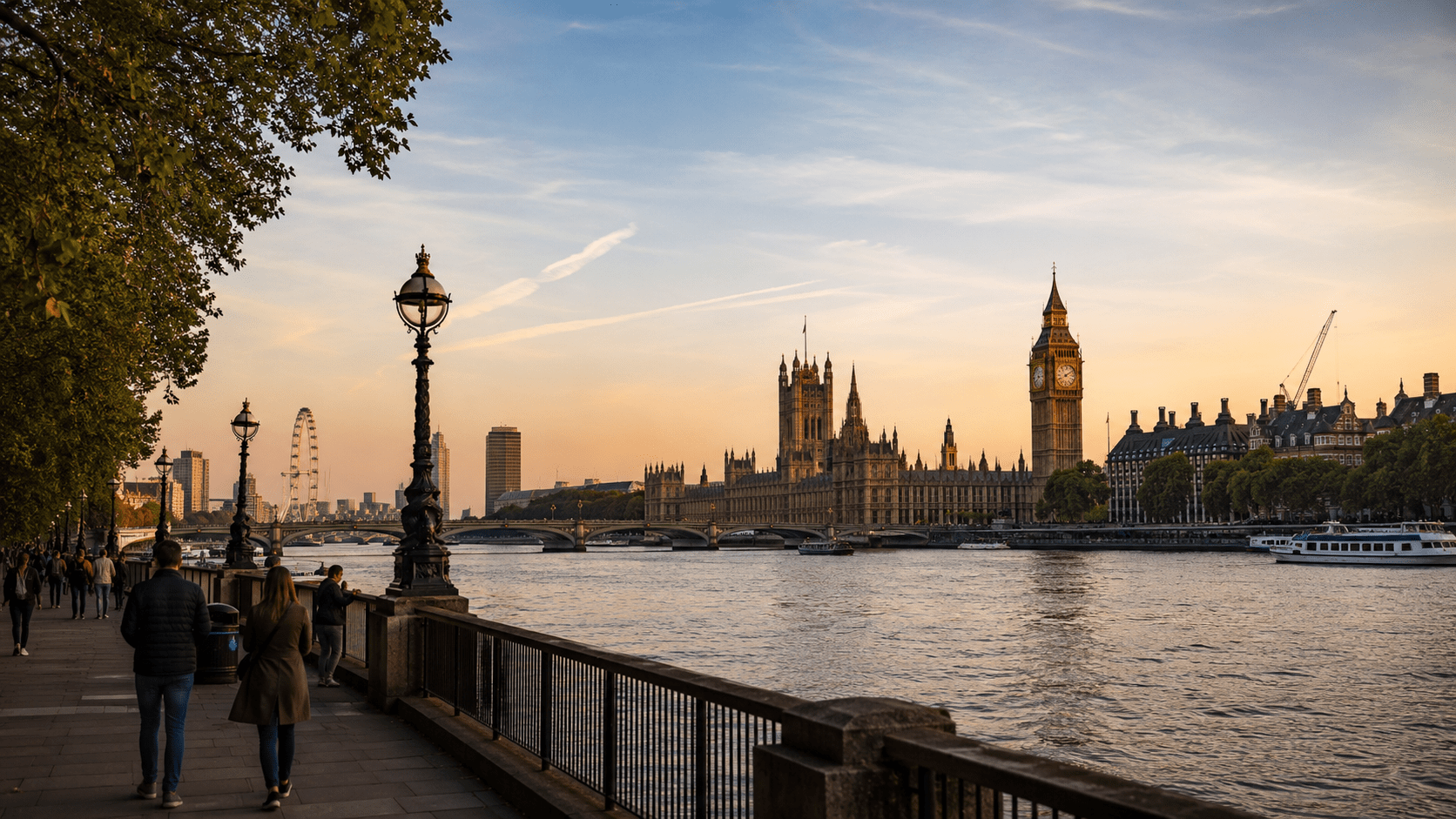
Paris unlike some other cruise destination can mean two completely different products. Ocean ships marketed as visiting Paris almost never dock anywhere near the city. River ships marketed as visiting Paris embark and disembark in the centre of it.
The First Thing Agents Need to Know
Paris is unlike any other cruise destination in this guide series. The word "Paris" on a cruise itinerary refers to two completely different products with completely different logistics, completely different client experiences, and completely different agent jobs.
Ocean cruises marketed as Paris almost never dock anywhere near Paris.
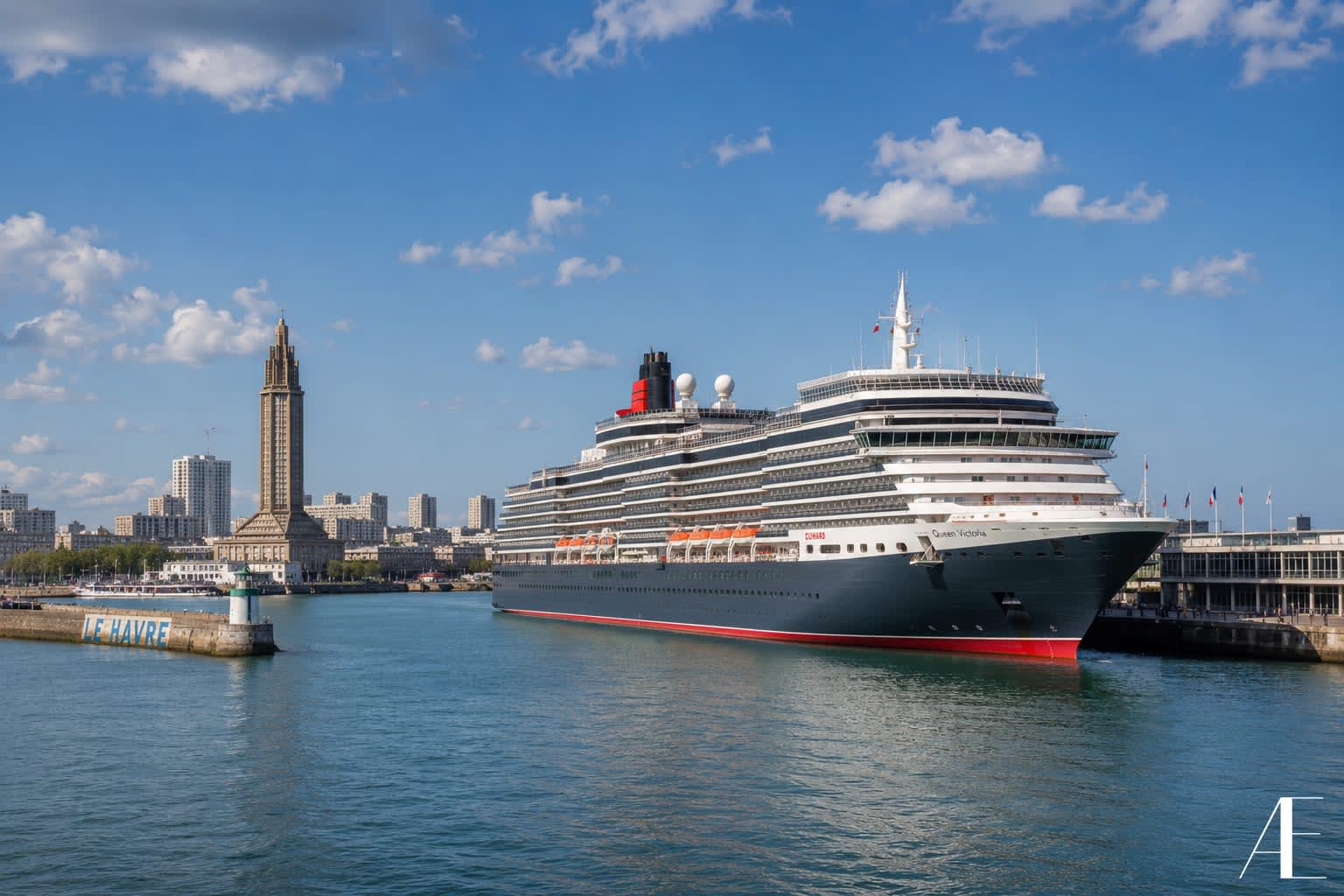
The vast majority of ocean ships that include Paris in the itinerary actually berth at Le Havre, 200 kilometres northwest of the city on the Channel coast (roughly a 2.5-hour drive or a 2-hour train each way).
A smaller number use Honfleur, immediately across the Seine estuary from Le Havre. A handful of mega-ships use Cherbourg, even further west. None of these are Paris in any meaningful sense, and clients who do not understand this before they book are routinely disappointed.
Seine river cruises, by contrast, embark and disembark in Paris itself.
Most river vessels berth on the Seine at one of several central piers, typically in the 15th or 7th arrondissement near the Eiffel Tower. River cruise clients see Paris on foot from the ship; ocean cruise clients see Paris on a coach if they are lucky.
This distinction is the single most important thing an agent selling a Paris-anchored cruise needs to understand and communicate. Confirm the cruise type, the port, and the transfer logic before any Paris accommodation, day-trip, or restaurant booking is made.
When a client's cruise itinerary says "Paris," never assume the ship is arriving in the city. The difference between Le Havre (2.5 hours from central Paris by road) and the Port de Grenelle in the 15th arrondissement (a walk to the Eiffel Tower) is the difference between a fly-in city stay and an exhausting day excursion from a French Channel port. The framing of the trip, and the structure of the upsell, flows from this fact.
The Ocean Ports
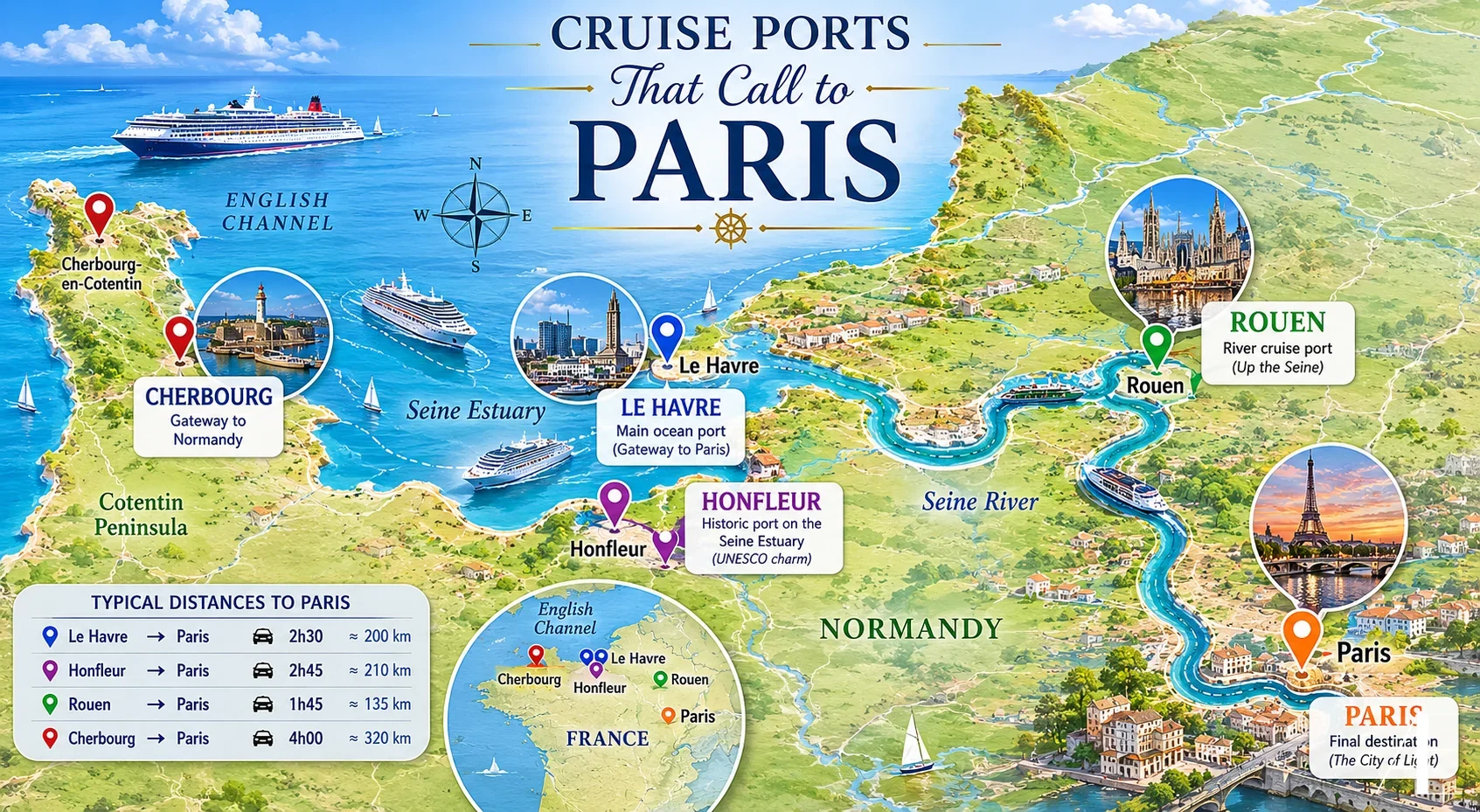
Port of Le Havre
- Operator: HAROPA Port (Grand Port Maritime du Havre)
- Location: Le Havre, Seine-Maritime, Normandy. Approximately 200 km northwest of central Paris on the Channel coast.
- Type: Major port of call. Le Havre is overwhelmingly used as a stop on Northern European, British Isles and Transatlantic itineraries rather than as a turnaround port, although turnaround calls have been increasing.
- Transfer to central Paris: Approximately 2 to 2.5 hours by road on the A13 motorway. Approximately 2 hours 10 minutes by direct SNCF train from Le Havre to Paris Saint-Lazare (intercité service, runs roughly hourly). Ship-arranged coach transfers are common but slow; private cars and trains are significantly faster for clients comfortable arranging their own day.
- Terminal facilities: Two cruise terminals operate at Le Havre, the Terminal Croisière (Pointe de Floride) and the Quai Roger Meunier. Both have standard cruise infrastructure, immigration, baggage handling and ground transport access. The terminals are 2 to 3 km from Le Havre town centre.
- Typical use: Port of call on British Isles, Northern Europe, Baltic, Mediterranean, and Transatlantic itineraries. Increasingly used as a turnaround port by selected lines.
- Lines that commonly use Le Havre: Cunard, P&O Cruises, Royal Caribbean, Celebrity, Princess, Norwegian Cruise Line, Holland America Line, MSC, Costa, Disney Cruise Line, Viking Ocean, Silversea, Regent Seven Seas, Oceania, and effectively every major Northern European itinerary.
Agent note: Le Havre is a Paris excursion port, not a Paris destination. Clients who fly into Paris and join a ship that calls at Le Havre two days later are seeing two different products: a French capital city stay, and a day-excursion from a Normandy port. Setting this expectation correctly during the booking conversation prevents the most common Paris cruise disappointment of all, clients who assumed the ship would actually dock in Paris.
For a Le Havre Paris excursion, the practical Paris window is approximately 6 to 7 hours after deducting transit time. That is enough for the Louvre headline visit, or a Seine cruise plus the Eiffel Tower, or Notre-Dame plus the Île de la Cité, never all three. The Le Havre Paris day is a forced march and clients should know it before they book.
Port of Honfleur
- Operator: HAROPA Port
- Location: Honfleur, Calvados, Normandy. Immediately south of the Seine estuary, directly across from Le Havre, linked by the Pont de Normandie. Approximately 200 km from Paris.
- Type: Port of call for smaller ocean cruise ships and river-going luxury vessels.
- Transfer to central Paris: Approximately 2.5 hours by road. No direct rail; transfers are by coach or private car.
- Terminal facilities: Limited. Honfleur is a working fishing port and yacht harbour rather than a purpose-built cruise terminal. Smaller ocean vessels berth at the Quai de la Tour in the old town; larger ones anchor offshore and tender ashore.
- Typical use: Port of call for smaller and luxury vessels, and an arrival point for some Seine river cruise itineraries.
- Lines that commonly use Honfleur: Silversea, Seabourn, Regent Seven Seas, Hapag-Lloyd, Ponant, Windstar, and smaller European lines. CroisiEurope's Seine river cruises terminate at Honfleur when vessel size allows.
Agent note: Honfleur is one of the prettiest small ports in France a postcard fishing harbour painted by Monet, Boudin and Jongkind, with restored 16th- and 17th-century buildings around the Vieux Bassin. For the right client, the Honfleur itself is the destination and a Paris excursion is a mistake. Suggest Paris only if the client has expressed a specific Paris interest; otherwise recommend Honfleur on foot, plus a short coach trip to the cliffs at Étretat or the apple orchards of the Pays d'Auge.
Port of Rouen
- Operator: HAROPA Port
- Location: Rouen, Seine-Maritime, Normandy. On the Seine, approximately 130 km northwest of central Paris.
- Type: Port of call for Seine river cruises (the standard middle stop on most Paris-Honfleur itineraries) and selected smaller ocean vessels.
- Transfer to central Paris: Approximately 90 minutes by road; 90 minutes by direct SNCF train to Paris Saint-Lazare.
- Terminal facilities: Modest. River cruise vessels berth on the city quays in the historic centre.
- Typical use: Standard middle call on Seine river cruise itineraries; some smaller ocean cruise lines use it for British Isles and Northern Europe rotations.
Agent note: Rouen is the most underrated cruise call on the Seine. The historic centre is one of the finest concentrations of Gothic, Renaissance and half-timbered architecture in Northern Europe. The cathedral, painted by Monet more than thirty times across his career, is the finest Gothic cathedral in France after Chartres.
Joan of Arc was burned at the stake in the Place du Vieux-Marché in 1431; the modern church on the site (1979) is one of the great pieces of 20th-century religious architecture. Rouen alone is worth a full day. Clients should not be encouraged to leave for Paris from a Rouen call; what is on the doorstep is enough.
Port of Cherbourg
- Operator: Ports de Normandie
- Location: Cherbourg-en-Cotentin, Manche, Normandy. Approximately 350 km west of Paris on the tip of the Cotentin Peninsula.
- Type: Major port of call for Transatlantic crossings and some Northern European itineraries.
- Transfer to central Paris: Approximately 3 to 3.5 hours by direct SNCF train (intercité) or 3.5 to 4 hours by road. Too far for any practical Paris day excursion.
- Lines that commonly use Cherbourg: Cunard (regular Transatlantic crossings), Princess, Holland America, P&O, Royal Caribbean, and others.
Agent note: Cherbourg is not a Paris port. It is a Normandy port, and its appeal is the access to the D-Day beaches (Utah Beach is 50 km east, Omaha and the American Cemetery another 30 km further). For any client with a military history interest, the Cherbourg call is a major asset and should be pitched as a D-Day day, not a Paris day.
Cunard's Queen Mary 2 regularly uses Cherbourg as the European end of the Transatlantic crossing, for clients on that voyage, the standard package is Cherbourg disembarkation, a few hours in the Cotentin, then a private transfer or train to Paris (3 hours) for the post-cruise stay.
Paris River Cruise Piers
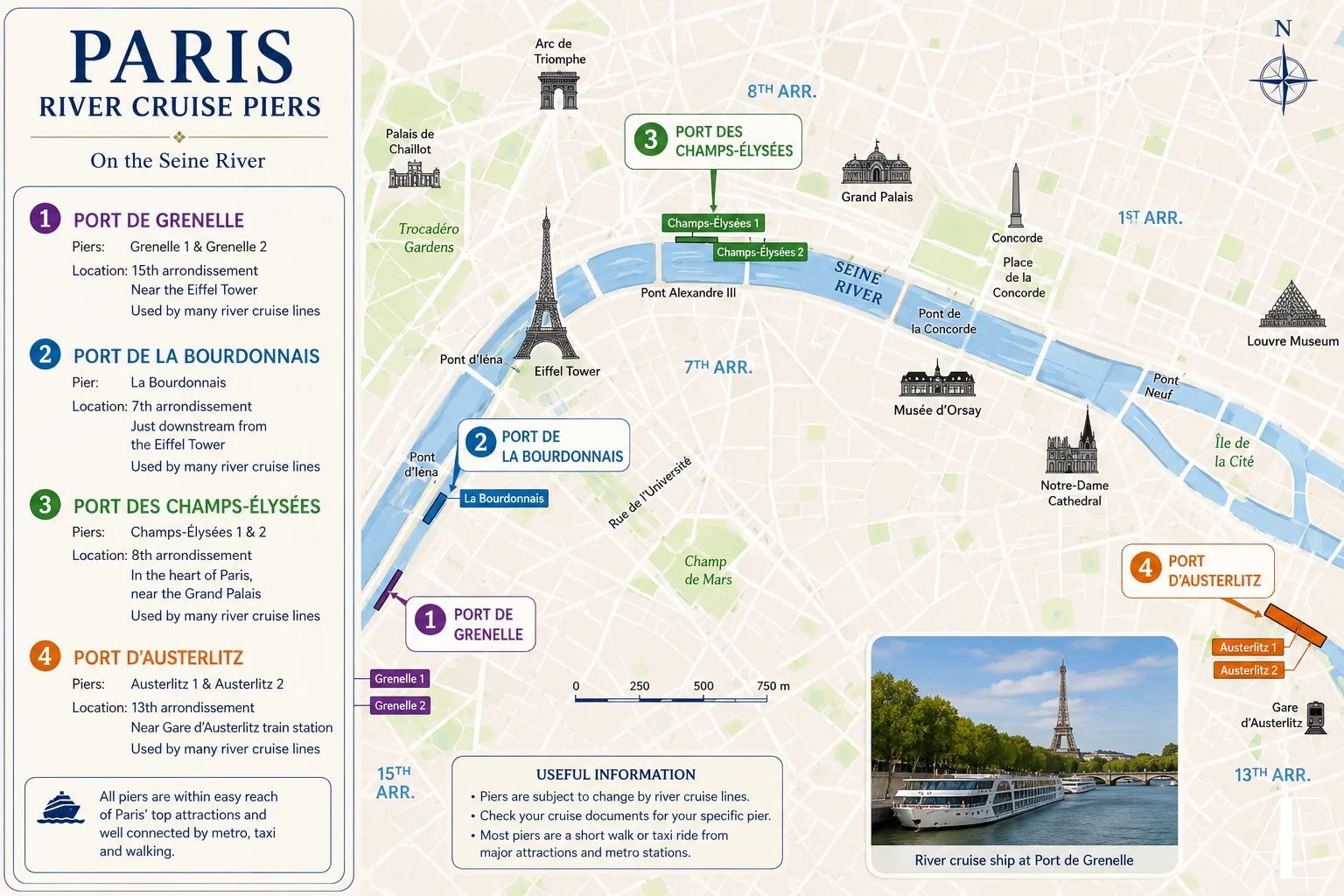
A separate category. Seine river cruise vessels embark, disembark, and overnight at piers in central Paris itself. The most commonly used:
- Port de Grenelle (15th arrondissement): The most-used river cruise berth in Paris, immediately downstream of the Eiffel Tower on the Left Bank. Walking distance to the tower; 15 minutes by Metro to central neighbourhoods. Used by Viking, AmaWaterways, Uniworld, and most major American-market river lines.
- Port de Javel Haut (15th arrondissement): Also downstream of the Eiffel Tower, slightly further west. Used by Avalon, Scenic, and smaller operators.
- Port de la Bourdonnais (7th arrondissement): The pier closest to the Eiffel Tower, used by short-cruise operators (Bateaux Parisiens, some river barges) and selected luxury vessels.
- Port de Solférino (7th arrondissement): Used by Bateaux-Mouches and some smaller river vessels. Immediately opposite the Musée d'Orsay.
- Port de la Conférence (8th arrondissement): Near the Pont de l'Alma; used by Bateaux-Mouches and some smaller cruises.
Agent note: Seine river cruises are the genuine "arriving in Paris" cruise experience, and they are increasingly the cruise product North American clients should consider when they say they want a Paris cruise. The ship is at the Eiffel Tower. The first morning is breakfast on board and a walk to the Trocadéro. The last evening is a Seine sail at sunset.
The pre-cruise hotel night is usually optional rather than essential because clients arrive at the ship the same day they fly in (although a pre-cruise night still helps with jet lag).
The Paris arc of the river cruise is the easiest cruise sell to a culturally engaged North American client in this entire market.
The Key Practical Point
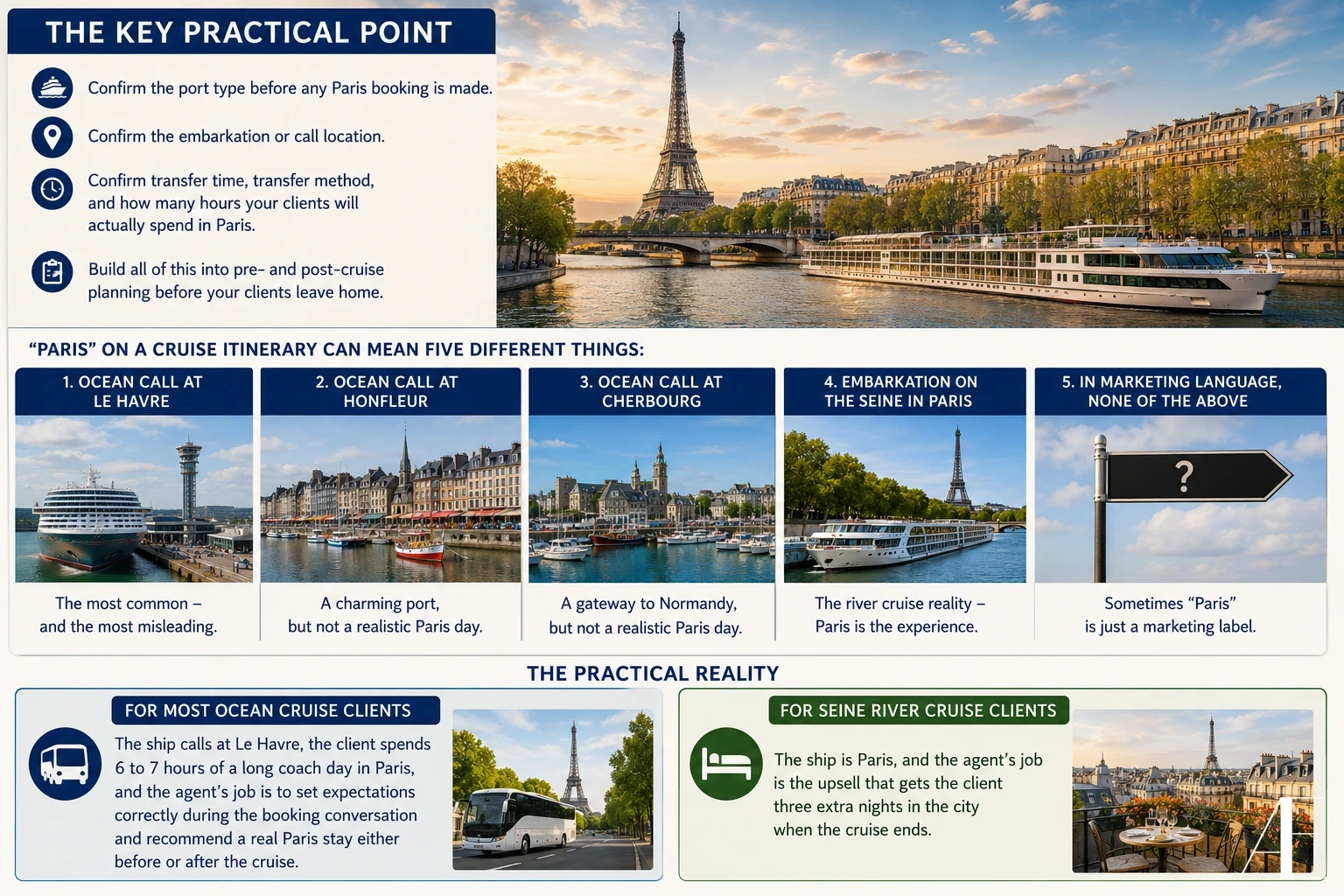
Confirm the port type before any Paris booking is made. Confirm the embarkation or call location. Confirm transfer time, transfer method, and how many hours your clients will actually spend in Paris. Build all of this into pre- and post-cruise planning before your clients leave home.
"Paris" on a cruise itinerary can mean five different things: an ocean call at Le Havre (the most common, and the most misleading), an ocean call at Honfleur or Cherbourg (neither of which is realistically a Paris day), an embarkation on the Seine in central Paris (the river cruise reality), or in marketing language, none of the above.
For the vast majority of ocean cruise clients, the practical reality is this: the ship calls at Le Havre, the client spends 6 to 7 hours of a long coach day in Paris, and the agent's job is to set expectations correctly during the booking conversation and recommend a real Paris stay either before or after the cruise. For Seine river cruise clients, the practical reality is the opposite: the ship is Paris, and the agent's job is the upsell that gets the client three extra nights in the city when the cruise ends.
Cruise Lines That Call in Paris
Ocean lines (Le Havre / Honfleur / Cherbourg)
Cunard Line
- Itineraries: Queen Mary 2 makes regular Transatlantic crossings between Southampton and New York that often call at Cherbourg. Queen Anne, Queen Victoria and Queen Elizabeth all use Le Havre on British Isles, Northern Europe and Mediterranean itineraries.
- Port type: Port of call.
- Time allocated: Typically 10 to 12 hours in port; long enough for a Paris day, brutal at both ends.
Agent note: Cunard's Cherbourg disembarkation for Transatlantic crossings is a natural setup for a post-voyage Paris stay. Three to five nights in Paris after the QM2 crossing pairs the great Atlantic ship with the great European city. The Cherbourg-to-Paris transfer is best done by private car (3 hours) or first-class SNCF rail (3.5 hours with one change). Cunard's older, culturally engaged demographic is among the most Paris-compatible in the cruise market.
Princess Cruises
- Itineraries: British Isles, Northern Europe, Baltic and Mediterranean itineraries from Southampton, with Le Havre as a Paris excursion call. Princess's North American demographic makes the Paris pre- or post-cruise stay a natural fit.
- Port type: Port of call.
Agent note: Princess's clients on British Isles and Northern Europe sailings will see the Le Havre call as their Paris experience and most will not know it is a 5-hour round trip. Set this expectation explicitly. For first-time Paris clients, recommend a three-night Paris stay before the cruise: Heathrow on arrival, Eurostar to Paris in 2 hours 15 minutes, three nights central, then Eurostar back to London and onward train to Southampton for embarkation. This is the most under-sold cruise pre-stay structure on the market for North American Princess clients.
Holland America Line
- Itineraries: British Isles, Northern Europe and Mediterranean sailings, frequently with Le Havre as the Paris call. Some itineraries embark or disembark Rotterdam, Dover or Southampton.
- Port type: Port of call.
Agent note: HAL's older, culturally engaged demographic responds well to the Paris pre-cruise stay. Recommend a five-night Paris extension before the cruise for any first-time Paris client. Hotels in the 6th or 7th arrondissement, walking distance to the major museums.
Royal Caribbean International and Celebrity Cruises
- Itineraries: British Isles and Northern Europe itineraries from Southampton with Le Havre as the standard Paris call.
- Port type: Port of call.
Agent note: Royal Caribbean's family demographic and Celebrity's premium demographic both benefit enormously from a real Paris stay. The Le Havre day is the excursion taste, not the meal. For any first-time Paris client on a Royal Caribbean or Celebrity sailing, three to five nights in Paris pre- or post-cruise is the correct recommendation.
Norwegian Cruise Line
- Itineraries: British Isles and Northern Europe sailings using Le Havre. NCL's freestyle dining and younger demographic translate well to a younger Paris pre-cruise stay structured around food, neighbourhoods and the bistro scene rather than the standard monument circuit.
MSC Cruises and Costa
- Itineraries: Mediterranean and Northern Europe itineraries calling at Le Havre. Costa's predominantly Italian and European clientele often arrives by overland transport; Paris stays are common pre- or post-cruise.
Disney Cruise Line
- Itineraries: Selected European seasons embark or disembark at Dover or Barcelona and call at Le Havre. For Disney clients with children of the right age, Disneyland Paris is the natural Paris extension and should be built into every Disney European cruise itinerary as a 2 to 3-night pre- or post-cruise add-on.
Viking Ocean Cruises
- Itineraries: Viking's British Isles and Northern Europe ocean sailings often call at Le Havre or Honfleur as the Paris stop.
- Port type: Port of call.
Agent note: Viking's destination-focused clientele is among the most Paris-compatible in the cruise market. The pre- or post-cruise Paris extension before a Viking ocean voyage is one of the most natural packages in the market — and Viking also operates Seine river cruises (see below), which means a Viking Atlantic crossing or British Isles voyage paired with a Viking Seine river cruise is a possible double-Viking option for the right client.
Silversea, Regent Seven Seas, Seabourn, Oceania
- Itineraries: Luxury small-ship British Isles, Northern Europe, Mediterranean and Transatlantic itineraries. Often Honfleur (smaller ships can berth at the Quai de la Tour) and Le Havre (for the larger vessels in these fleets).
- Port type: Port of call.
Agent note: Luxury small-ship clients are the most Paris-compatible cruise demographic of all. Always pair the cruise with a serious Paris stay. A private guided Paris itinerary plus a Silversea or Regent British Isles voyage is one of the strongest products in luxury travel. For these clients, recommend the Plaza Athénée, the Crillon or the Ritz for the Paris portion; Eurostar to or from London if the itinerary allows.
Ponant
- Itineraries: Ponant is the French luxury small-ship line, frequently using Honfleur, Le Havre and other Atlantic-French ports on Northern Europe and Mediterranean itineraries.
- Port type: Mixed — both turnaround and port of call.
Agent note: Ponant clients are usually French-speaking, but the line is increasingly marketed to North American clients. Honfleur is a routine Ponant call, and the French-line atmosphere on board pairs well with a Paris pre-cruise stay.
River lines (Seine River Cruises from Paris)
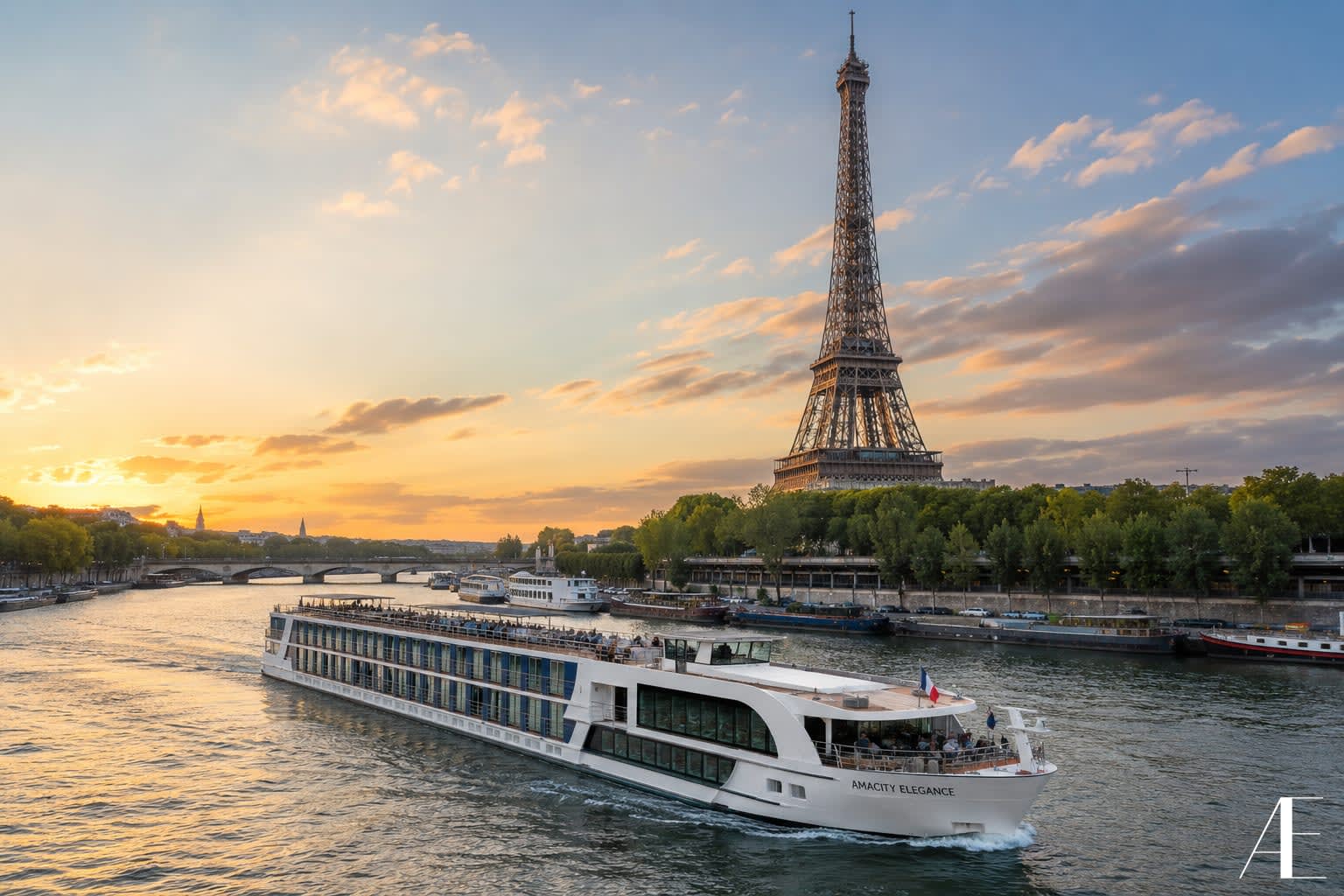
The Seine river cruise market is one of the strongest river cruise products in Europe, second in North American volume only to the Rhine and the Danube. The classic itinerary is Paris – Vernon (for Giverny) – Rouen – Caudebec-en-Caux – Honfleur – back to Paris, typically 7 to 8 nights round-trip.
Viking River Cruises
- Vessels and itineraries: Viking's "Paris & the Heart of Normandy" itinerary is the single most-sold Seine river cruise to the North American market. Standard 8-day Paris round-trip on a Viking longship-class river vessel.
- Port type: Home port. Paris (Port de Grenelle).
Agent note: Viking is the volume leader and the easiest sell. Their marketing, pricing structure and consistency of product are the cleanest in the river cruise market. For first-time river cruise clients, the Viking Paris itinerary is the safe and correct recommendation. Always upsell the pre- and post-cruise hotel package: Paris is the centrepiece of the itinerary, and an extra night before plus two extra nights after is the right structure.
AmaWaterways
- Vessels and itineraries: AmaDante, AmaLyra and other vessels on the Paris–Honfleur loop. Slightly higher-end positioning than Viking, with a strong food and wine programme.
- Port type: Home port. Paris.
Agent note: AmaWaterways is the right recommendation for clients who liked the Viking pitch but want a slightly more refined experience. The line's emphasis on food and wine pairs naturally with the Normandy and Seine valley itinerary.
Avalon Waterways
- Vessels and itineraries: Avalon Tapestry II and other vessels on Paris–Normandy itineraries. Distinguished by panorama-suite rooms with floor-to-ceiling glass.
- Port type: Home port. Paris (Port de Javel Haut and others).
Agent note: Avalon's room design is the differentiator. For clients who emphasised "want to see the river from the ship," lead with Avalon.
Uniworld Boutique River Cruises
- Vessels and itineraries: S.S. Joie de Vivre — the flagship of the Uniworld Seine fleet, with an explicit Paris-French theme through the public spaces and the cuisine.
- Port type: Home port. Paris.
Agent note: Uniworld is the more design-led, more all-inclusive luxury option. The Joie de Vivre is one of the most photographed river vessels in Europe. Right for clients who valued their last cruise's interior design as much as the destination.
Scenic Cruises
- Vessels and itineraries: Scenic Gem and other vessels on Seine itineraries. Australian-owned but increasingly marketed to North American clients. All-inclusive at the genuinely all-inclusive end (excursions, drinks, butler service).
- Port type: Home port. Paris.
Agent note: Scenic competes with Uniworld at the luxury end. For clients who specifically mentioned all-inclusive expectations, Scenic is often the right answer.
Tauck
- Vessels and itineraries: MS Sapphire, MS Emerald and other Tauck-chartered vessels operating Paris-Normandy itineraries with a strong cultural and historical programme. Often paired with pre- or post-cruise land arrangements in Paris and Bayeux.
- Port type: Home port. Paris.
Agent note: Tauck is the right line for clients who value cultural depth over ship amenities. The shore programme is more substantial than the standard river cruise excursion package. Strong for repeat travellers and history-focused clients.
CroisiEurope
- Vessels and itineraries: The French river cruise line. The largest operator of Seine river cruises by volume, but historically marketed to the European (especially French and Belgian) market. Increasingly present in North America.
- Port type: Home port. Paris.
Agent note: CroisiEurope is the value option. The on-board atmosphere is more European than American — French is the primary language on most sailings, though English-language sailings are increasing. For the right adventurous client this is a stronger French immersion than the American-market lines. For clients who want familiar service, point them to Viking.
Riviera Travel
- Vessels and itineraries: UK-based mid-market river cruise line. Operates Seine itineraries marketed primarily to British clients but increasingly available to Canadian and American travellers.
- Port type: Home port. Paris.
Emerald and Other Smaller Lines
A growing number of smaller and newer lines operate the Seine — Emerald Waterways, U by Uniworld (the now-discontinued younger sister brand), and various charter and theme cruises. Verify availability per season.
The Distinction: Excursion Port vs. Home Port
Paris on a cruise itinerary is unique in this guide series because it is a destination served by both products in genuinely different ways.
The Le Havre / Honfleur / Cherbourg port-of-call experience is an extended day-excursion from a Normandy seaport, with the ship as the base.
The Seine river cruise experience is the inverse: the ship is in Paris, and Paris is the daily life of the trip.
For the agent, this means two completely different sales conversations:
- For ocean cruise clients calling at Le Havre or Honfleur: the Paris day excursion is a taste, not a substitute. The genuine Paris experience must be sold separately as a pre- or post-cruise stay. The question is not "what can your clients realistically see in 6 hours ashore?" The question is "how many Paris hotel nights should be built around the cruise?"
- For Seine river cruise clients: Paris is the cruise. The question is how many additional Paris nights to add at either end of the river itinerary to make the trip a real city stay rather than just a river loop.
What Is Realistic in a Le Havre Port Call
For ships calling at Le Havre on Northern Europe, British Isles or Mediterranean itineraries, the practical window in central Paris is approximately 6 to 7 hours after deducting 2.5 hours of transfer time each way. A typical Le Havre call is 10 to 12 hours, of which roughly half is transit.
Option 1: The Louvre and the Eiffel Tower
Train from Le Havre to Paris Saint-Lazare (2h10), Metro or taxi to the Louvre (10 min), 2 to 2.5 hours at the Louvre with a pre-booked timed entry focused on the highlights (Mona Lisa, Venus de Milo, Winged Victory, Apollo Gallery), lunch at a brasserie near Place du Palais Royal, Metro to Trocadéro, photographs of the Eiffel Tower from the Trocadéro esplanade, walk to the tower (10 min), return Metro to Saint-Lazare, return train to Le Havre.
- Time required: approximately 6 to 7 hours in central Paris
- Right for: first-time visitors who want the iconic Paris compressed into a single day
Option 2: Notre-Dame, Sainte-Chapelle and the Île de la Cité
Train to Saint-Lazare, Metro to Cité station, Sainte-Chapelle (the medieval royal chapel of Louis IX, the most spectacular Gothic stained glass interior in France) with a pre-booked timed entry, Conciergerie (Marie Antoinette's prison cell), Notre-Dame Cathedral (now fully reopened and free to enter, but the reservation system avoids the wait), lunch on the Île Saint-Louis, walk to the Latin Quarter, return Metro to Saint-Lazare.
- Time required: approximately 6 hours
- Right for: history clients, second-time Paris visitors who already saw the Louvre on a previous trip
Option 3: A Seine River Cruise plus the Eiffel Tower
Train to Saint-Lazare, Metro to Bir-Hakeim, Eiffel Tower (with pre-booked timed ticket, second floor — the summit is not realistic in a port day), lunch at a brasserie on the Champ-de-Mars or Rue Cler, Bateaux-Mouches or Vedettes de Paris one-hour Seine cruise from the Pont de l'Alma, return Metro to Saint-Lazare.
- Time required: approximately 6 hours
- Right for: clients who want a relaxed Paris taste rather than a museum forced march. The Seine cruise is the most underrated single experience for a Le Havre port-day Paris client because it shows so much of central Paris with no walking.
Option 4: Stay in Normandy
The most underrated choice. Skip the Paris day, take a coach excursion to Honfleur (the painters' harbour, 30 min from Le Havre), or to Étretat (the white chalk cliffs immortalised by Monet, 30 min north), or to the D-Day beaches at Omaha and Utah (90 min west of Le Havre) and the American Cemetery at Colleville. For history and culture clients, the D-Day day is one of the most affecting single days a cruise itinerary can offer; for art and landscape clients, Étretat is the photograph they will frame.
- Right for: anyone who has been to Paris before, military history clients, art clients, photography clients. Many cruise clients regret the long Paris day; almost no one regrets the Honfleur or Étretat day.
What Is Realistic on a Seine River Cruise
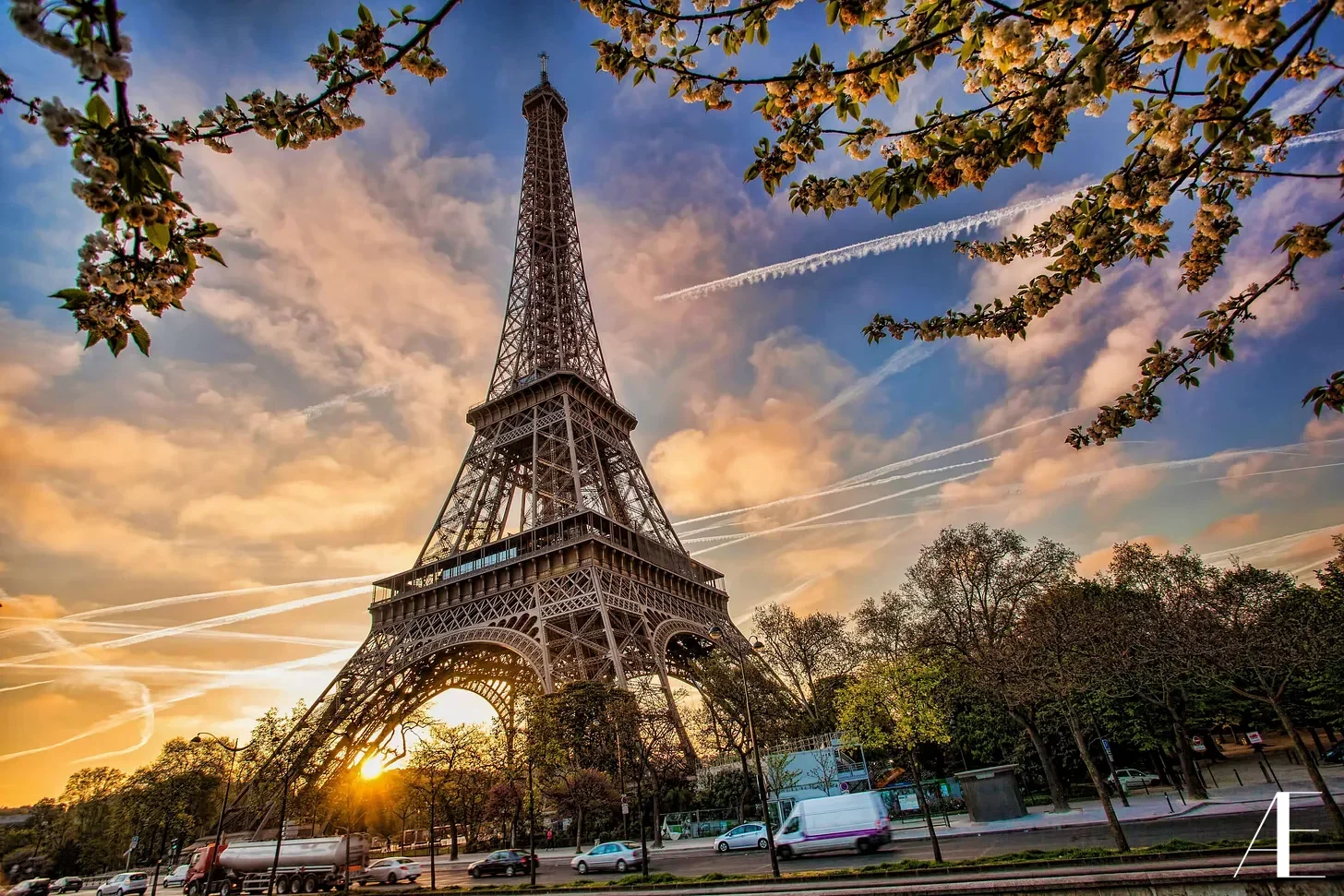
Seine river cruises are structurally different from ocean cruise calls. The ship is the Paris hotel. Most itineraries spend 1 to 2 days in Paris at embarkation and another 1 to 2 days at the end of the loop. The ship also typically overnights in Paris for the first or last night of the cruise, with the city floodlit outside the cabin window.
The standard Seine cruise structure
Days 1–2 (Paris): Embarkation at Port de Grenelle (Viking) or other central pier. Walking distance to the Eiffel Tower. The ship usually offers a city orientation excursion on day 1; the included tours typically cover the Louvre, Notre-Dame area, the Champs-Élysées and a Seine sail. Day 2 is usually free in Paris or a day trip to Versailles (almost always included as a half- or full-day excursion).
Day 3 (Vernon for Giverny): The ship sails downstream to Vernon, where excursions go to Monet's house and gardens at Giverny (a 10-minute drive). This is one of the most popular single excursions on any river cruise in Europe.
Day 4 (Les Andelys): A stop at the medieval town of Les Andelys, with the ruined Château Gaillard (Richard the Lionheart's fortress) on the cliff above.
Day 5 (Rouen): A full day in Rouen — the cathedral, the Joan of Arc sites, the half-timbered streets.
Days 6–7 (Honfleur and the Normandy coast): Honfleur as the western turning point. Excursions to the D-Day beaches, Étretat, the Pays d'Auge (apple and cider country, calvados distilleries), or Bayeux (the medieval cathedral and the 70-metre Bayeux Tapestry depicting the Norman Conquest of 1066).
Day 8 (back to Paris): Return sail to Paris and disembarkation, often after a final overnight in the city.
The pre- and post-cruise Paris stay: the agent's job
The Seine river cruise itinerary is physically in Paris on two days. That is not enough for first-time Paris visitors, and most river cruise clients know it on some level. The agent's job is the upsell.
Pre-cruise Paris stay (the easier sell): Add 2 to 3 nights in Paris before embarkation. Clients arrive at the hotel, recover from the flight, see the Louvre or the Orsay properly, walk the Marais, and then board the ship rested. The pre-cruise Paris night is partly jet-lag insurance, but it is also the chance to see what the river-cruise excursion programme does not have time for.
Post-cruise Paris stay (the easier upsell): Add 2 to 3 nights in Paris after disembarkation. The cruise ends with a fairly compressed Paris portion; the post-cruise nights are where clients can finally do the museum they missed, walk the neighbourhoods, and have an unrushed last dinner. For first-time Paris clients, the post-cruise three-night extension is the single highest-yield additional sale in this entire market.
For Viking, AmaWaterways and Uniworld clients specifically: the line will offer a pre- or post-cruise hotel package directly. These packages are usually fine but rarely the most interesting Paris hotels — they are mid-market chain properties chosen for group logistics. Agents who book independent boutique or luxury hotels for the pre- and post-cruise nights add genuine value to the trip and capture the commission that would otherwise sit with the cruise line.
Shore Excursions: What to Recommend
Best ship excursions (ocean and river)
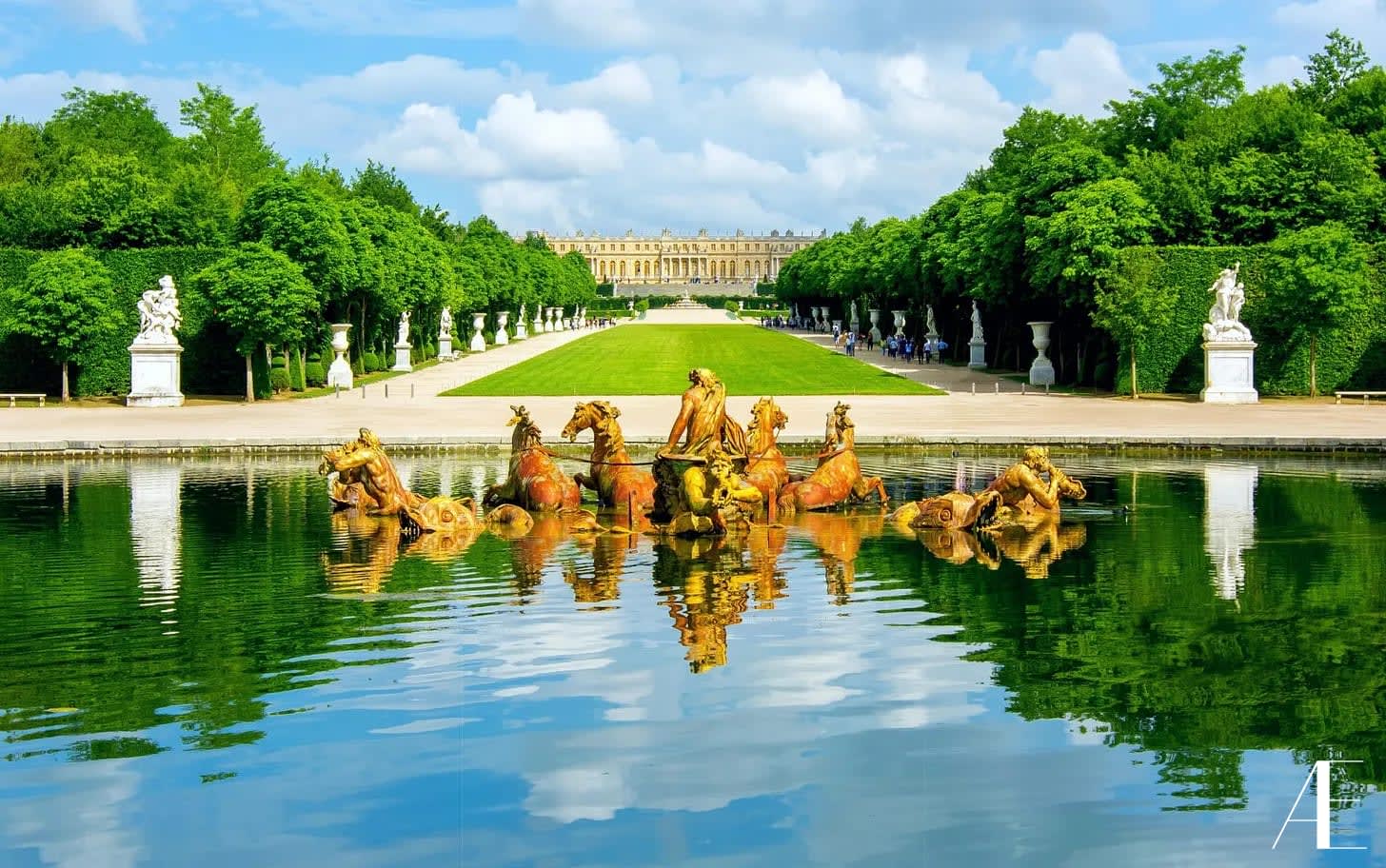
Versailles full day (river cruise): The standard Seine river cruise's Versailles excursion is well-run and worth taking with the ship. The logistics of Versailles independently from a cruise schedule are punishing; the ship's coach transfers, advance entry tickets and timing are worth the price.
Giverny (river cruise from Vernon): The single most-recommended ship excursion on any Seine river cruise. Monet's gardens at Giverny are one of the great single-site experiences in France. The ship's transfer and entry tickets are well coordinated.
D-Day beaches (river cruise from Honfleur): The ship's excursion is the right way to do this for the first time. The transfer is long; the on-site guidance matters. Lead clients toward this excursion for any military or 20th-century history interest.
Etretat or Honfleur (ocean cruise from Le Havre): As discussed above, the Normandy excursion is often the better choice than the Paris coach day for clients who have been to Paris before.
Bateaux-Mouches Seine cruise (Le Havre Paris day or independent Paris stay): A standard one-hour Seine cruise from the Pont de l'Alma is the most consistently recommended Paris experience for clients with limited time. Sunset cruises are the best.
What to book independently
Book independently through GetYourGuide or Viator for commission, or direct on the official websites.
- Louvre: louvre.fr — always book a timed entry ticket online in advance. Walk-up tickets are largely unavailable in peak season.
- Musée d'Orsay: musee-orsay.fr — timed entry recommended.
- Versailles: chateauversailles.fr — timed entry is now effectively mandatory in peak season. The Passport with timed entry (which includes the gardens and the Trianon) is the right product for a full day.
- Sainte-Chapelle: sainte-chapelle.fr — timed entry recommended. The combined Sainte-Chapelle + Conciergerie ticket is the value option.
- Eiffel Tower: toureiffel.paris — book timed entry online. Summit access is significantly slower than second-floor access.
- Notre-Dame: notredamedeparis.fr — entry is free; the official mobile app offers free time-slot reservations to skip the wait. Reservation strongly recommended in 2026 with the cathedral reopened and demand still very high.
Book through the ship
- Coach-based Versailles, Giverny and D-Day day trips where logistics are complex.
- Any excursion involving multiple stops with tight timings — the ship's coordination is genuinely better than independent attempts.
Self-guided (free, no booking required)
- The Seine walks (Berges de Seine on the Left Bank, Quai des Tuileries on the Right).
- The Champs-Élysées walk from the Place de la Concorde to the Arc de Triomphe.
- The Marais (Place des Vosges, Rue des Rosiers, the Picasso Museum's external courtyards).
- Montmartre (early morning or late afternoon; the streets, the Place du Tertre, the view from Sacré-Cœur).
- Père Lachaise Cemetery.
- The Île Saint-Louis.
- The Luxembourg Gardens and the Tuileries.
What to Warn Clients About
- The Le Havre Paris day is genuinely long. Five hours of transit out of a 10 to 12-hour port day is brutal. Clients who imagined a relaxed Paris afternoon should know in advance that this is a march. The agent who frames this expectation correctly is the agent the client trusts on the next trip.
- Notre-Dame reservations. Since the December 2024 reopening, Notre-Dame has been one of the highest-demand free attractions in Europe, with daily visitor numbers around 35,000. Entry is free, but the official mobile app offers free timed reservations that bypass queues that can reach 90 minutes or more for walk-ups in peak season. Recommend the reservation for every Paris client visiting Notre-Dame.
- The Louvre on Tuesday is closed. A surprising number of cruise itineraries call at Le Havre on a Tuesday. Cunard's QM2 frequently does. If your client's Paris day is a Tuesday, the Musée d'Orsay (open Tuesday) is the correct alternative, or the Pompidou (open every day except Tuesday — also closed on Tuesday), or just walk the city and skip the museum entirely.
- Versailles on Monday is closed. Build itineraries accordingly.
- Pickpockets in tourist areas. Paris has an active and skilled pickpocket scene around the Eiffel Tower, the Louvre, the Champs-Élysées and the Metro lines that serve them (especially Line 1). Standard urban awareness is sufficient: bag in front, no wallets in back pockets, no phones loose on café tables.
- The Metro rush hours. Avoid 7:30 to 9:30am and 5:30 to 7:30pm, especially with luggage on transfer days.
- Taxis vs. Uber. Both work. Black-and-white official Paris taxis are reliable and metered; Uber is sometimes cheaper and almost always faster on the app. Avoid unmarked "taxis" approaching tourists at airports and stations.
- Strikes. France has more transport strikes than most Northern European countries. Build a small buffer into transfer days, especially in winter (December and February are statistically the worst months).
- EES border processing. Since October 2025 the Schengen Entry/Exit System has been collecting biometric data (fingerprint and facial scan) on first arrival. First-time-arrival queues at CDG and ORY are longer than the pre-EES baseline. Warn clients to allow extra airport buffer, especially on cruise transfer days.
- The August closure. Many small restaurants and boutiques close for two to four weeks in August (fermeture annuelle). If a client's cruise is in August, this affects independent dining choices in Paris. Build flagged backup options into recommended itineraries.
The Insider Detail That Makes Agents Look Good
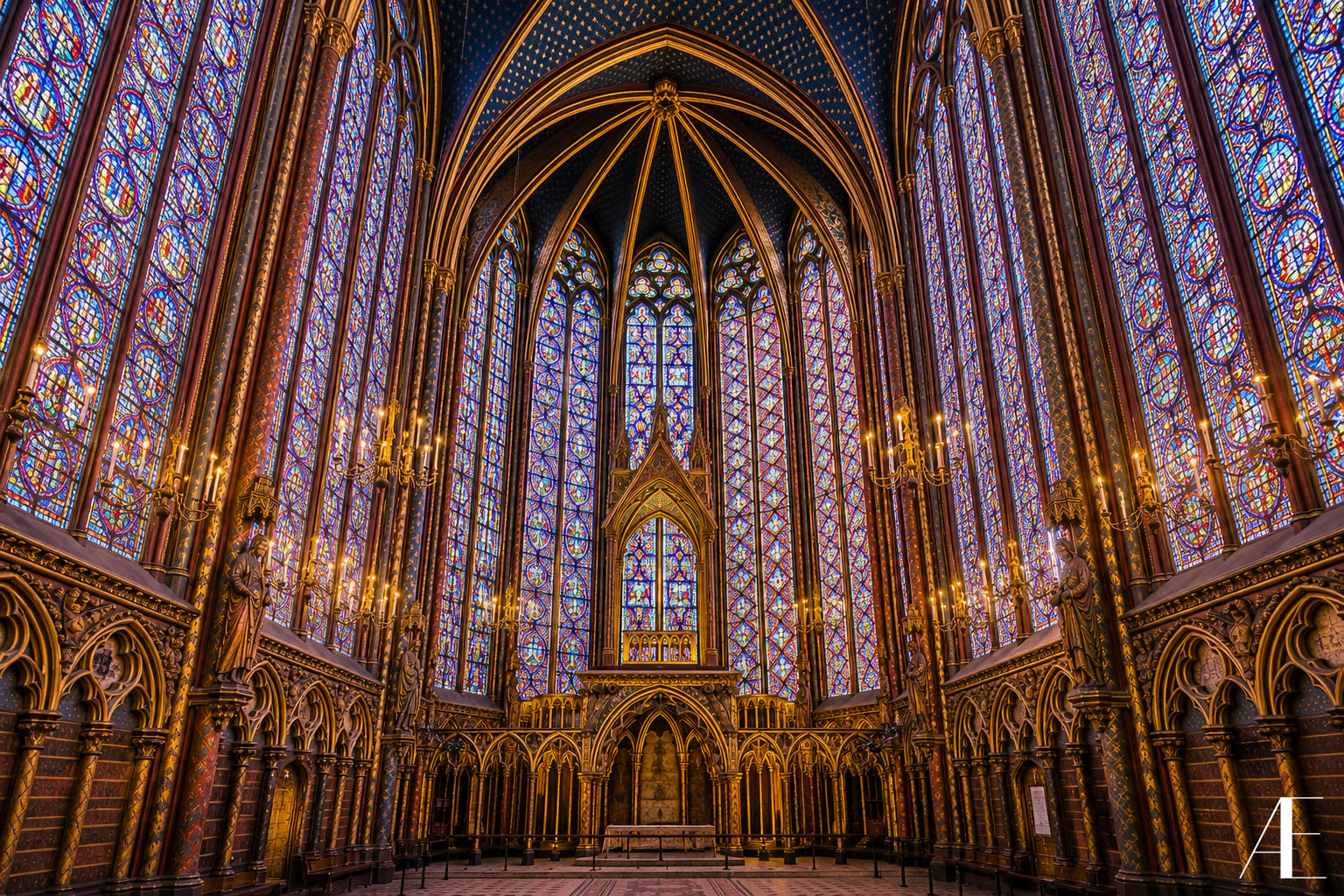
Sainte-Chapelle is the single most underrated major attraction in Paris. It is on the Île de la Cité, two minutes' walk from Notre-Dame, inside the Palais de Justice (the medieval royal palace). The chapel was built by King Louis IX between 1242 and 1248 to house the Crown of Thorns, the relic he had purchased from the Latin emperors of Constantinople — a relic that nearly bankrupted the French crown in the buying.
The upper chapel contains 1,113 square metres of 13th-century stained glass arranged across fifteen 15-metre-high windows. Roughly two-thirds of the glass is original. On a sunny afternoon between approximately 2pm and 4pm, the light comes through the south rose window and the experience is one of the most extraordinary in any building in Europe. It is also, on most days, almost empty compared to Notre-Dame next door.
Tell your clients this before they go. They will mention it for the rest of the trip, and they will tell every friend they have about the agent who recommended it.
Learn More

For the complete Paris destination guide, including the full seasonal breakdown, restaurant and hotel recommendations, client objections, and historical curiosities, see Paris: The Complete Agent's Guide in the Academy.
For the destination overview in under 5 minutes, see Paris: The Brief Overview.
For the sales playbook with discovery questions, client profiles, objection handling, upsell paths, and email templates, see Paris: The Pitch to Close Deals.


Member discussion