
Holland America Line: The Complete Agent's Guide
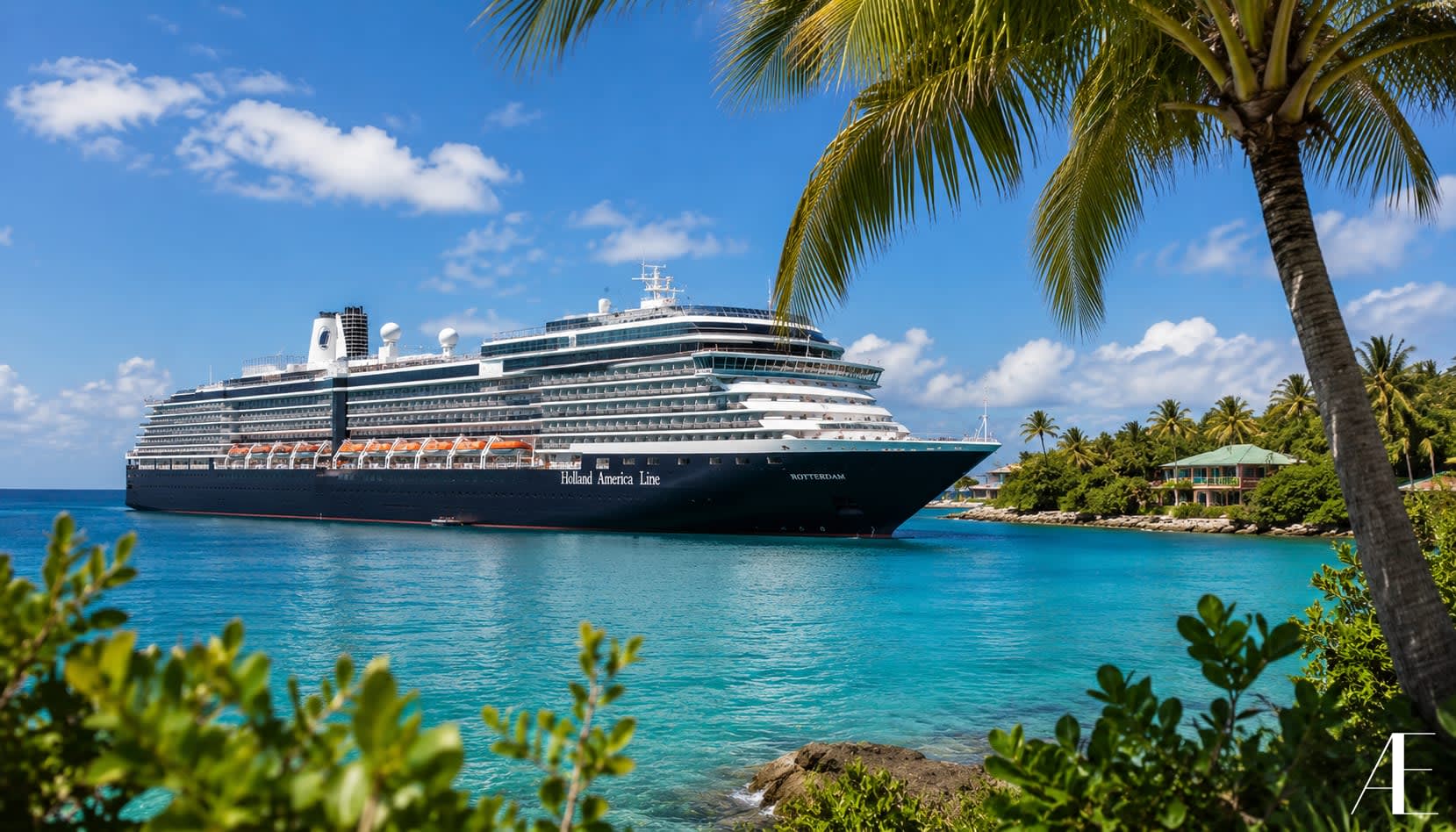
Holland America Line is one of the oldest continuously operating names in ocean travel, founded in Rotterdam in 1873 and now sailing a fleet of eleven ships to all seven continents from its Seattle headquarters. It occupies a precise and well-defined position in the cruise market: above the high-energy mainstream lines in atmosphere, cultural depth and culinary investment, but more accessible in price and formality than the traditional luxury segment.
For travel agents, Holland America is easy to undersell and easy to misplace. Agents who pitch it as simply "the older person's cruise line" leave money on the table and do clients a disservice. The brand has the finest live music programme in mainstream cruising. The most developed Alaska operation of any cruise line, with proprietary lodge infrastructure at Denali. A culinary enrichment platform built with America's Test Kitchen that has no equivalent at this price point. An art collection of over 1,920 original works distributed across the fleet. And a guest atmosphere that clients consistently describe, voyage after voyage, as the thing that brought them back.
This guide covers everything an agent needs to sell Holland America with complete confidence: the brand's history and identity, every ship in the fleet, the full inclusions and pricing breakdown, stateroom categories and the Neptune Lounge, the dining programme in detail, the onboard experience and what it actually feels like, the complete itinerary portfolio with an Alaska deep dive, the Mariner Society loyalty programme, client matching frameworks, competitive positioning, common objections with answers, and historical curiosities worth sharing.
The 60-Second Brief
Holland America Line is a premium mainstream cruise line founded in Rotterdam in 1873, headquartered today in Seattle, Washington, and owned by Carnival Corporation since 1989. It operates a fleet of eleven ships sailing to all seven continents, carrying between 1,432 and 2,668 guests per voyage depending on the ship class.
It sits in the market above the high-energy mainstream lines — Royal Caribbean, Norwegian, Carnival — in atmosphere, cultural depth and culinary investment, but below the full luxury tier of Seabourn and Regent in price and formality. The brand is defined by four things that no competitor at this price point matches simultaneously: the Music Walk, a three-venue live music programme with classically trained musicians nightly; the America's Test Kitchen culinary enrichment platform; the most developed Alaska programme in the industry, including proprietary lodge infrastructure at Denali; and an art collection of over 1,920 original works spread across the fleet.
The guest profile skews to couples and individuals in their 50s, 60s and beyond who want cultural depth, genuine live music, a well-paced ship atmosphere and itineraries that treat destinations seriously. It is the line for clients who want to feel enriched at sea, not just entertained.
Quick Reference
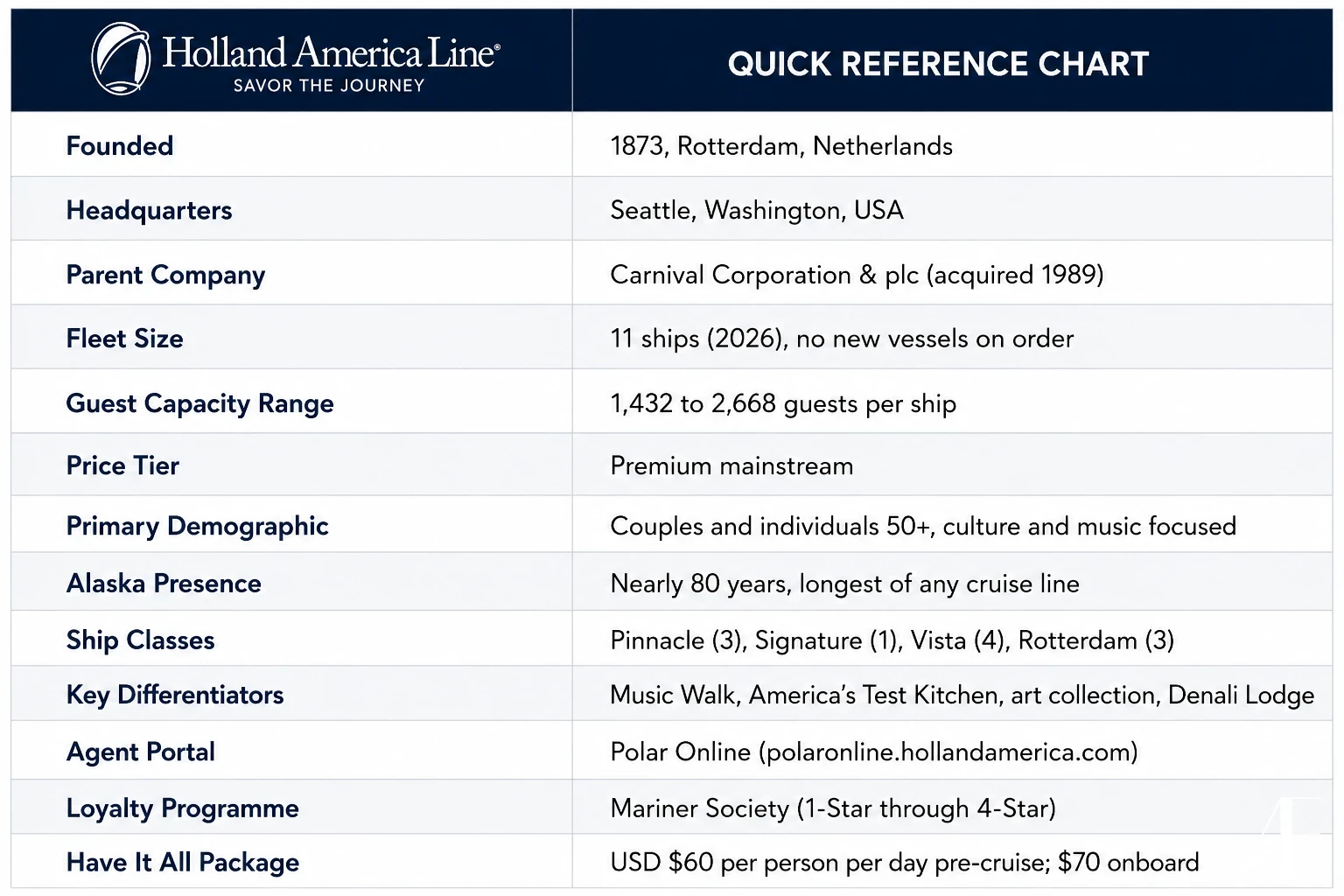
One-line client pitch: "Holland America is the cruise line that treats music, food and art as seriously as the destinations at a price that makes the experience feel like a discovery."
The Brand History and Identity
Understanding Holland America's history is not an academic exercise. It is what allows an agent to explain why the brand feels the way it does: unhurried, museum-quality, culture-forward, and rooted in a specific maritime tradition that most cruise lines simply do not have. Clients who know this story respond to it. It frames the entire selling conversation.
Rotterdam, 1873: The Emigrant Line
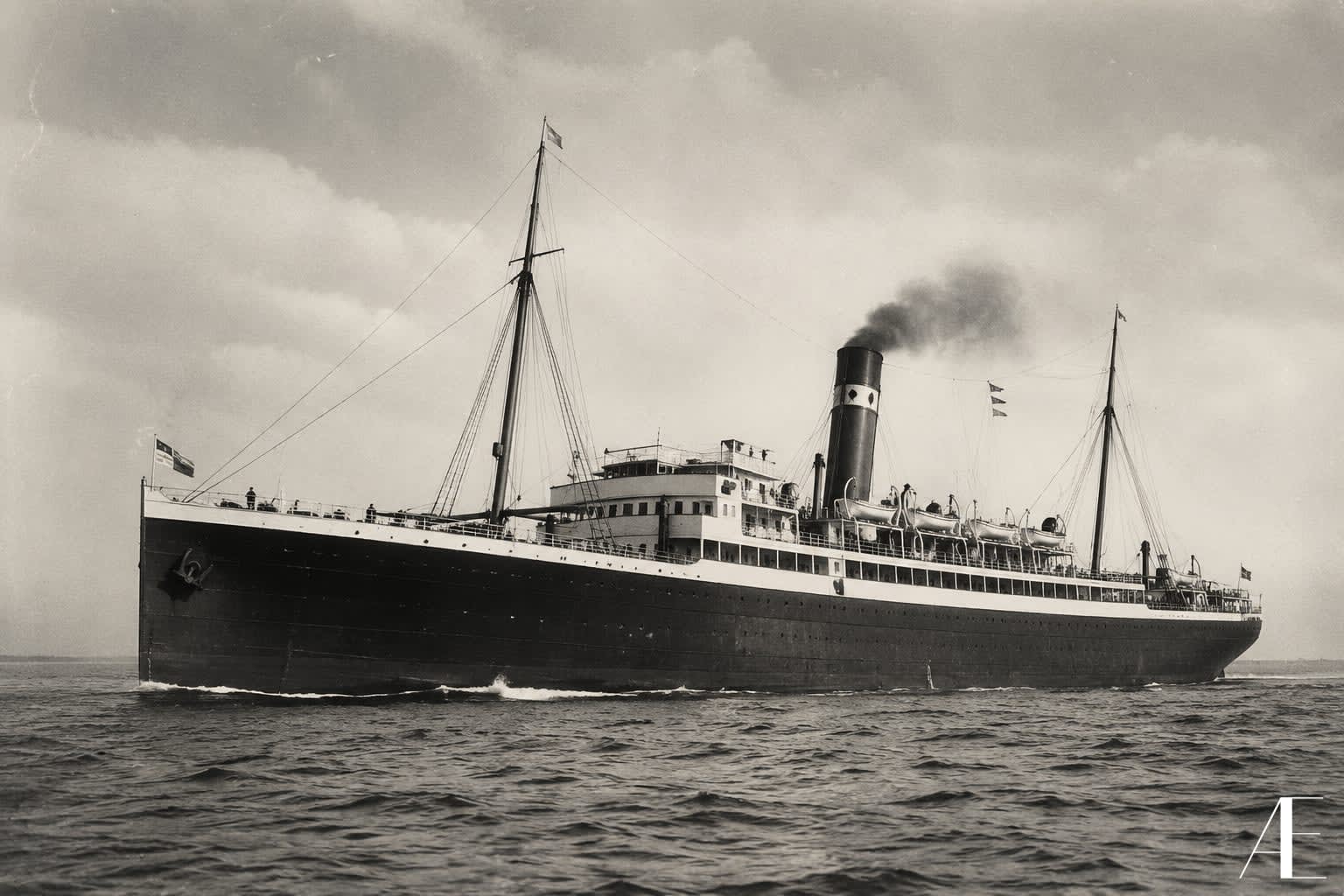
Holland America Line was founded on 18 April 1873 in Rotterdam as the Nederlandsch-Amerikaansche Stoomvaart Maatschappij, or NASM. Its first ship, the Rotterdam, completed her maiden westbound crossing from Rotterdam to Hoboken, New Jersey, that October. The original business model was as consequential as it was straightforward: transport people and cargo reliably across the North Atlantic on a schedule.
What that meant in practice was the emigrant trade. Between the 1880s and the 1920s, Holland America became one of the primary carriers of European emigrants to the United States and Canada. Its ships moved Poles, Germans, Scandinavians, Russians, Dutch and Lithuanians across the Atlantic in numbers that permanently shaped the demographic history of North America. Historians estimate that Holland America ships carried well over a million emigrants during this period. Many of those who passed through Ellis Island arrived on NASM vessels.
The significance of this for agents: Holland America is not simply a cruise brand. It is one of the instruments through which the modern North American population was assembled. For clients with European ancestry — which describes a substantial proportion of the Canadian and American market — there is a genuine and sometimes personal connection between their own family history and this company's history. That is a selling tool of unusual power.
The Rotterdam embarkation halls in the Netherlands still bear the name, and the Holland America Museum in Rotterdam at the Rijnhaven, the company's original departure point, documents this emigrant story in detail. It is worth recommending for clients extending their cruise with a night in Rotterdam.
The Early Twentieth Century: Two Wars and a Market Transformation
Holland America's early 20th century followed the disruptions of the broader shipping world. The First World War interrupted transatlantic service, with several NASM ships requisitioned or sunk. The company rebuilt afterwards, launching the SS Nieuw Amsterdam in 1906 and continuing to develop its North Atlantic service throughout the 1920s.
The critical turning point came from American immigration legislation rather than from any action by the company. The Immigration Act of 1924 imposed strict national-origin quotas on immigration to the United States, cutting the flow of European emigrants dramatically. The emigrant trade that had sustained Holland America for fifty years effectively collapsed. The company had to reinvent itself or fail.
The response was to pivot toward leisure cruising for affluent travellers, a market that had existed in smaller form for decades but now became the primary revenue stream. Holland America began offering cruises to the Norwegian fjords, the Mediterranean, and eventually the Caribbean, South America and the Pacific. The culture of careful service and cultural enrichment that had characterised the emigrant liner experience translated naturally into the leisure cruise product.
The Second World War again disrupted operations. The SS Nieuw Amsterdam, one of the most celebrated ships in the fleet, served as a troopship throughout the conflict, carrying Allied forces across multiple theatres. She survived the war intact and returned to leisure service afterwards, a symbol of the company's continuity and resilience.
The Shift to Seattle: Carnival and the Modern Era
By the 1960s, Holland America had completed its transformation into a premium leisure cruise operation targeting affluent American and European travellers. The Alaska programme, launched in the 1940s, had become the single most distinctive element of the brand's itinerary portfolio.
The modern corporate structure arrived in 1989 when Carnival Corporation acquired Holland America for approximately USD $625 million. The acquisition also included Westours, the land-tour company that operated in Alaska, and the Westmark Hotels chain — giving Carnival not just a cruise line but an integrated Alaska tourism operation. This was the foundation of what would become the Holland America Denali Lodge programme.
The Carnival ownership preserved Holland America's brand identity to a degree unusual in corporate acquisitions of this kind. The Dutch heritage aesthetics, the unhurried onboard culture, the art collection programme and the independent booking infrastructure were all maintained. Holland America was run as a distinct brand rather than folded into the Carnival mass-market product. That independence continues today.
In 2023, Holland America celebrated its 150th anniversary. The milestone was marked with themed voyages and special programming, but its real significance is straightforward: this is a company with genuine institutional memory. The art collection, the ship names, the Dutch terminology for onboard spaces and the service culture all carry that history. It is not nostalgia for its own sake. It is continuity.
What "Dutch Heritage" Actually Means Onboard
Holland America references its Dutch heritage throughout the onboard experience. Here is what that means in practice:
- The ships are named in Dutch: Koningsdam (King's Dam), Nieuw Statendam (New States Dam), Oosterdam (East Dam), Westerdam (West Dam), Zuiderdam (South Dam), Noordam (North Dam). The naming convention references the distinctive Amsterdam canal geography.
- The art collection is curated thematically by ship, with each vessel's collection tied to Dutch historical and geographic narratives. The Zuiderdam's collection centres on the art of the southern Netherlands; the Westerdam's on Dutch heritage in the New World.
- The social spaces use Dutch architectural and maritime references: the Crow's Nest observation lounge at the bow, the Explorers Lounge, the Lido Market.
- Onboard terminology uses Dutch maritime references throughout — a deliberate choice to differentiate the brand atmosphere from American or British competitors.
- A Museum of the Sea display installed on several ships presents the company's own maritime history in permanent exhibition format.
The Dutch identity is not decoration. It is a coherent design philosophy that creates a distinctive atmosphere most first-time Holland America guests notice immediately, even if they cannot articulate exactly what it is.
The Deliberate Pacing Philosophy
Perhaps the most important thing an agent can understand about Holland America is the concept of pacing. The brand has never chased the mega-ship market. It has not built waterslides, ropes courses or theme park attractions. It has instead invested consistently in the quality of onboard time: the music programme, the art collection, the culinary enrichment, the enrichment lectures, the library.
The implicit promise to the guest is that time on this ship is well spent, not just occupied.
This has commercial consequences. Holland America is deliberately not for everyone, and the brand is comfortable with that. The clients who choose HAL repeatedly do so because the atmosphere suits them. They are not looking for constant stimulation. They are looking for quality stimulation: a chamber music concert in the afternoon, a cooking demonstration in the morning, a well-curated wine list at dinner, and enough time in port to actually understand a destination.
For agents, this philosophy is the strongest sales tool available. When a client expresses frustration with the chaos and noise of large mainstream ships, or wants to feel as if the cruise is enriching rather than merely entertaining, Holland America is the correct recommendation. The pacing philosophy is the answer to the objection before the objection is raised.
The Fleet Breakdown
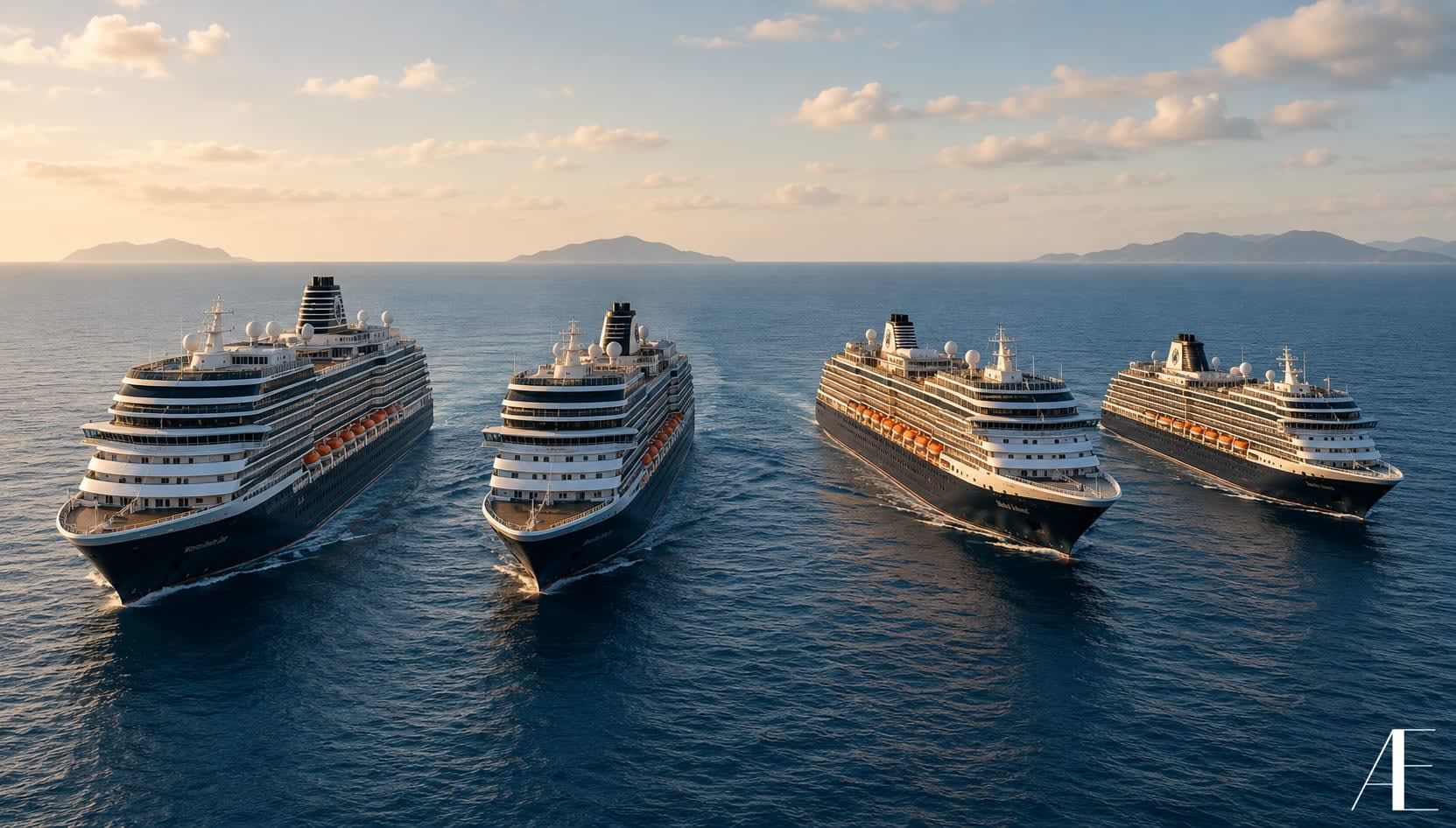
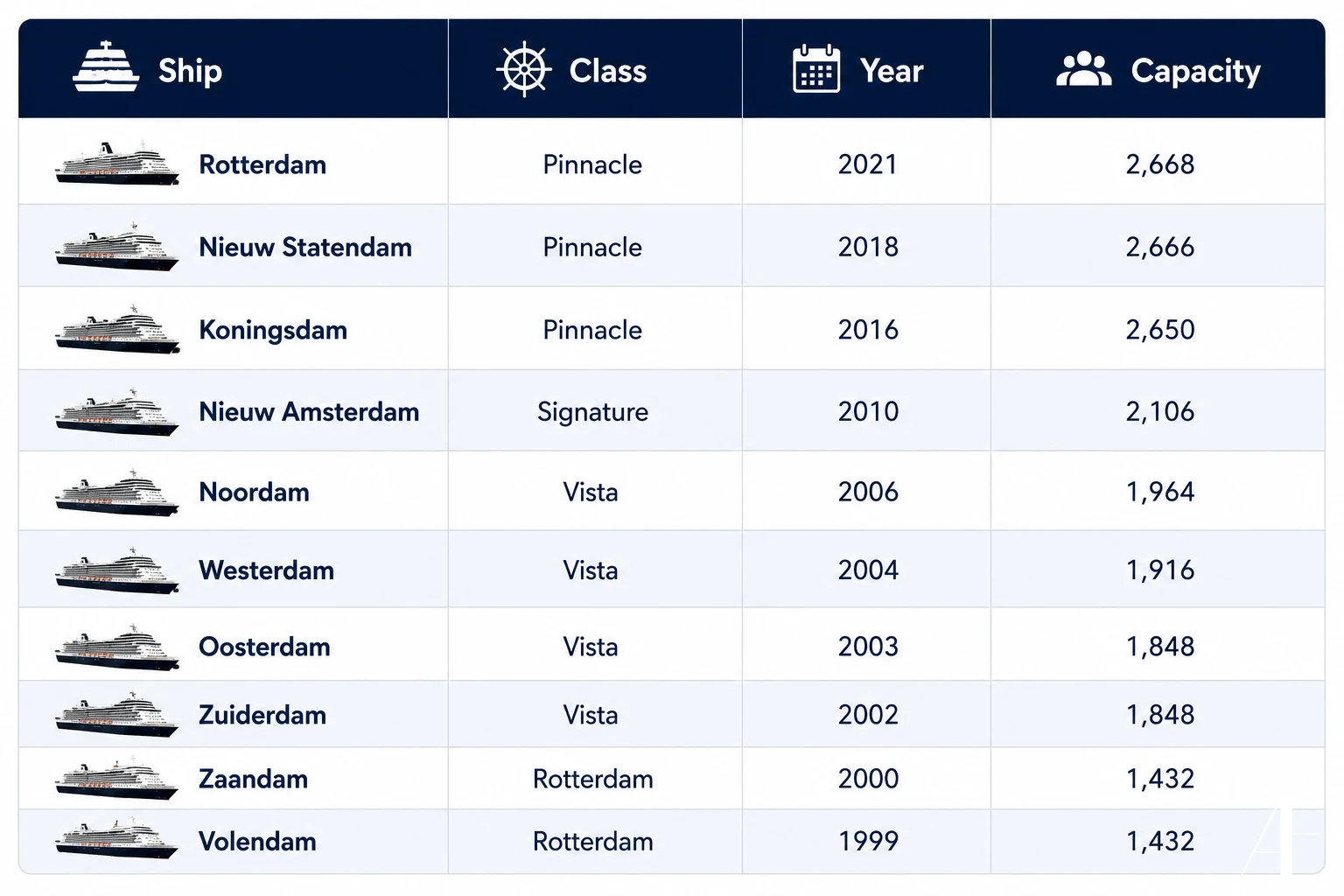
Holland America operates eleven ships across four classes. Understanding the fleet in detail is essential because the ship matters enormously to the client experience. A Vista-class ship from 2002 and a Pinnacle-class ship from 2021 carry the same brand name but offer meaningfully different products. Recommending without knowing this distinction will generate client disappointment.
Key principle: no new ships are on order as of 2026. The fleet is mature and stable, which is worth understanding both as a product fact and as a conversation point. HAL is not trying to be the biggest or the newest. It is trying to be the best at what it does with the fleet it has.
PINNACLE CLASS
- Koningsdam (2016)
- Nieuw Statendam (2018)
- Rotterdam (2021)
Each carries approximately 2,650 to 2,668 guests at 99,500 gross tons with a passenger-to-crew ratio of approximately 2.3 to 1, among the more favourable ratios in mainstream cruising at this scale.
The Pinnacle class introduced the full Music Walk entertainment spine — the three connected live music venues that now define the brand's entertainment identity. It also brought a more contemporary design language to the fleet while maintaining the Dutch heritage aesthetics: lighter woods, more open sightlines and a significantly expanded specialty dining programme.
Koningsdam (2016)
The first Pinnacle-class ship and the first Holland America vessel to carry the full Music Walk in its original configuration. Koningsdam was designed around the 'Music in Motion' concept: visual motifs inspired by musical notation, architecture and sound running throughout the ship's public spaces. The result is one of the most coherent interior design concepts in mainstream cruising. Koningsdam operates Alaska itineraries from Seattle and Vancouver as well as Caribbean and European sailings. The Pinnacle Grill and Tamarind specialty restaurants are both present; Rudi's Sel de Mer is not.
Best for: First-time Holland America guests wanting the full Music Walk experience; Alaska sailings; Caribbean winter departures.
Nieuw Statendam (2018)
The second Pinnacle-class ship, designed around a Baroque-inspired concept that takes a more ornate and maximalist direction than Koningsdam. The art collection on Nieuw Statendam is among the largest and most thematically rich in the fleet. Rudi's Sel de Mer is present on Nieuw Statendam, making it one of two ships in the fleet to carry the French seafood specialty venue. Nieuw Statendam operates a mix of Caribbean, European and seasonal itineraries.
Best for: Food clients (Rudi's Sel de Mer), art enthusiasts, clients wanting the most fully realised Pinnacle experience.
Rotterdam (2021)
The seventh ship in Holland America history to carry the name Rotterdam, and widely regarded as the finest ship in the fleet. Delivered in July 2021, Rotterdam reflects the lessons learned from the first two Pinnacle ships: improved cabin finishes throughout, a more resolved design language balancing contemporary and heritage aesthetics, and a more developed suite product. Rudi's Sel de Mer is present. The Neptune Lounge on Rotterdam is the most carefully finished private lounge in the fleet. The Pinnacle Suite, at approximately 1,290 square feet with private butler service, is the flagship accommodation product. Rotterdam operates Alaska, Mediterranean, Northern Europe and Caribbean itineraries.
Best for: Clients who want the best HAL has to offer; suite clients; honeymoon and special occasion bookings; clients for whom ship quality matters as much as destination.
SIGNATURE CLASS
Nieuw Amsterdam (2010)
The only Signature-class ship, carrying approximately 2,106 guests at 86,700 gross tons. Nieuw Amsterdam sits between the Vista and Pinnacle classes in size and features. She predates the full three-venue Music Walk installation but carries BB King's Blues Club and several of the same dining and enrichment concepts. The ship was significantly refurbished in recent years. Nieuw Amsterdam is a solid performer for Caribbean and Alaska itineraries, offering a somewhat smaller and more intimate experience than the Pinnacle ships without the age of the Vista class.
Best for: Clients who find the Pinnacle ships too large but want more current amenities than the Vista class; Caribbean family sailings.
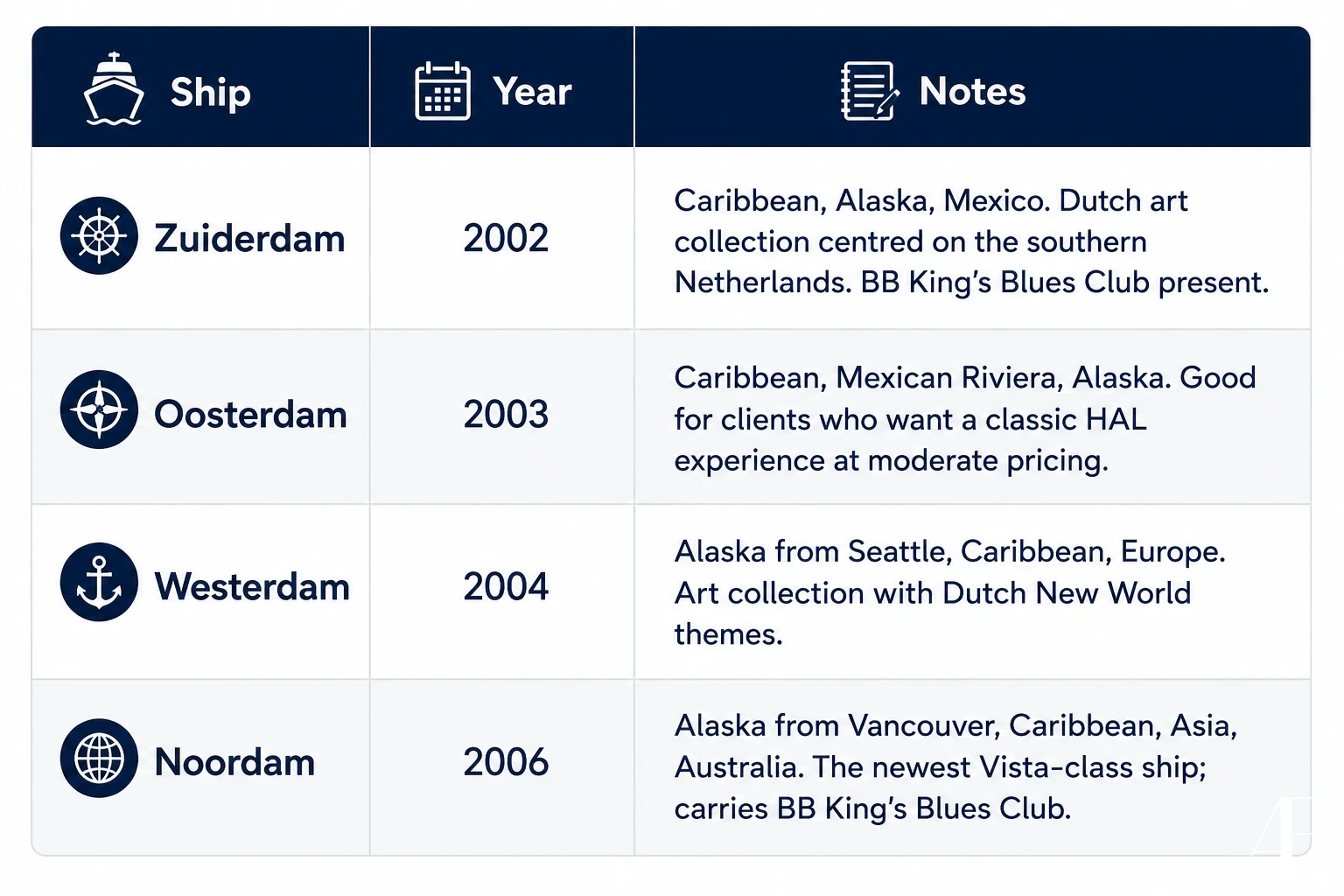
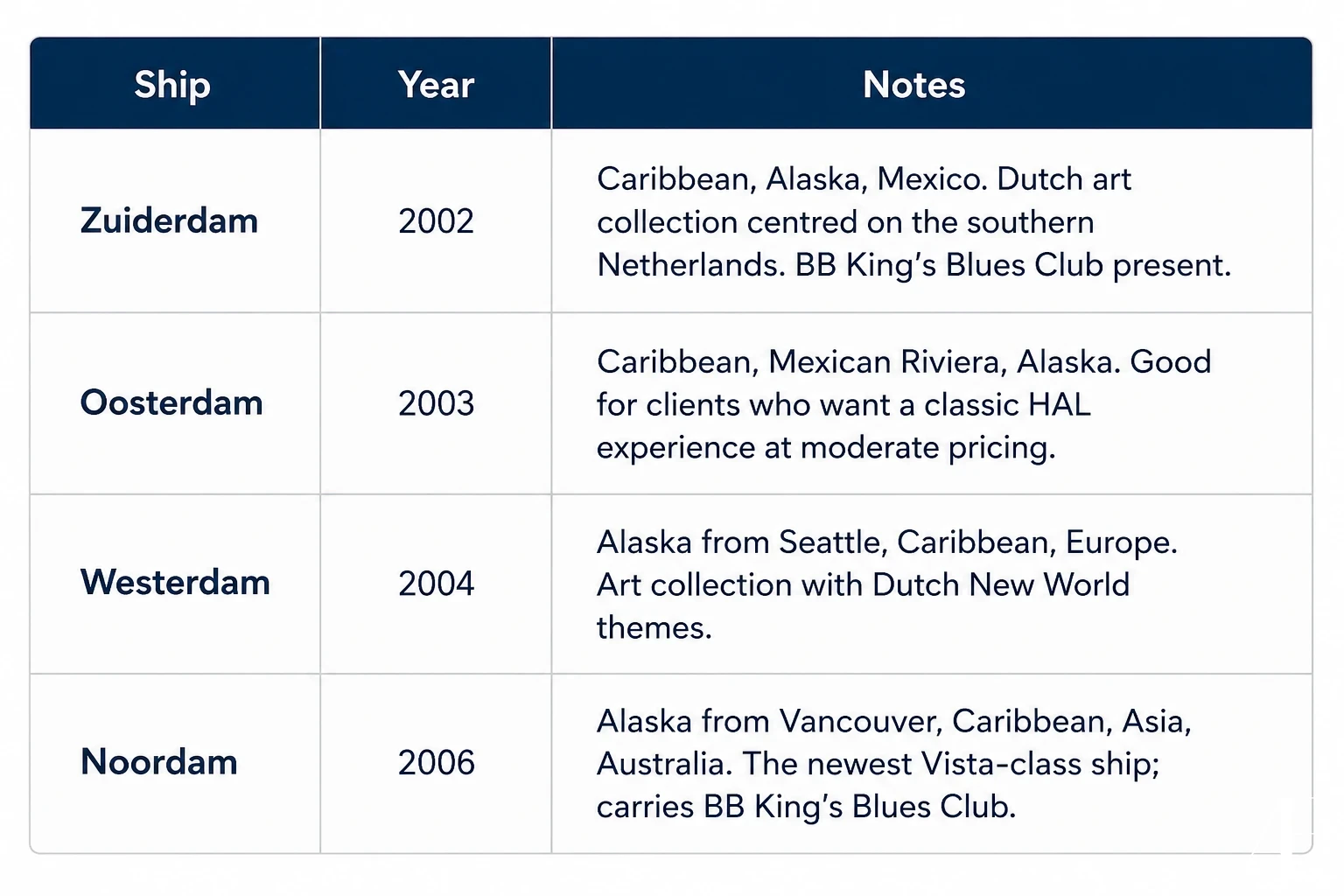
VISTA CLASS: THE TRADITIONNAL CORE
- Zuiderdam (2002)
- Oosterdam (2003)
- Westerdam (2004)
- Noordam (2006)
Each carries approximately 1,848 to 1,964 guests at 82,305 gross tons.
The Vista-class ships are the oldest active vessels in the fleet, and they require the most careful recommendation. They have each been refurbished and remain capable performers. The traditional Holland America aesthetic is most purely expressed on these ships: warm mahogany, classic Dutch art, intimate scale and a genuinely unhurried atmosphere.
The honest assessment for agents: compared directly to the Pinnacle class, the Vista ships show their age in cabin finish, the entertainment programme (no full Music Walk on most) and the specialty dining options. They should be booked knowingly, not by default.
Where they work well: itineraries where the destination dominates the experience, where the smaller scale is an active selling point, and for guests who have cruised HAL before and appreciate the traditional product.
ROTTERDAM CLASS: SMALL SHIP SPECIALISTS
- Volendam (1999)
- Zaandam (2000)
Each carries approximately 1,432 guests at 61,000 gross tons. These are the smallest and oldest ships in the active fleet, and they are also the most specialised in deployment. Their smaller size opens ports and anchorages not accessible to the larger classes.
The honest assessment: these ships show their age more than any other class in the fleet. Cabin finishes, entertainment infrastructure and specialty dining options are significantly more limited than on the Pinnacle class. They are appropriate for clients who prioritise the destination and the intimate scale over the onboard product.
Fleet at a Glance
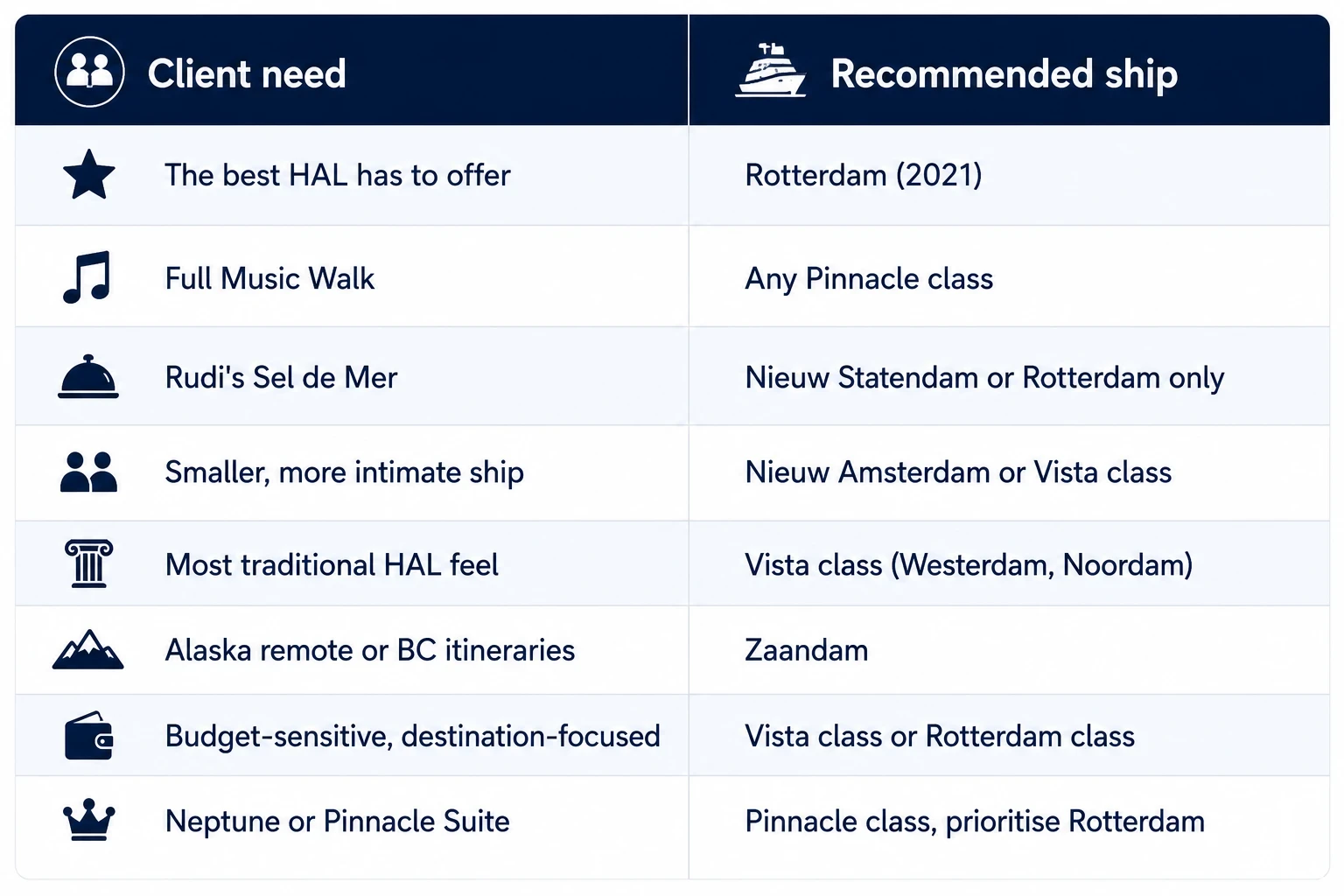
How to Match a Client to the Right Ship
The Inclusions
The single most common source of client dissatisfaction on a first Holland America sailing is the expectation mismatch around inclusions. The base fare is genuinely good value for what it covers. But clients who expect an all-inclusive experience and find themselves charged for beverages, Wi-Fi and specialty dining will feel blindsided. Agents who set this up clearly at the point of sale prevent the problem entirely.
Base Fare Inclusions: The Exhaustive List
The following are included in every Holland America base fare, at every cabin category, on every sailing:
- All accommodation in the booked stateroom category
- All meals in the main Dining Room for breakfast, lunch and dinner
- All meals at the Lido Market (buffet) throughout the day
- Room service for select items (a delivery charge of USD $9.50 applies to most orders; a limited continental breakfast is complimentary)
- All Music Walk performances: Lincoln Center Stage, BB King's Blues Club, Rolling Stone Rock Room — no ticket or reservation required, open to all guests
- All EXC Port Talks and destination lectures
- America's Test Kitchen demonstration events (hands-on classes carry an additional charge; demonstrations are included)
- Fitness centre and gymnasium access
- Swimming pools, hot tubs and deck facilities
- Non-alcoholic beverages: water, coffee, tea, juice, lemonade and iced tea at meals and in buffet areas
- All general entertainment: production shows, Mainstage theatre, Billboard lounge programming
- Art talks and museum programming
- Club HAL children's programming (where applicable)
- Captain's welcome and farewell events
What Is Never Included : The Exhaustive List
- Alcoholic beverages of any kind outside complimentary occasions
- Specialty coffees and soft drinks in bar settings
- Wi-Fi (all tiers charged separately)
- All specialty restaurants: Pinnacle Grill, Rudi's Sel de Mer, Tamarind, Canaletto, Nami Sushi, Morimoto by the Sea
- Shore excursions
- Crew Appreciation (daily gratuities): USD $16.00 to $17.50 per person per day depending on cabin category
- Spa and salon treatments
- Casino
- Shopping onboard
- Medical services
- Laundry and dry cleaning (self-service laundry available on most ships)
- Photography services
- Hands-on America's Test Kitchen cooking classes
The Have It All Package : The Complete Breakdown
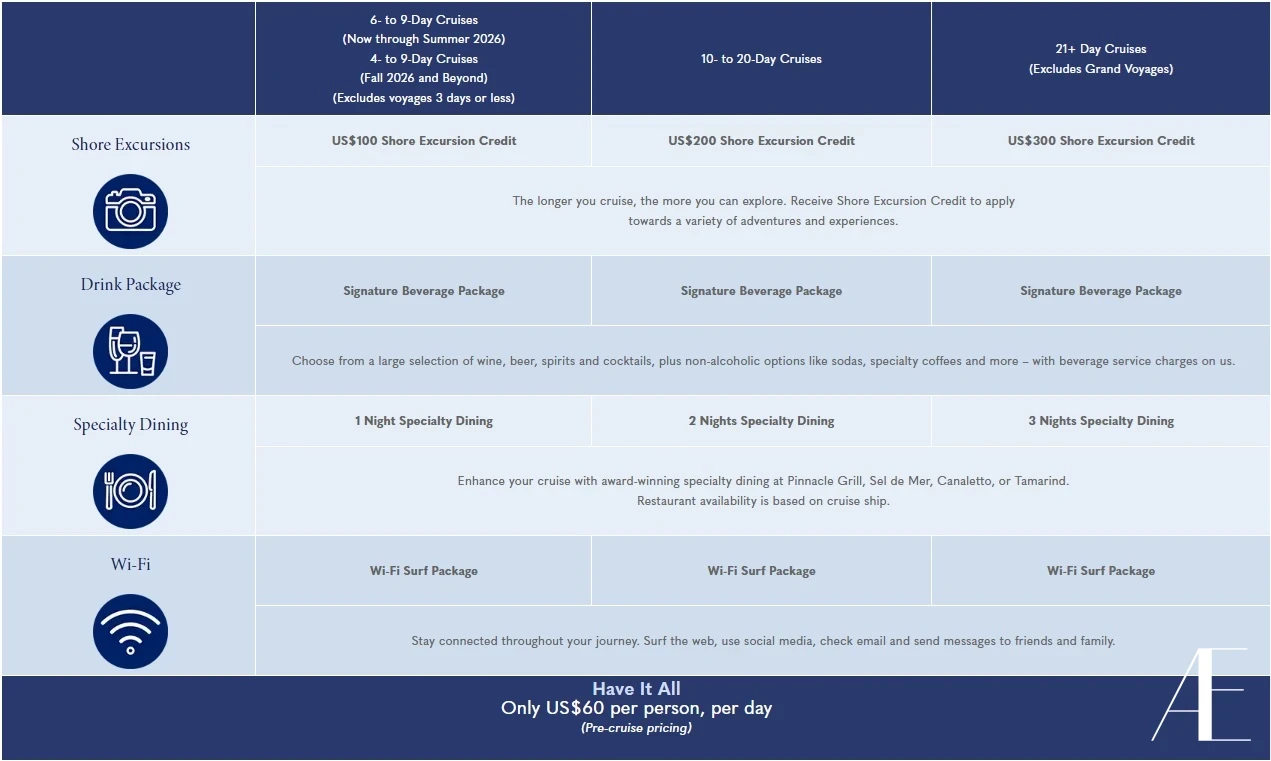
Have It All is Holland America's primary bundled add-on, combining the four most commonly purchased extras at a meaningful discount. It is not a full all-inclusive package, but for guests who plan to drink wine with dinner, use Wi-Fi regularly, book at least one shore excursion and dine at a specialty restaurant, it offers genuine and often significant savings.
Pricing: USD $60 per person per day when booked before the voyage. USD $70 per person per day if purchased onboard. Available on all itineraries except Grand Voyages.
When Have It All makes sense: Run the math before recommending. For a couple on a 7-day sailing, the Signature Beverage Package alone retails at approximately USD $64 per person per day if purchased separately.
Have It All at $60 per person per day, with the beverage package plus the excursion credit plus specialty dining plus Wi-Fi, is clearly the better value for guests who plan to drink and connect. For guests who do not drink alcohol and plan to buy no shore excursions, the math tilts the other way. Do not recommend Have It All reflexively. Ask the client how they cruise.
Crew Appreciation
| Cabin category | Daily rate per person |
|---|---|
| Interior, Ocean View, Verandah | USD $16.00 |
| Neptune Suite, Pinnacle Suite, Signature Suite | USD $17.50 |
Crew Appreciation can be pre-paid at booking through the agent portal. This is the cleaner client experience and eliminates any surprise on the onboard account.
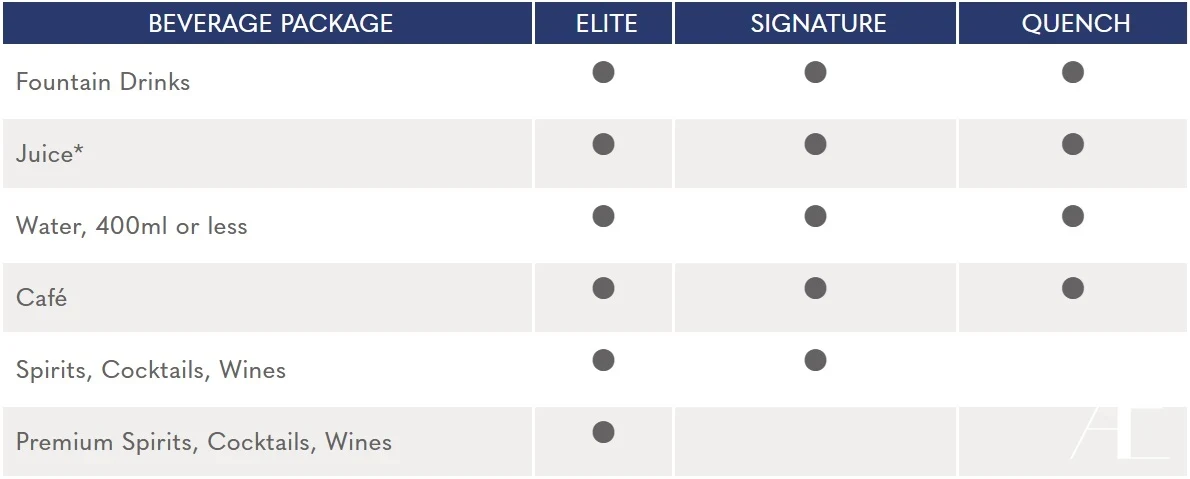
Beverage Packages
Wi-Fi Packages
The All-In Price Calculation
When quoting Holland America to a client, present an all-in price rather than just the base fare. The relevant components are: base fare + Have It All + Crew Appreciation + return flights + travel insurance + any pre- or post-cruise hotel.
Presenting the all-in number is also a competitive advantage when comparing to lines that advertise higher base fares with more inclusions. A fully loaded HAL cabin at the Have It All level is often comparable in total cost to a Viking or Oceania base fare, but the HAL conversation starts from a more accessible number.
The Stateroom Categories
Holland America's cabin hierarchy is one of the clearest in mainstream cruising. The grades are logical, the upgrade path is well-defined, and the Neptune Lounge benefit creates a meaningful tier distinction at the suite level. Understanding each category in detail allows agents to make confident recommendations and to have the upgrade conversation at the right moment.
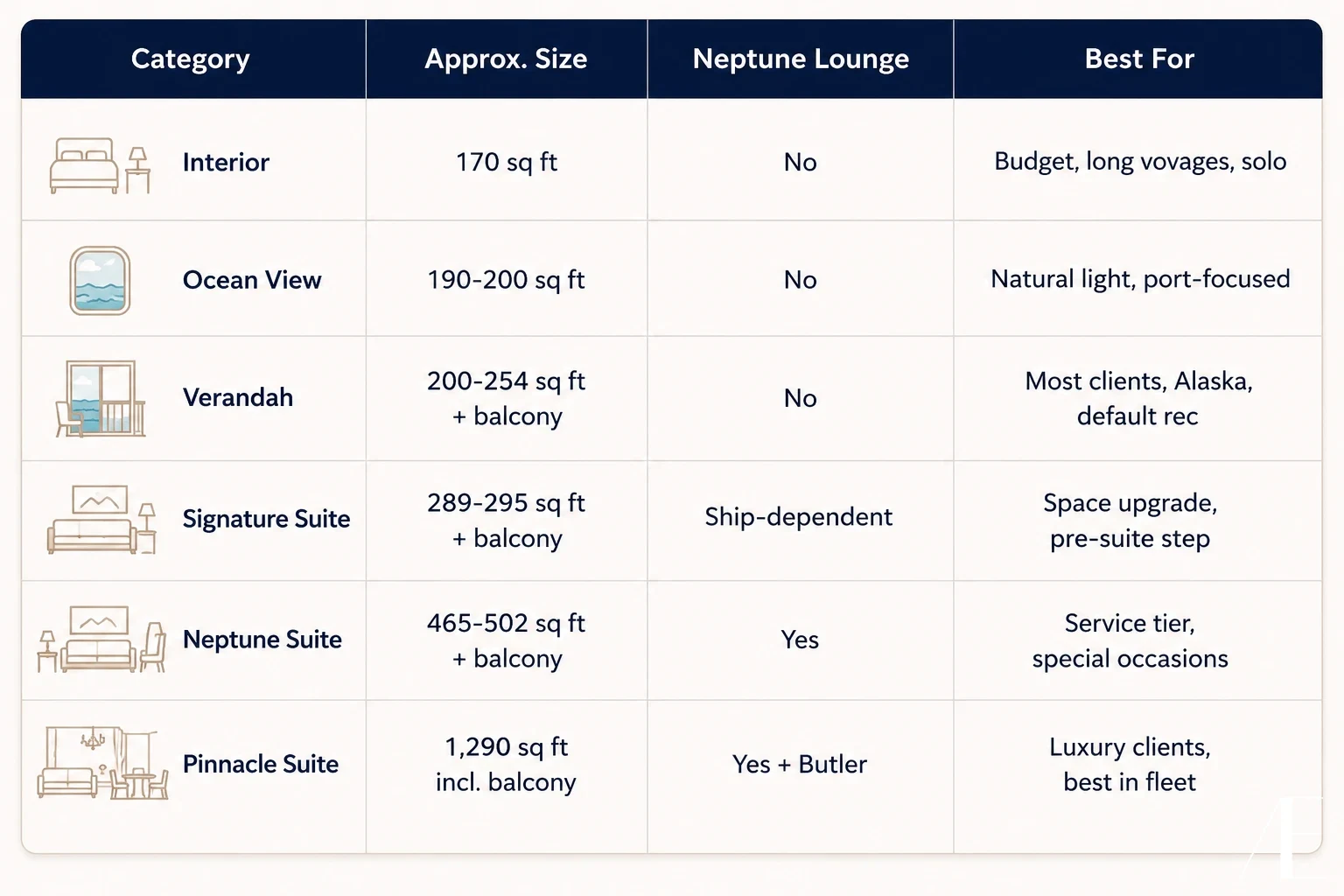
The Interior Staterooms
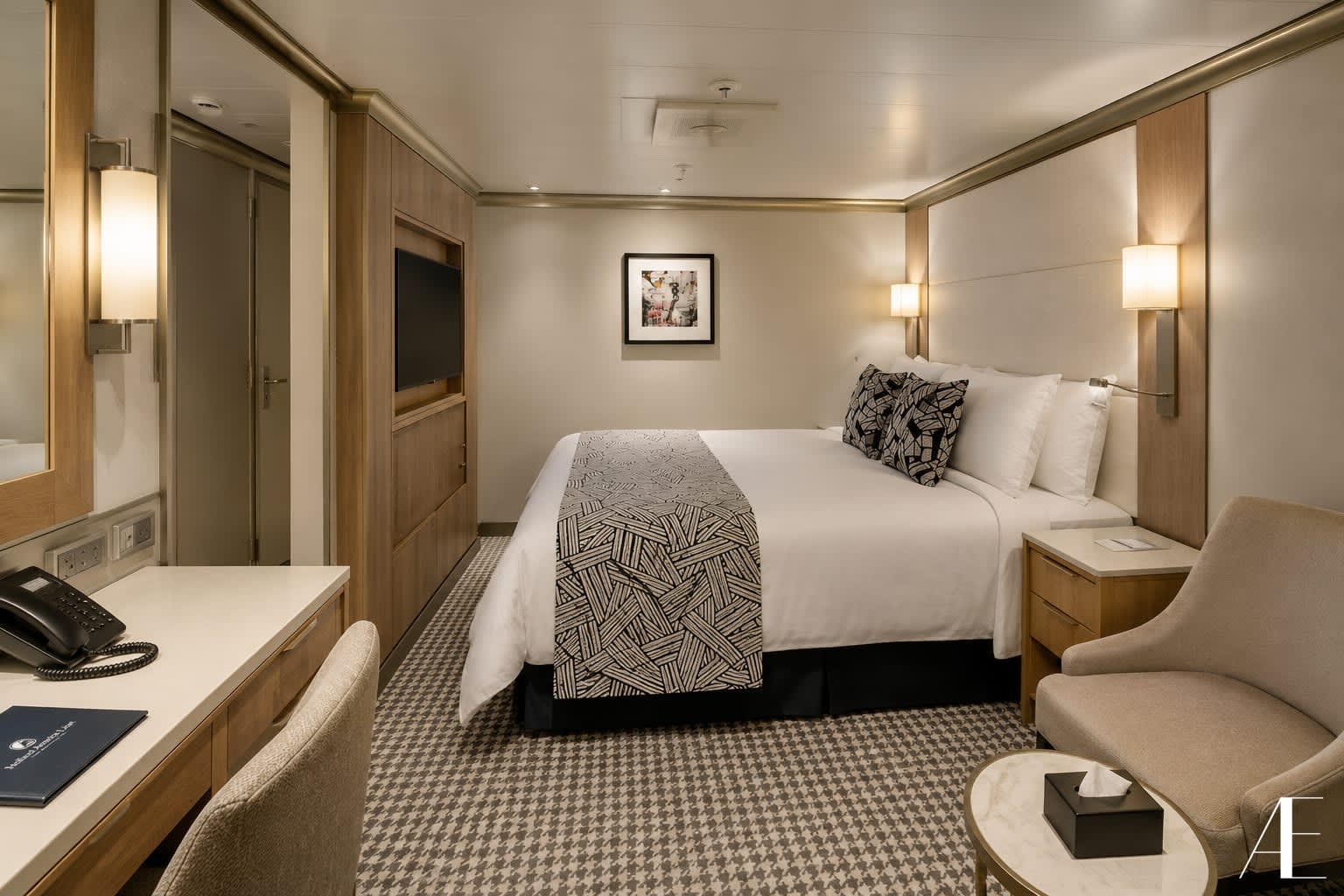
Approximately 170 square feet. Among the more generous interior cabin sizes in mainstream cruising at this price point. The defining feature across all cabin categories fleet-wide is the Mariner's Dream bed: a premium euro-top mattress developed in partnership with a sleep specialist. Consistent client feedback ranks the sleep quality as one of the most memorable aspects of any HAL sailing, regardless of cabin category.
Interior cabins on the Pinnacle class have been built or refreshed in the 2016-2021 cycle and feel contemporary. Interior cabins on the Vista class are functional but noticeably older in finish. Set expectations accordingly.
Best for: Budget-conscious clients, clients doing long voyages where the cabin is primarily for sleeping, solo travellers on a budget.
The Ocean View Staterooms
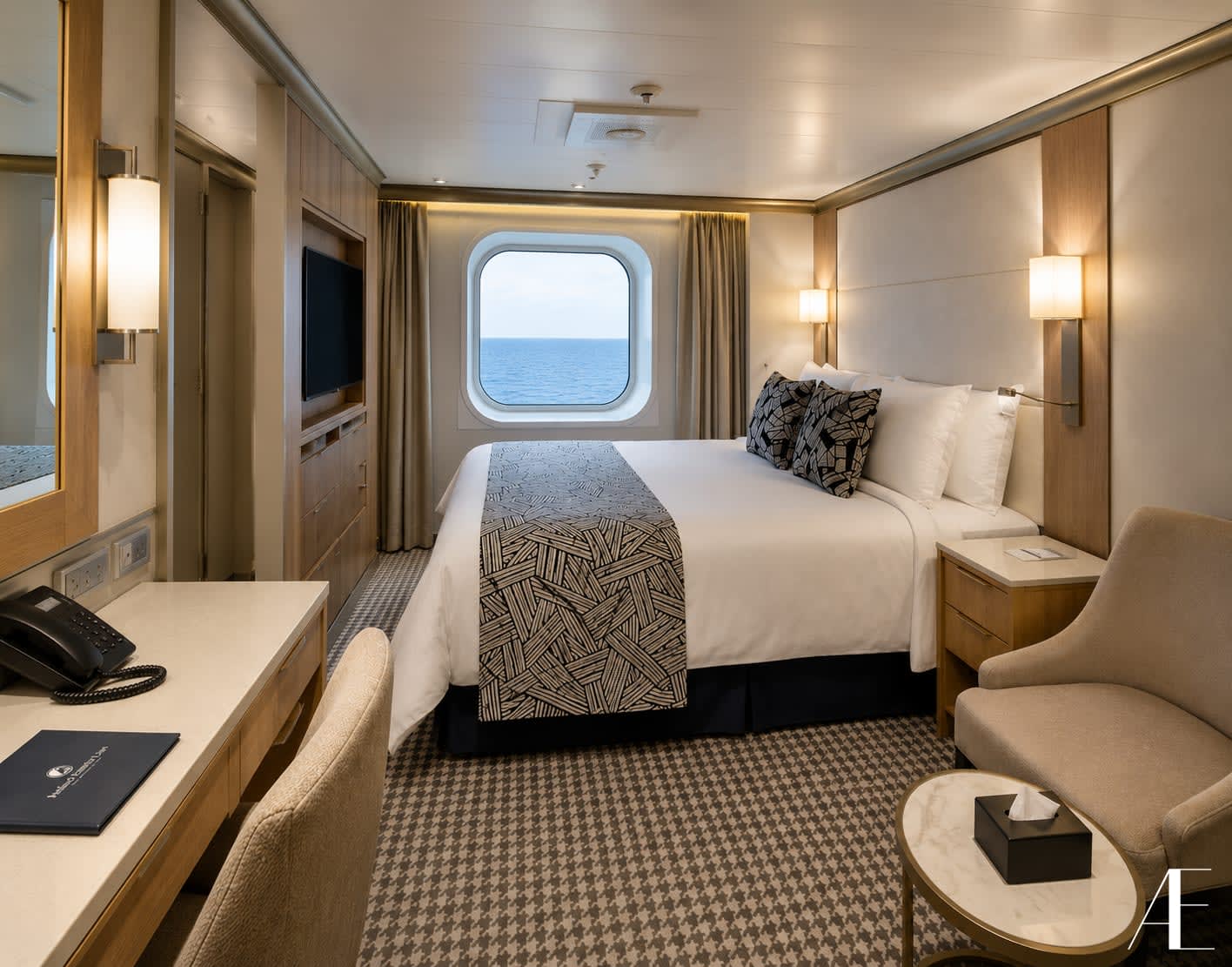
Approximately 190 to 200 square feet with a picture window and no outdoor access. Window size and placement varies by ship and deck: on the Vista class, certain Ocean View cabins have partially obstructed views from lifeboats or deck equipment. On the Pinnacle class, Ocean View windows are typically larger and less obstructed. Always verify the specific cabin configuration on Polar Online before recommending a particular Ocean View cabin to a client who values the view.
Best for: Clients who want natural light and sea views but are not interested in paying for balcony access; clients whose cruise focus is on port days rather than sea days.
The Verandah Staterooms
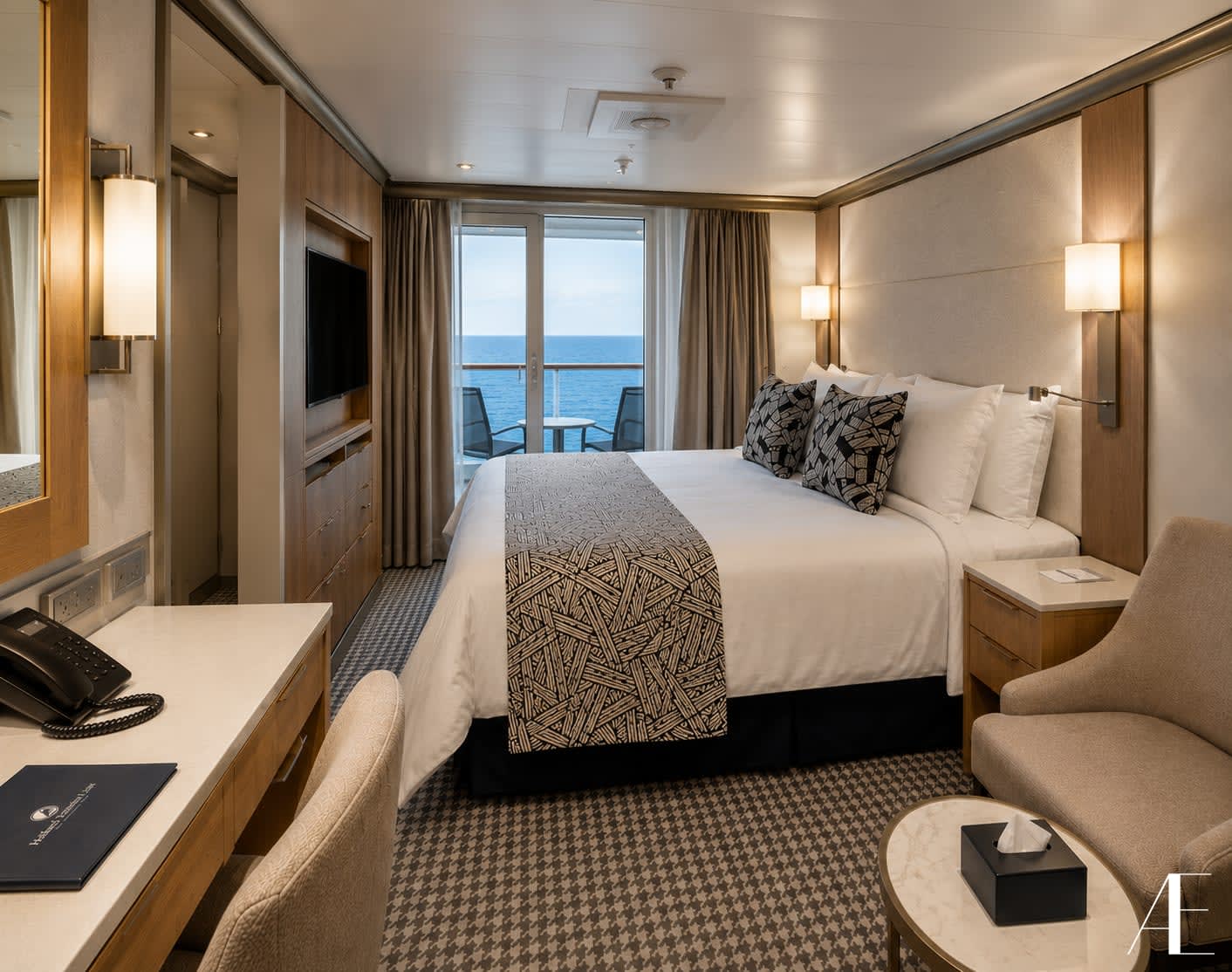
Approximately 200 to 254 square feet with a private balcony of 40 to 60 square feet. The most popular category across the fleet and the standard recommendation for most clients. The balcony is essential for Alaska itineraries, where wildlife and glacier viewing from the private outdoor space is one of the most cited highlights of the entire sailing.
Balcony size and configuration varies meaningfully by deck and ship. Mid-ship verandah cabins tend to be slightly larger; aft-facing verandah cabins on some ships offer exceptional proportions and views but can carry more engine noise at low speeds. The Navigation Deck verandah cabins on Rotterdam are among the most recommended bookings on the ship.
Spa Verandah Staterooms include direct spa access, priority treatment booking and a dedicated spa concierge.
Best for: Almost all client types as the default recommendation; Alaska in particular; couples who plan sea days on the balcony; Northern Europe itinerary clients.
The Vista Suites
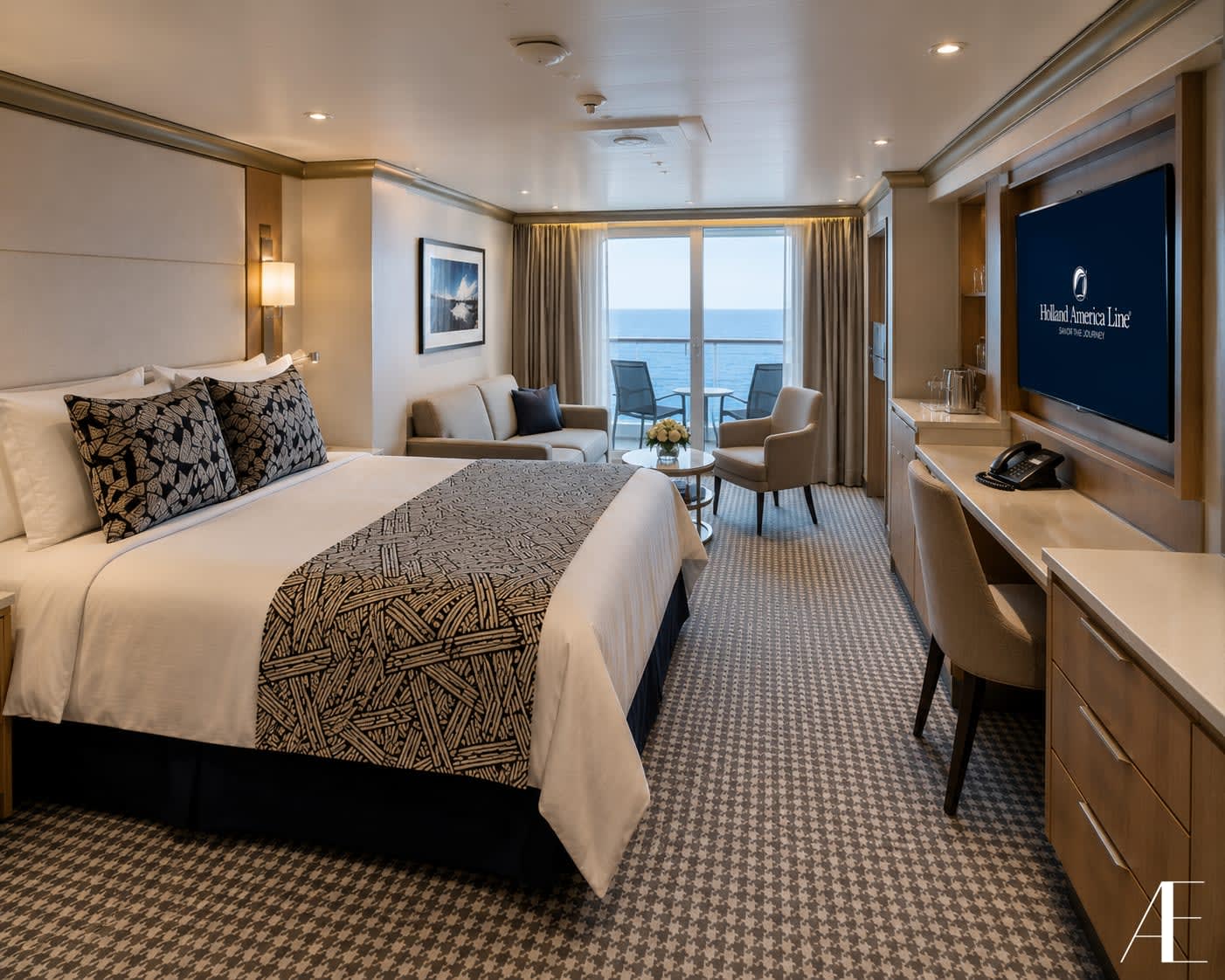
Approximately 260 to 400 square feet including a private veranda, depending on ship and configuration. Vista Suites represent the entry point into Holland America Line’s true suite experience and are a major step up in comfort, storage space, and overall onboard living compared to standard verandah staterooms. Most include a spacious sitting area, expanded bathroom layout, premium bath amenities, and priority boarding benefits.
On Pinnacle-class ships, Vista Suites feel particularly modern and efficient, with excellent natural light and larger-feeling interiors than their square footage suggests. Forward-facing Vista Suites can offer exceptional panoramic ocean views, while aft-facing configurations on select ships are highly sought after for wake views and larger balconies.
Best for: Clients celebrating special occasions; longer itineraries where additional living space matters; couples upgrading from standard balcony cabins; premium Alaska and Northern Europe sailings; travelers wanting suite-level comfort without moving into the higher luxury suite tiers.
The Signature Suites
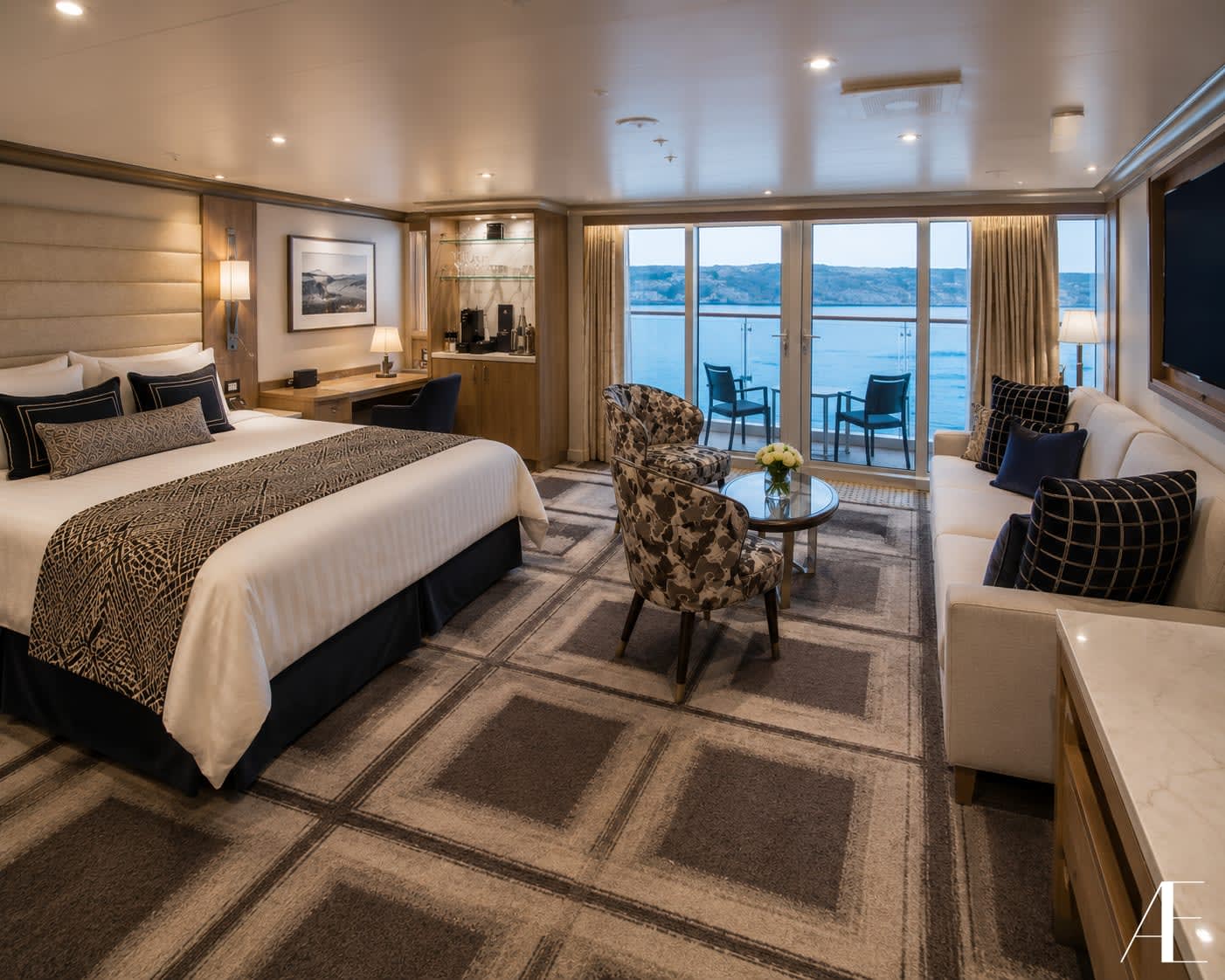
Approximately 393 to 400 square feet with a private verandah and expanded sitting area featuring floor-to-ceiling windows. Signature Suites are widely considered the sweet spot in Holland America Line’s premium accommodation categories, offering a noticeably more upscale residential feel while remaining far below the pricing of the top-tier Neptune and Pinnacle Suites.
The larger living area makes a significant difference on longer voyages and scenic itineraries, especially for clients who spend meaningful time in their suite during sea days or glacier cruising. Bathrooms are substantially upgraded compared to standard staterooms and Vista Suites, and the additional storage and seating make these suites particularly comfortable for extended travel.
Depending on ship and configuration, Signature Suites can accommodate up to four guests with convertible king or queen Mariner’s Dream™ beds alongside a Murphy, Pullman, or sofa bed. Included amenities such as in-suite binoculars, expanded mini-bar setup, and enhanced service touches further reinforce the premium positioning of the category.
On Pinnacle-class ships, Signature Suites are especially attractive because they include access to the Neptune Lounge, adding concierge service, a private retreat space, and additional suite privileges that substantially enhance the onboard experience. On older Vista-class ships, benefits may vary slightly and should always be confirmed ship by ship at booking.
Best for: Couples seeking a true premium cruise experience; longer itineraries; Alaska and Norway sailings where balcony viewing matters heavily; multigenerational travelers needing additional space; clients celebrating anniversaries or milestone trips; luxury-curious clients not yet ready for top-tier suite pricing.
The Neptune Suites
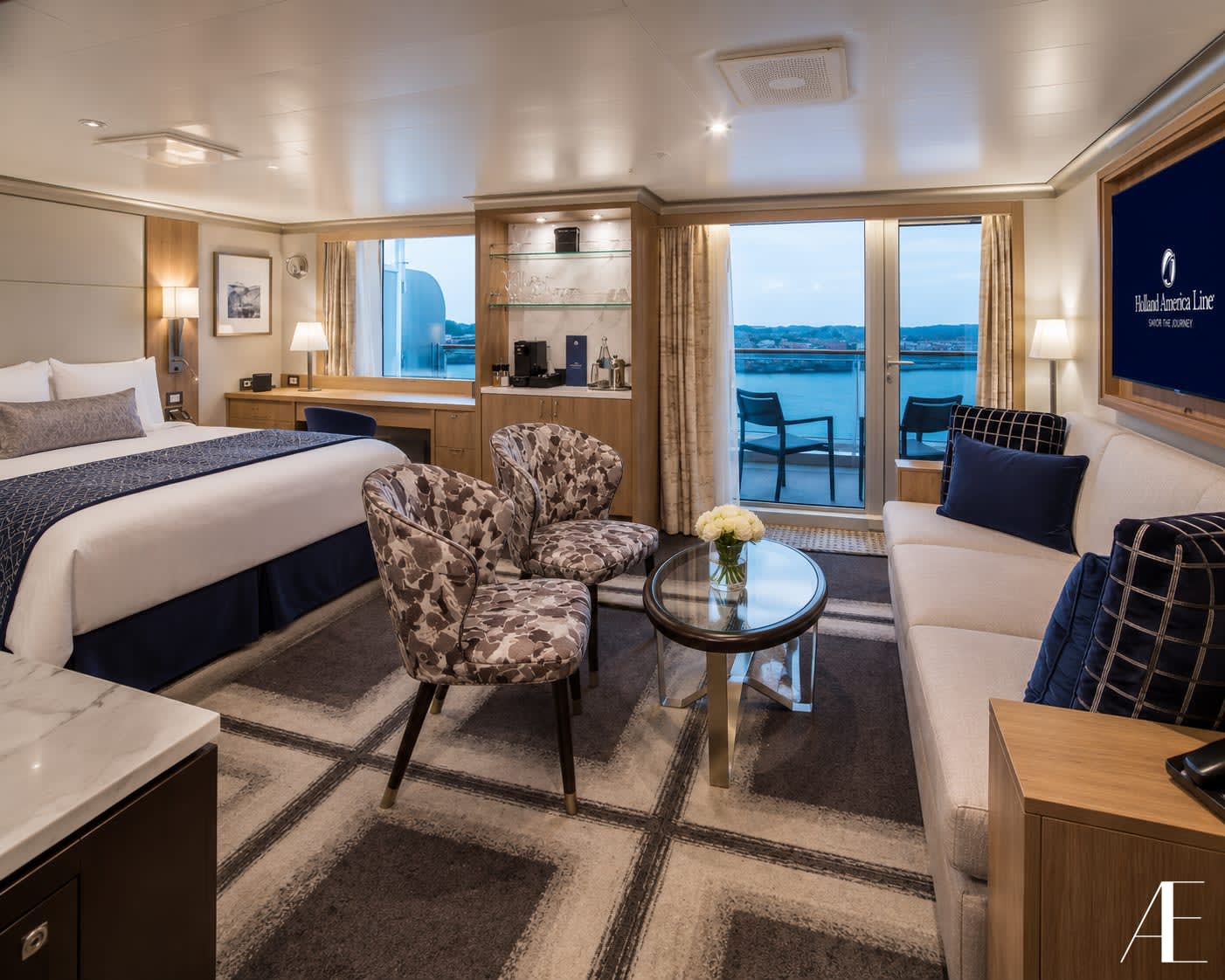
Approximately 465 to 502 square feet on Pinnacle and Signature-class ships. The Neptune Suite is the tier at which the Holland America experience transforms from very good to genuinely distinctive, because of the Neptune Lounge.
The Neptune Lounge is a private concierge space exclusive to Neptune Suite and Pinnacle Suite guests. On Pinnacle-class ships, particularly on Rotterdam, it is a carefully designed and attentively staffed retreat that provides:
- Daily continental breakfast service with table seating and full menu options
- Afternoon tea and light snacks throughout the day
- A dedicated Neptune Concierge whose sole function is guest logistics
- Dining reservations at all specialty restaurants
- Shore excursion bookings, recommendations and rebookings
- Priority embarkation and debarkation assistance
- Luggage handling and coordination
- Pressing and minor laundry services
- Any complaint resolution or special request management
The Neptune Concierge is the single most effective agent for making a HAL suite guest feel cared for. Brief suite clients before the sailing: tell them to introduce themselves to the Neptune Concierge within the first hour onboard. This person will handle everything for the voyage.
Best for: Clients who want a meaningful service tier upgrade; special occasions; clients who have done several Verandah sailings and are ready to step up.
The Pinnacle Suites
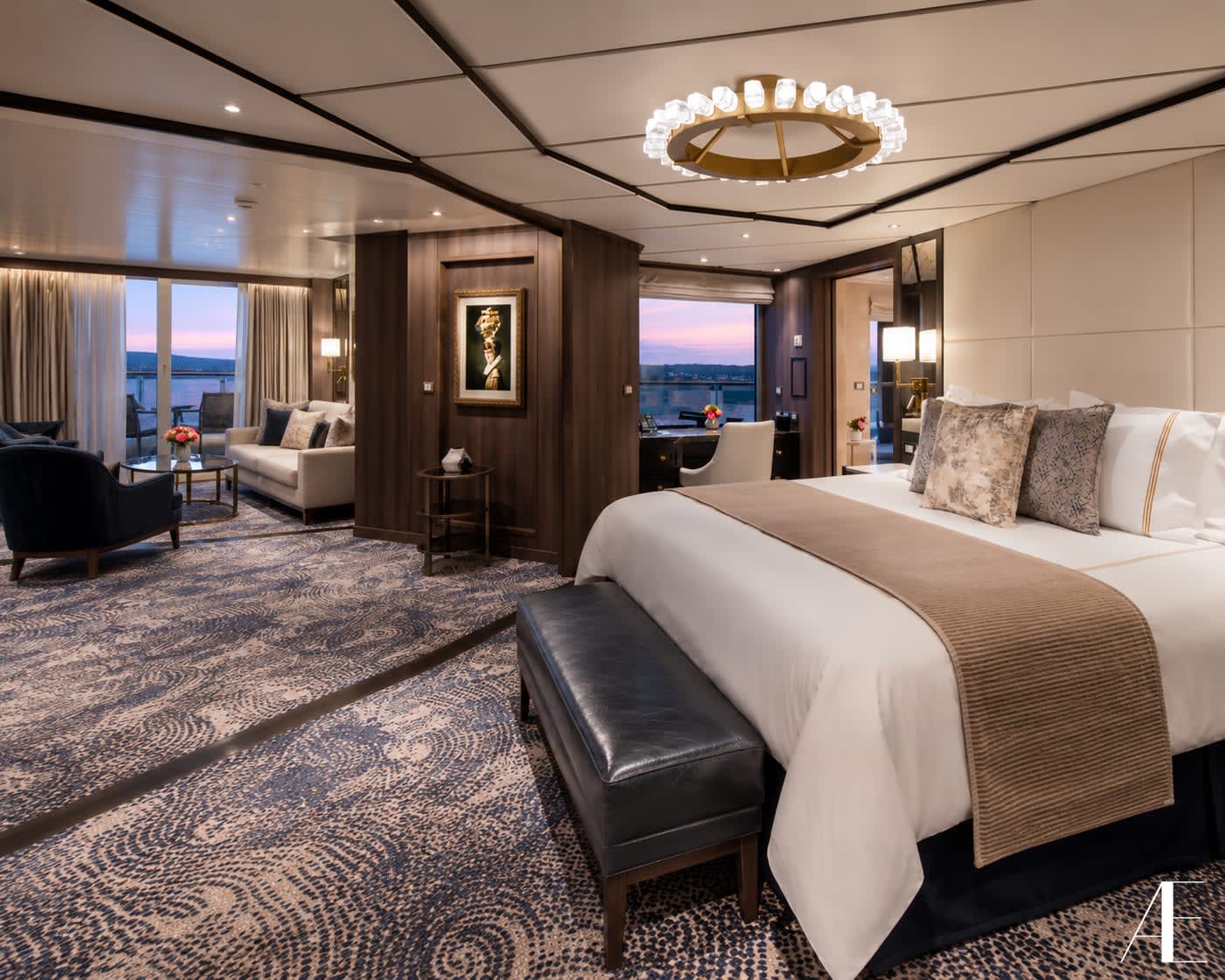
Approximately 1,290 to 1,500 square feet including one of the largest private verandahs in the Holland America Line fleet. The Pinnacle Suite is the flagship accommodation category onboard and is positioned firmly within the luxury-suite segment rather than traditional premium cruise accommodations. These suites feature expansive living and dining areas, oversized bathrooms with whirlpool tubs and separate showers, pantry space, and extensive floor-to-ceiling windows throughout.
The experience is designed for clients who view the suite itself as a central part of the voyage rather than simply a place to sleep. Entertaining space, private dining capability, upgraded technology, premium furnishings, and highly personalized concierge and Neptune Lounge services all become part of the onboard lifestyle. On longer itineraries, the additional space can dramatically change the feel of the cruise experience, especially during sea days.
Bedroom configurations vary by ship, but most Pinnacle Suites include a separate master bedroom, convertible sleeping arrangements for additional guests, and some of the most impressive private outdoor spaces at sea within the premium cruise market. Forward-facing Pinnacle Suites on Pinnacle-class ships are particularly prized for panoramic views during scenic cruising in Alaska, Norway, Iceland, and Antarctica repositioning voyages.
Best for: Luxury travelers accustomed to five-star hotels; milestone celebrations; world cruise and Grand Voyage clients; executives or VIP travelers wanting privacy and entertaining space; multigenerational families seeking a top-tier shared suite experience; clients comparing Holland America Line against luxury brands while still preferring larger ships and traditional cruising atmosphere.
The Dining Breakdown
Holland America's dining programme is one of its most consistently praised attributes and a genuine competitive differentiator at this price point. The culinary investment is visible at every level from the main dining room to the flagship specialty venues, and the America's Test Kitchen partnership adds an enrichment dimension no competitor has matched. Agents who can speak to this in detail will find it resonates strongly with food-focused clients and provides a clear answer to the "why HAL over X" question.
The Dining Room
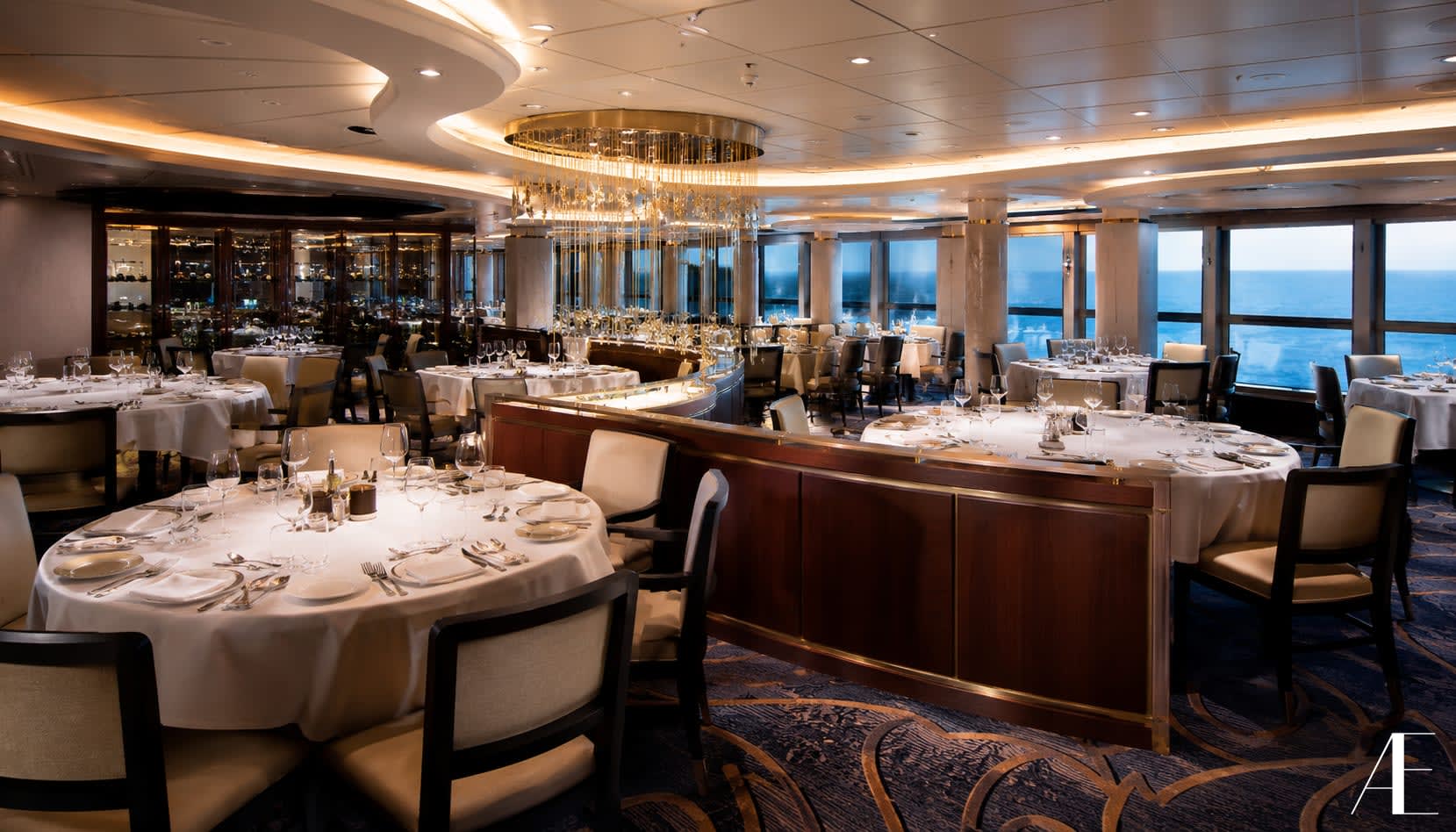
The main restaurant, available for breakfast, lunch and dinner on every ship. Open seating at most meal periods gives guests the flexibility to dine when they choose; a traditional fixed-seating dinner option is also available for guests who prefer the same table and companions each evening.
Menu quality is well above mainstream cruise-line standard. Menus rotate daily with clear regional inspiration from the current itinerary: on Alaska sailings, Pacific Northwest seafood features prominently; on Mediterranean itineraries, regional produce and preparation styles are incorporated. The wine list is curated rather than generic, with a clear focus on varietal representation and appropriate price distribution.
The kitchen brigade on Holland America ships has been led for decades by Culinary Director Rudi Sodamin, a Vienna-born chef who joined the company in 1996 and has shaped the entire culinary culture of the fleet. Sodamin's philosophy combines classical European technique with ingredient-forward preparation and a strong emphasis on presentation. His signature happy face food presentations — visible particularly in the Lido and at special events — are a recurring brand detail that guests often remember and mention.
Pinnacle Grill
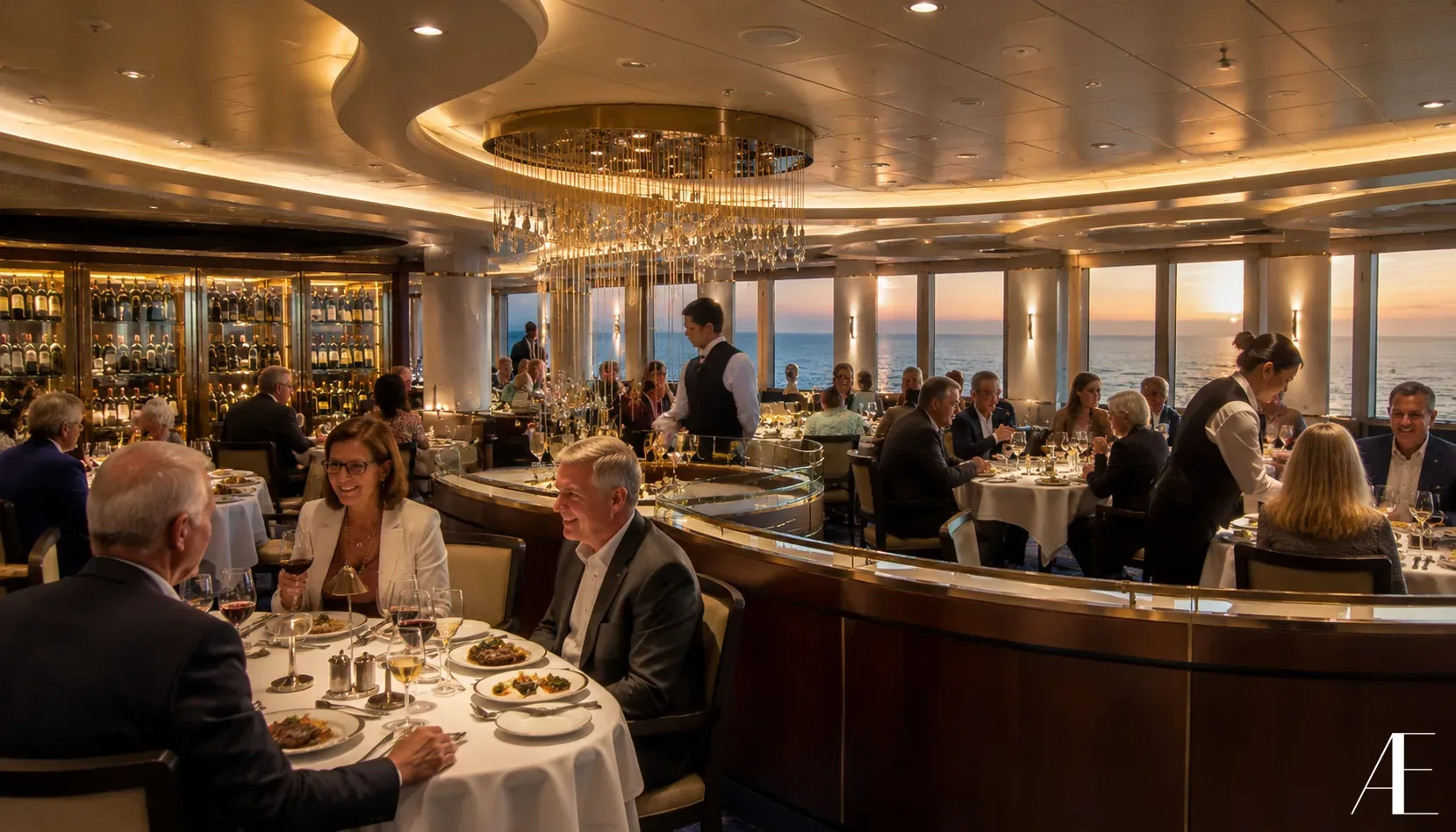
The flagship specialty restaurant, present on every ship in the fleet. A USDA Prime steakhouse with tableside preparations, a serious wine programme emphasising American and international producers, and a dinner atmosphere that genuinely competes with mid-market urban steakhouses ashore.
Supplement: approximately USD $49 to $59 per person depending on sailing and ship. One Pinnacle Grill dinner is included in the two and three-night Have It All specialty dining allocation for longer voyages.
Reservations are strongly recommended and can be booked pre-cruise through the agent portal or My Account on hollandamerica.com. Busy sailings can fill the early seatings within the first day onboard. Brief clients to book immediately at embarkation if not pre-booked.
Best for: Special occasion dinners, steak-focused clients, Neptune and Pinnacle Suite guests as a baseline recommendation.
Rudi's Sel de Mer
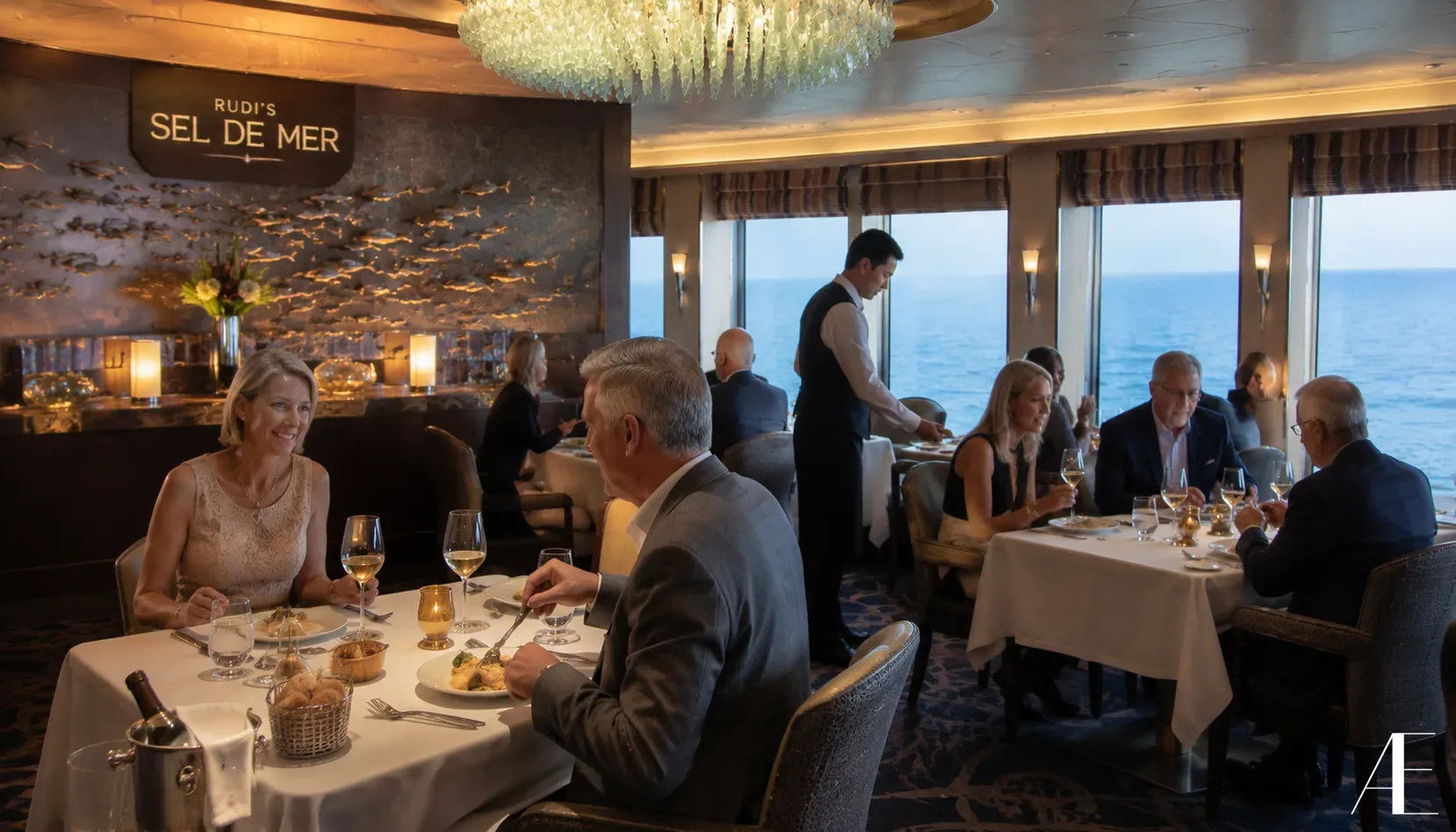
Available on Rotterdam (2021) and Nieuw Statendam (2018) only. The French seafood specialty restaurant named for Culinary Director Rudi Sodamin, offering classic French preparations of fresh seafood with a precision and technical standard that is genuinely impressive at sea.
The menu reads like a well-edited French coastal restaurant: plateaux de fruits de mer, soupe de poisson, Dover sole meunière, lobster bisque, moules marinières executed properly. The wine list is French-forward with appropriate weight in Burgundy and Loire whites.
Supplement: approximately USD $49 to $59 per person. Pre-booking is essential: Rudi's is the smallest specialty venue on the ships that carry it, and demand from guests who research before sailing is high.
Best for: The strongest selling point for culinary clients on Rotterdam or Nieuw Statendam. Also the correct recommendation for any client whose first question is "how is the seafood?"
Tamarind
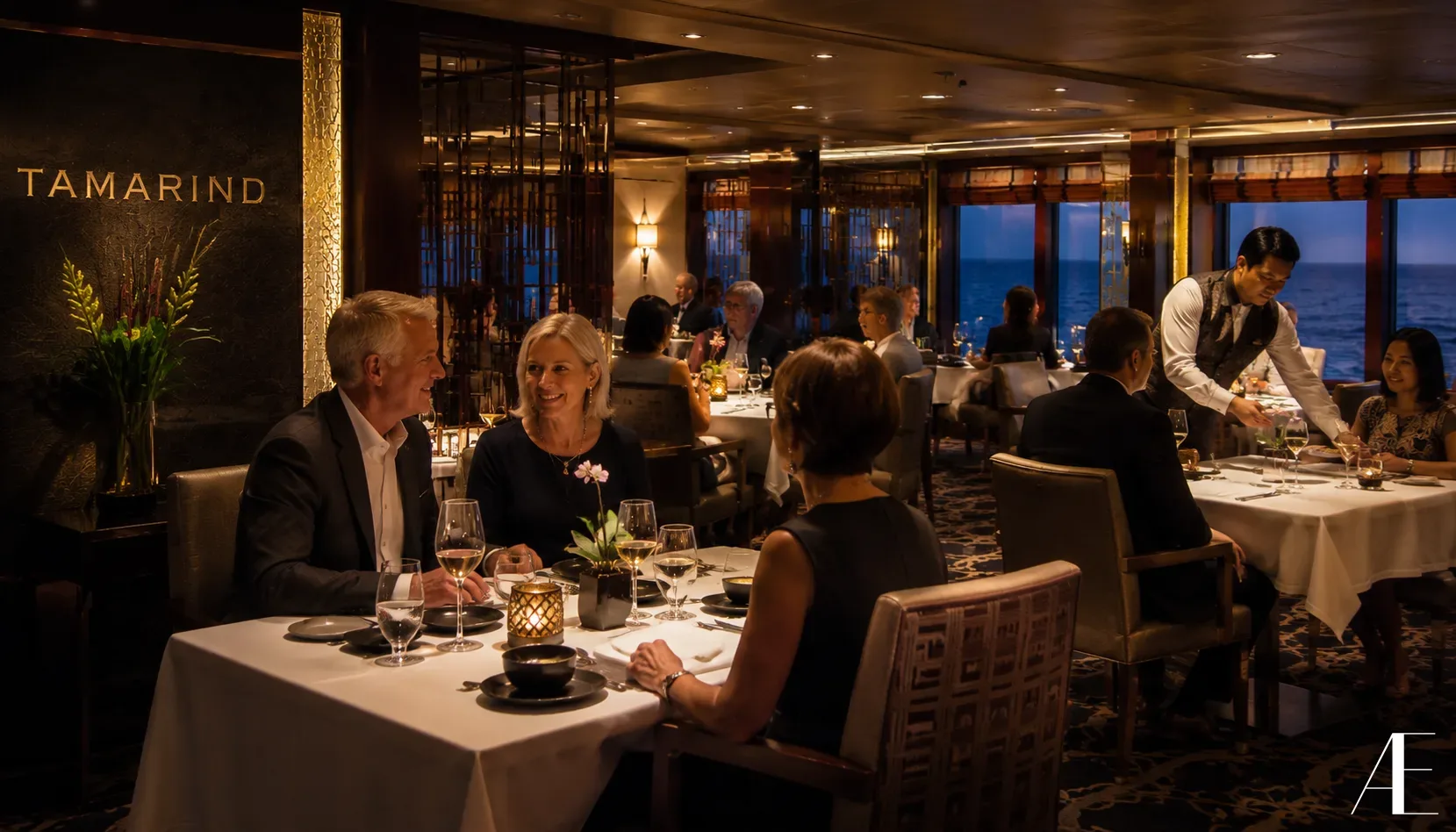
Pan-Asian specialty restaurant, available on Pinnacle-class ships. The menu draws from Japanese, Thai, Vietnamese, Indonesian and Indian culinary traditions in a single cohesive tasting journey. The aesthetic is warm and atmospheric with a bamboo-and-lacquer design language.
Supplement: approximately USD $39 per person. Included in the Have It All specialty dining allocation.
Best for: Clients interested in Asian cuisine, couples who like sharing, clients who want something other than a steakhouse dinner.
Canaletto
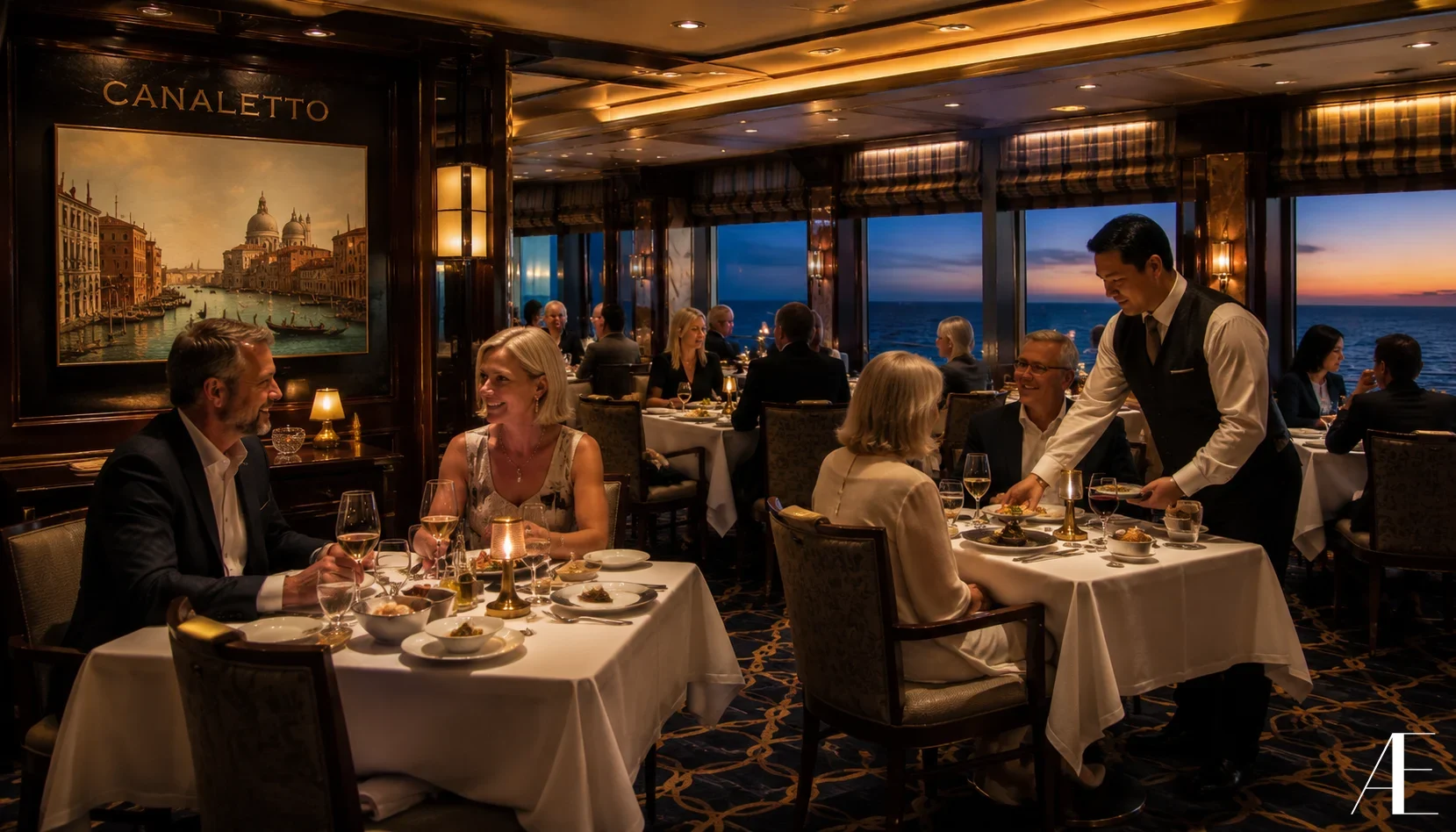
Italian specialty restaurant, present on most ships in the fleet. A comfortable and well-executed Italian menu centring on pasta, risotto, traditional secondi and a wine list with Italian regional focus.
Supplement: approximately USD $29 per person. The most accessible specialty dining supplement in the fleet. Included in Have It All specialty dining.
Best for: Groups, families, clients who want Italian, casual special occasion dinners.
Nami Sushi and Morimoto by the Sea
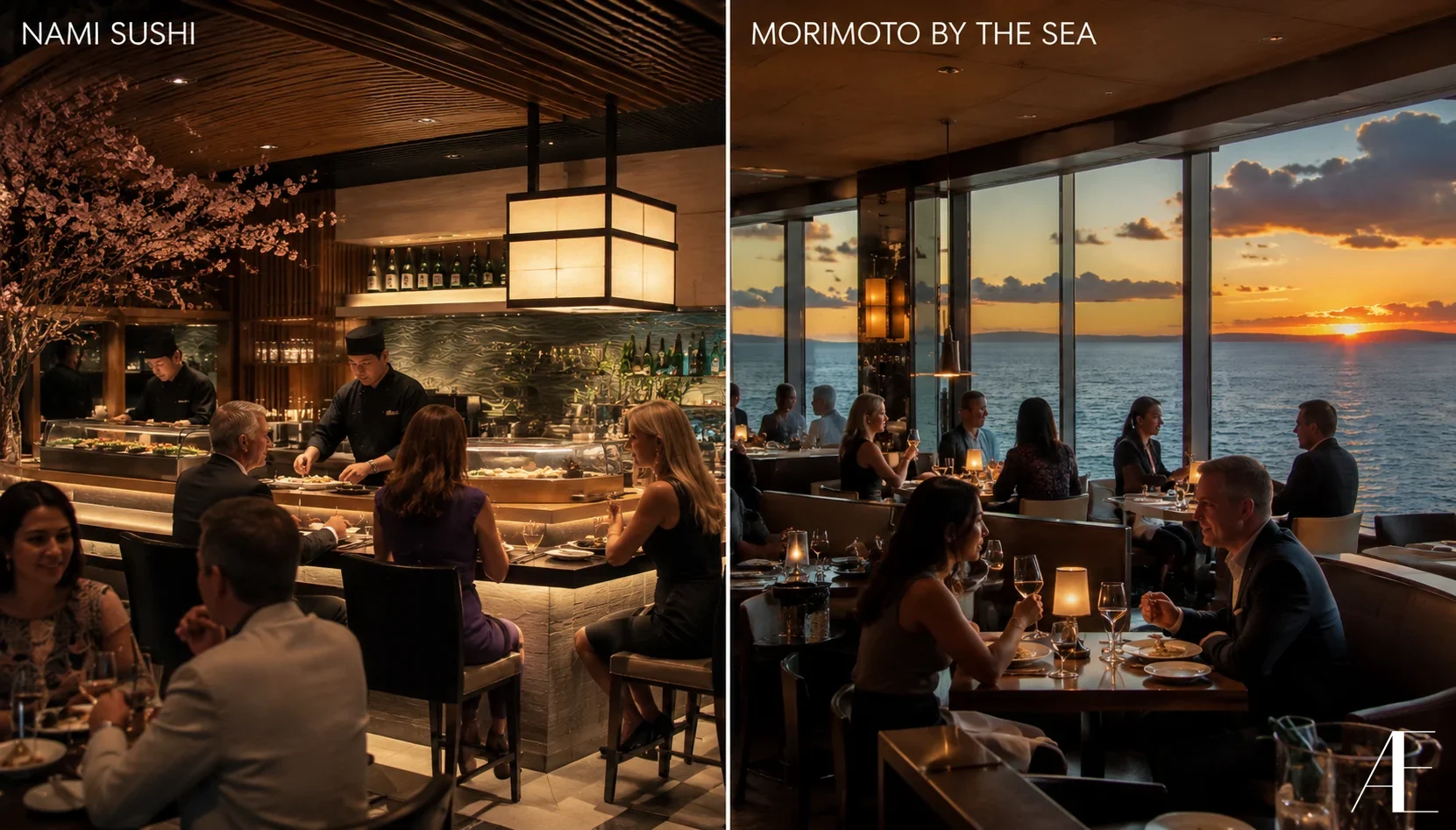
Available on select Pinnacle-class ships. Nami Sushi offers a dedicated sushi and Japanese small plate menu. Morimoto by the Sea, a collaboration with celebrity chef Masaharu Morimoto, offers a more elevated Japanese menu with signature dishes from the Morimoto restaurant empire. Both carry per-item or prix-fixe pricing.
America's Test Kitchen
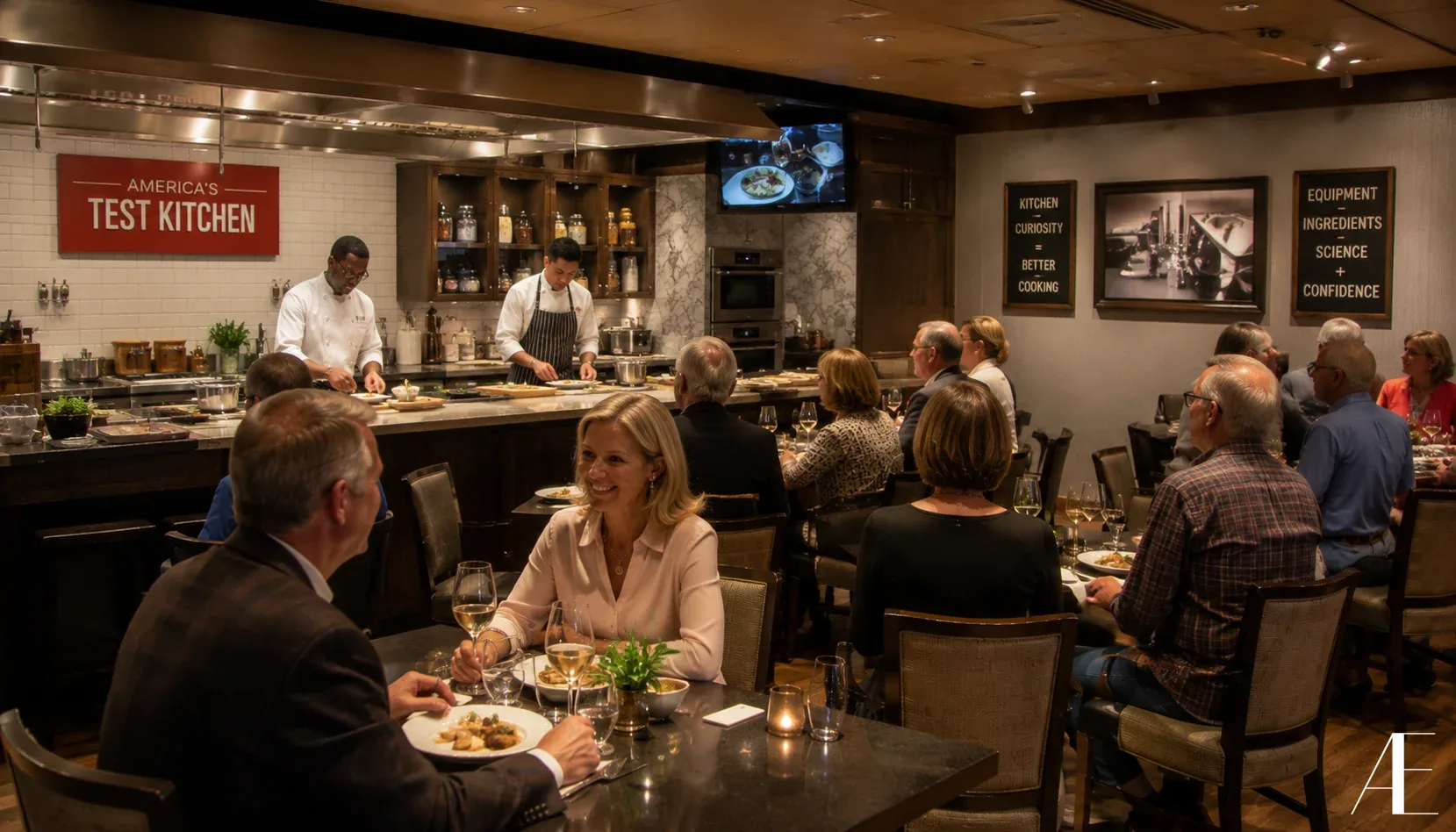
America's Test Kitchen is Holland America's culinary enrichment programme and one of the most distinctively successful partnerships in the cruise industry. It operates on every ship in the fleet and provides both free-to-attend demonstration events and reservable hands-on cooking classes.
The programme runs in a fully equipped demonstration kitchen space installed on each ship. ATK-trained chefs conduct live cooking demonstrations, typically 45 to 60 minutes, covering recipe development, technique and the science of cooking. The demonstrations are tied to the itinerary where possible: on Alaska sailings, Pacific seafood preparation; on Caribbean sailings, rum-based cooking and tropical ingredients.
Demonstrations are included in the base fare. Hands-on classes, where guests cook alongside the instructor, carry an additional charge of approximately USD $29 to $39 per person and book out quickly. Agents should brief clients to book hands-on classes immediately at embarkation.
The ATK partnership means that the programme has curriculum depth. The demonstrations draw on the published test kitchen methodology: recipes that have been tested many times to identify exactly why they work, and a teaching approach that explains technique rather than simply presenting it. This is meaningfully different from a generic cooking show at sea.
For food-focused clients, the combination of America's Test Kitchen, Rudi's Sel de Mer (on the two ships that carry it), the Pinnacle Grill and Tamarind creates a culinary argument for HAL that no competitor at this price point can match.
The Lido Market
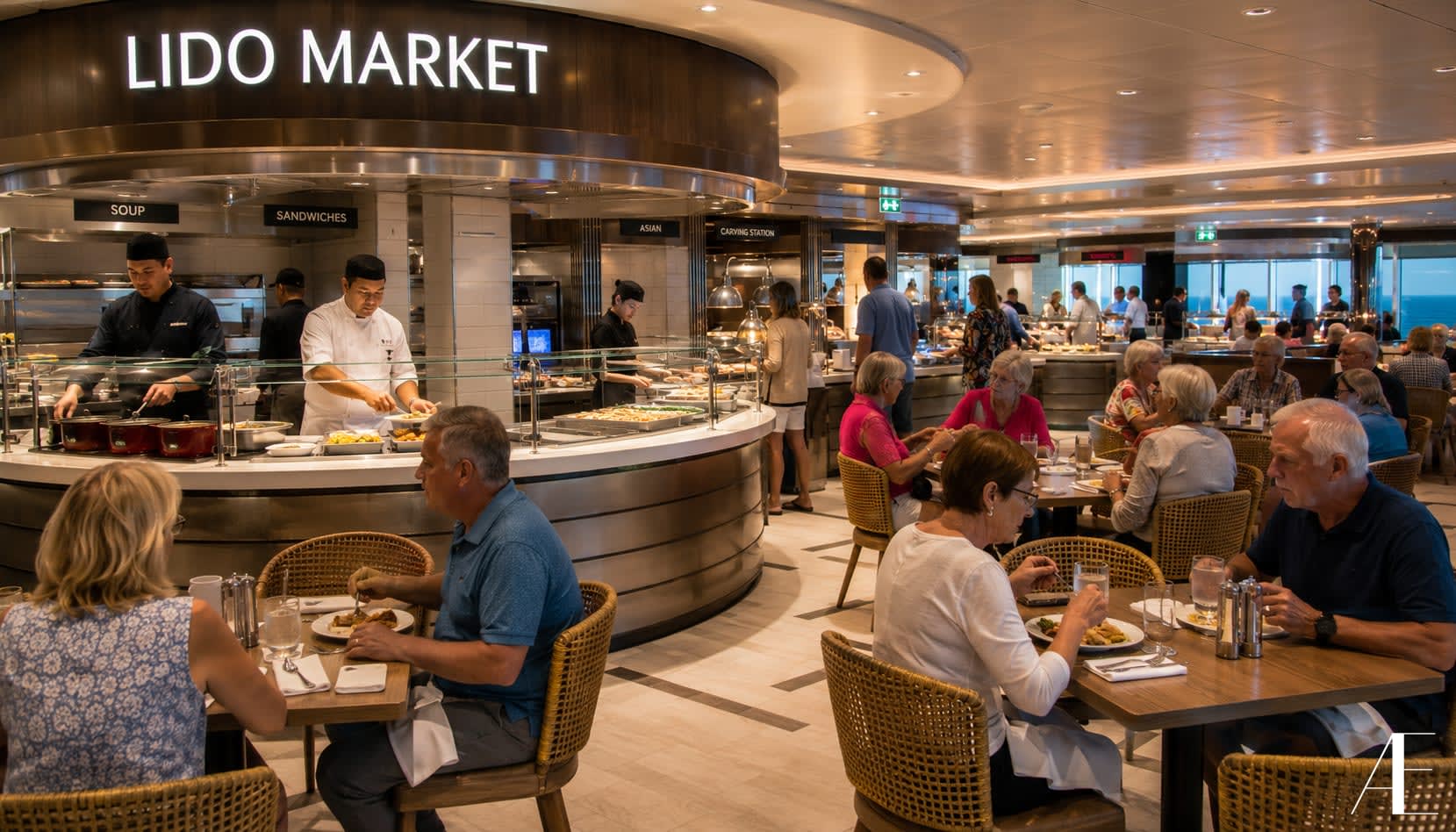
The casual buffet venue, designed as a market hall with open kitchen stations rather than a traditional cafeteria layout. Available for breakfast, lunch and casual dinner. Quality is above mainstream cruise buffet standard, with made-to-order stations for eggs, carved meats, fresh pasta and international cuisine.
The Onboard Experiences
The onboard experience is where Holland America most clearly differentiates itself from competitors at the same price tier. The combination of the Music Walk, the art collection, the EXC enrichment programme and the America's Test Kitchen creates an intellectual and cultural environment that has no direct equivalent in mainstream cruising.
The Music Walk
The Music Walk is the single feature that most defines the Holland America onboard experience on Pinnacle-class ships. It consists of three dedicated live music venues arranged along a connecting spine of public space through the ship's interior. All three venues feature live musicians rather than recorded tracks. All three are included in the base fare and open to every guest.
The Lincoln Center Stage
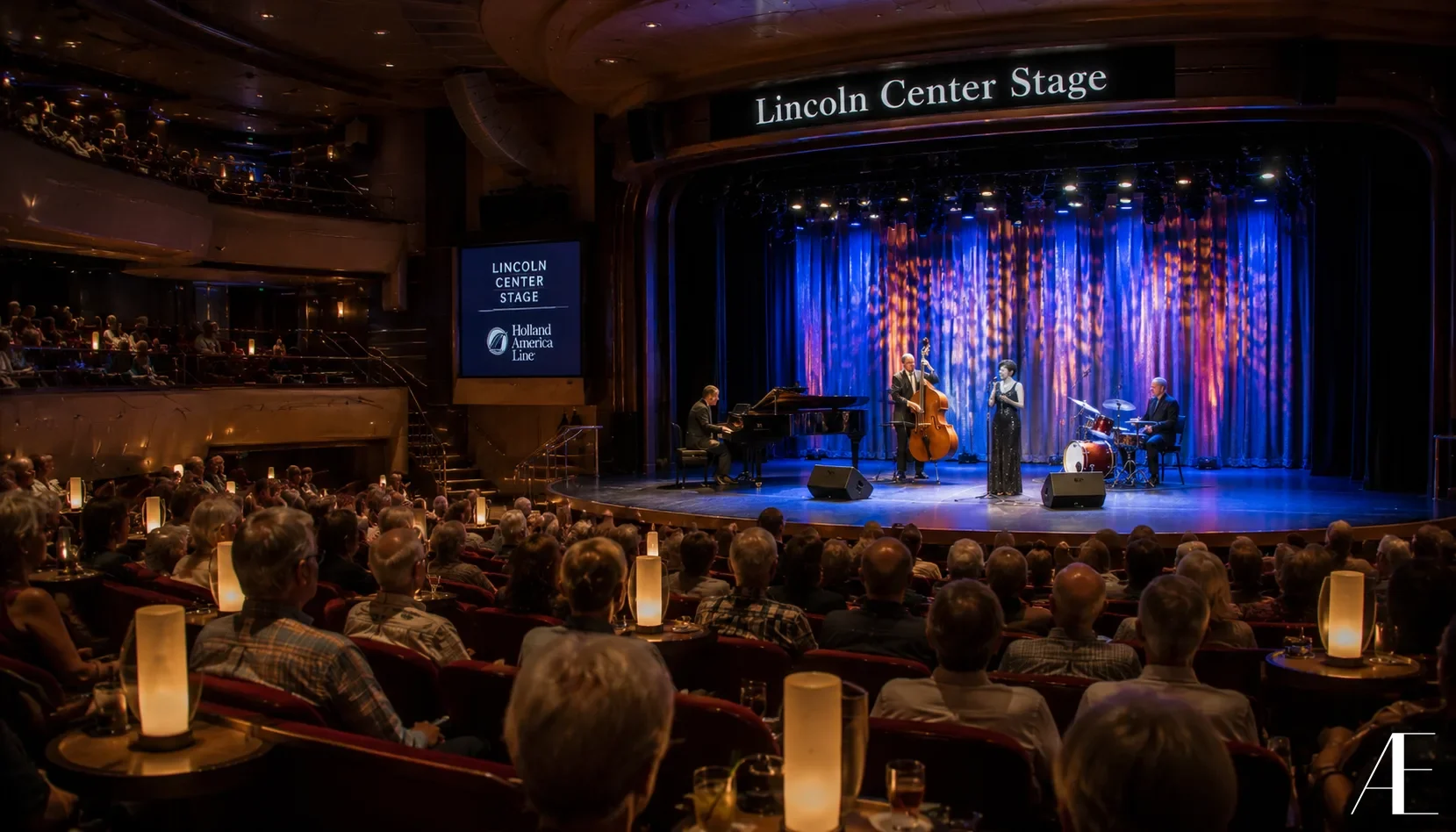
A dedicated recital hall designed in collaboration with Lincoln Center for the Performing Arts, the world's leading performing arts organisation based in New York City. The resident ensemble is a chamber music group of four to six classically trained professional musicians covering violin, viola, cello, piano and other instruments.
Performances occur daily, typically in both afternoon and evening slots. The repertoire rotates throughout the voyage and covers the classical and Romantic periods as the foundation, with contemporary and cross-genre works integrated. The quality of musicianship is genuinely impressive by any standard, and the contrast with the typical showband entertainment of mainstream cruising is immediate and striking.
This is the detail to lead with for clients who love music in any form, not just classical. The argument is not "you will enjoy classical music." It is: "every evening, there are professional musicians performing at a level you would pay to see ashore, and it is included."
The B.B. King's Blues Club
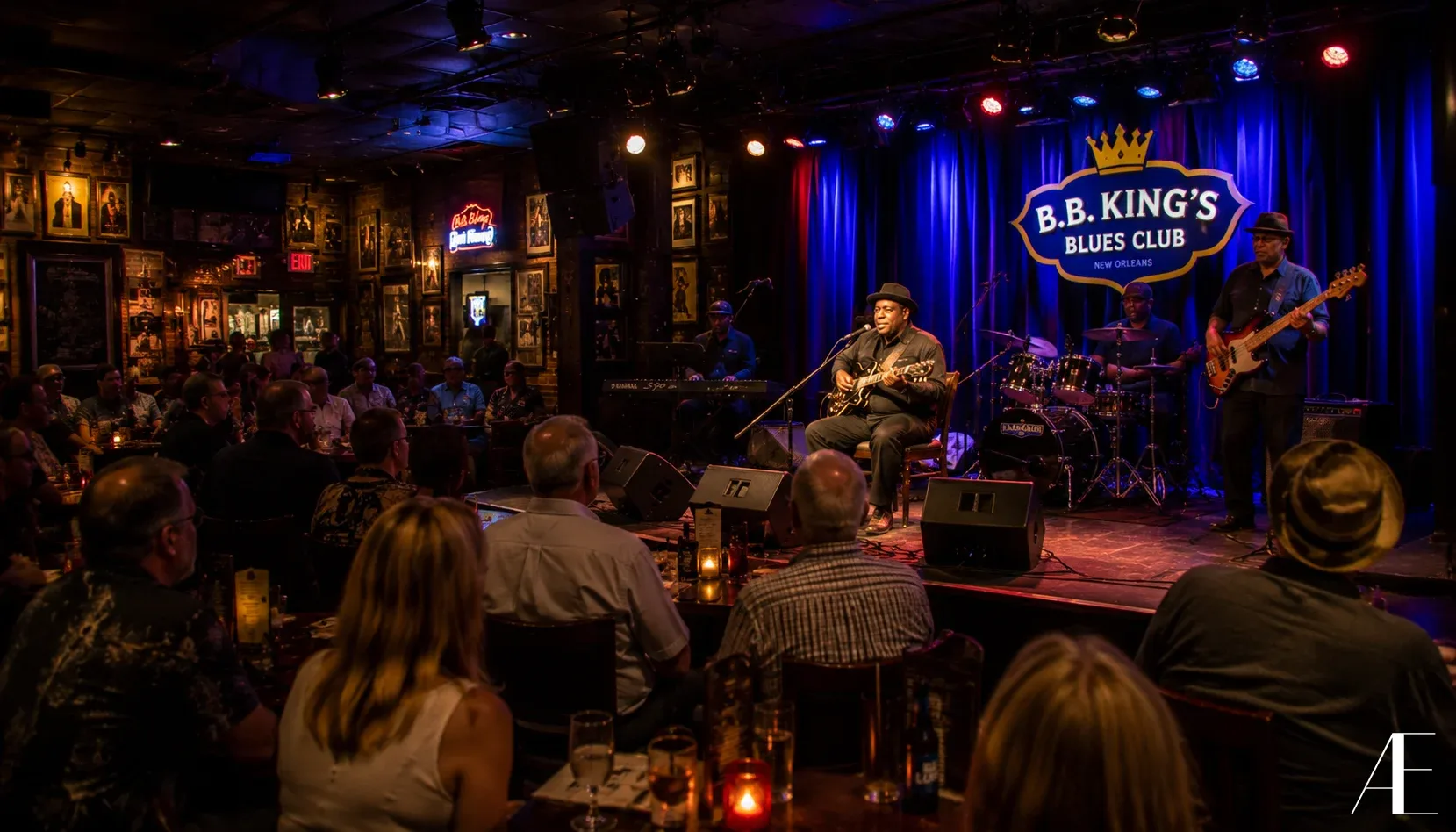
A licensed partnership with the BB King estate, operating with a full live band performing the blues catalogue nightly. The band performs two-hour sets covering blues standards, BB King's own catalogue and blues-adjacent territory including R&B and soul. The bar service is active and the atmosphere is the most convivial of the three Music Walk venues.
BB King's is available on Pinnacle-class ships as part of the Music Walk and also on Nieuw Amsterdam and several Vista-class ships independently.
The Rolling Stone Rock Room
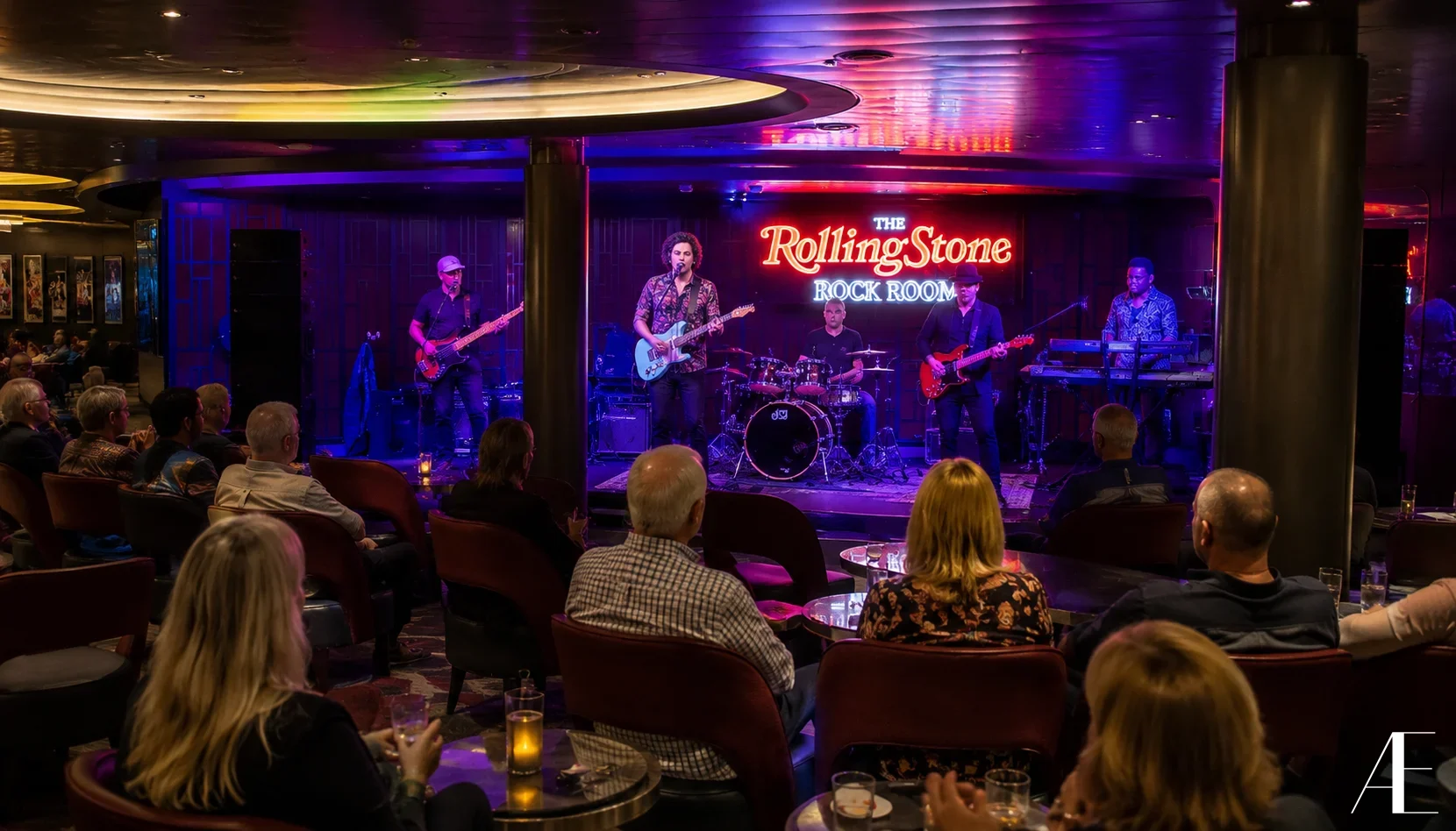
A live band covering rock music across multiple decades. On Nieuw Statendam, the Billboard onboard concept integrates pop music programming and DJ sets alongside the Rock Room's live band schedule.
Why this matters for sales
No other mainstream cruise line offers live music programming of comparable depth, quality and variety as a standard fleet-wide product. Royal Caribbean's entertainment budget goes to ice shows and production spectaculars. Norwegian's goes to Broadway licences. Holland America's investment is different: quieter, more personal, more sustainable across a long voyage. Clients who value live music as an evening activity — not a show to watch but an atmosphere to inhabit — will not find a better option in mainstream cruising.
Note: On Vista-class ships, the Music Walk does not exist in full form. BB King's Blues Club is present on most Vista ships, but without the three-venue configuration. Guests who prioritise the full Music Walk experience should book Pinnacle-class ships.
The Art Collection
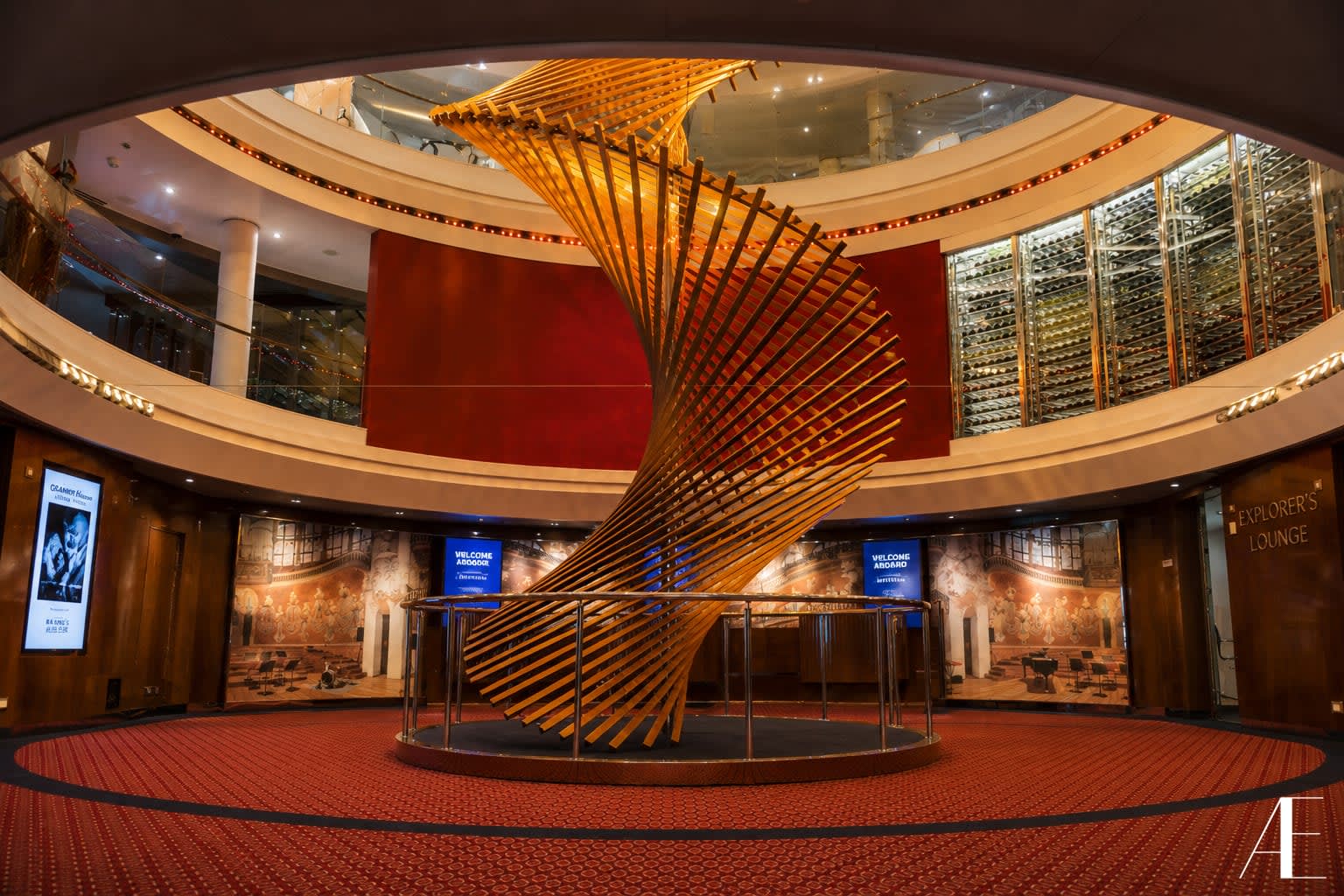
Holland America's fleet carries over 1,920 original works of art by artists from more than 150 countries. This is not corporate decoration bought in bulk from a hospitality supplier. The collection has been built and curated deliberately over decades by fleet historians with a formal acquisition and thematic programme.
Each ship's collection is themed to the ship's name and heritage. The Zuiderdam's collection centres on the art of the southern Netherlands; the Westerdam's on Dutch presence in the New World; the Koningsdam's on music and motion as visual concepts. Original sculpture, oil paintings, photography, textile art, glass, ceramics and site-specific installations are distributed across public spaces, corridors and dining venues. Walking the ship is genuinely a museum experience.
Onboard art talks — formal presentations by knowledgeable staff covering specific works or themes within the collection — are a standard part of the enrichment calendar on every sailing.
For clients with any interest in visual art, this is worth leading with. Most mainstream cruise guests do not expect to find a curated museum-quality art collection distributed across a ship. The surprise and delight this creates is significant.
The EXC Explorations Central
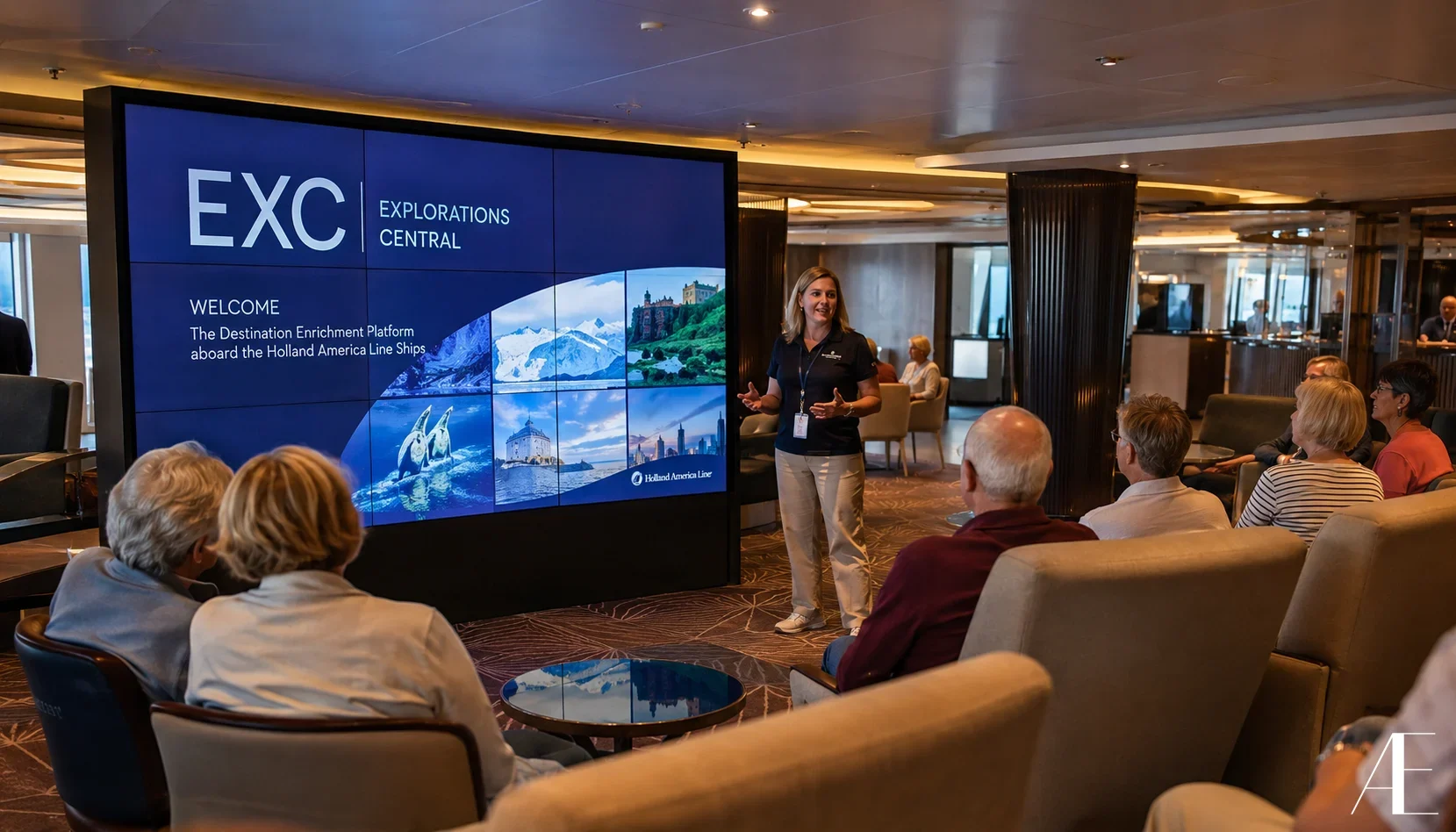
The EXC programme is Holland America's structured approach to destination education. It operates on every sailing and provides three distinct formats:
EXC Port Talks are daily destination briefings held before each port of call. These are not generic tourist-board presentations. They cover the specific history, cultural context, practical logistics and insider recommendations for each port on the current itinerary.
EXC Port Experts are destination specialists who sail on specific voyages where their expertise is directly applicable: an Alaska wildlife biologist on Inside Passage sailings, a historian of Dutch colonial art on a Northern Europe voyage, a specialist in Japanese cultural history on a trans-Pacific sailing. Port Experts offer scheduled deep-dive sessions and informal Q&A availability throughout the voyage.
On Location events are exclusive ashore experiences organised by Holland America at select ports: private museum access outside opening hours, cultural ceremonies not normally accessible to visitors, exclusive concert venues and destination dinners in private settings. On Location events carry an additional cost and are available to all guests. Flag these to clients at the point of sale on any sailing where they are offered.
The Greenhouse Spa and Salon
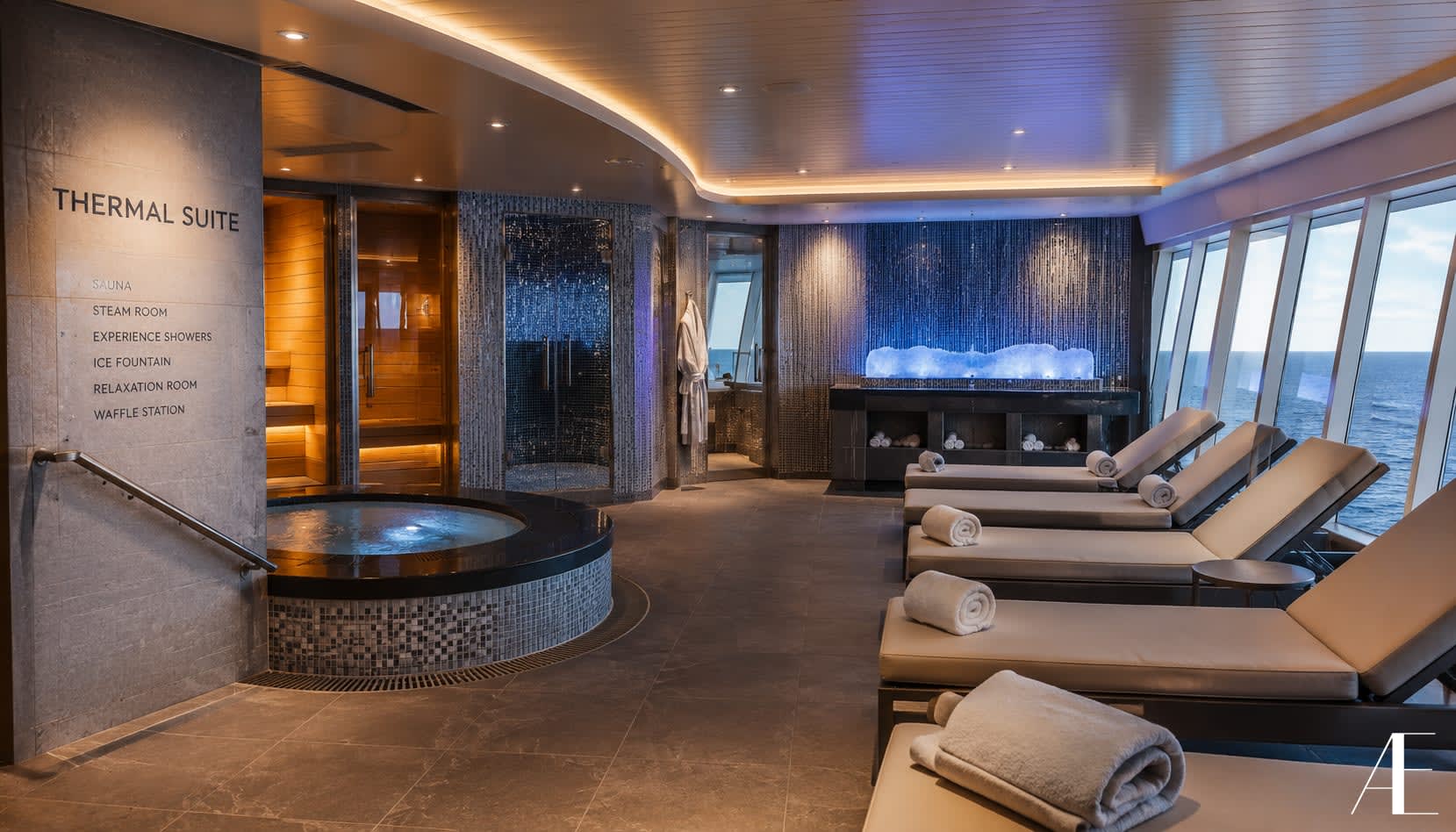
The Greenhouse Spa operates on all ships and offers a full menu of treatments including massages, facials, body wraps, hair and beauty services. The thermal suite: steam room, sauna, hydrotherapy pool and heated loungers, is available for a day or voyage pass. Spa Stateroom and Spa Suite guests receive direct corridor access to the spa and priority treatment booking.
The Club HAL: Children's Programming
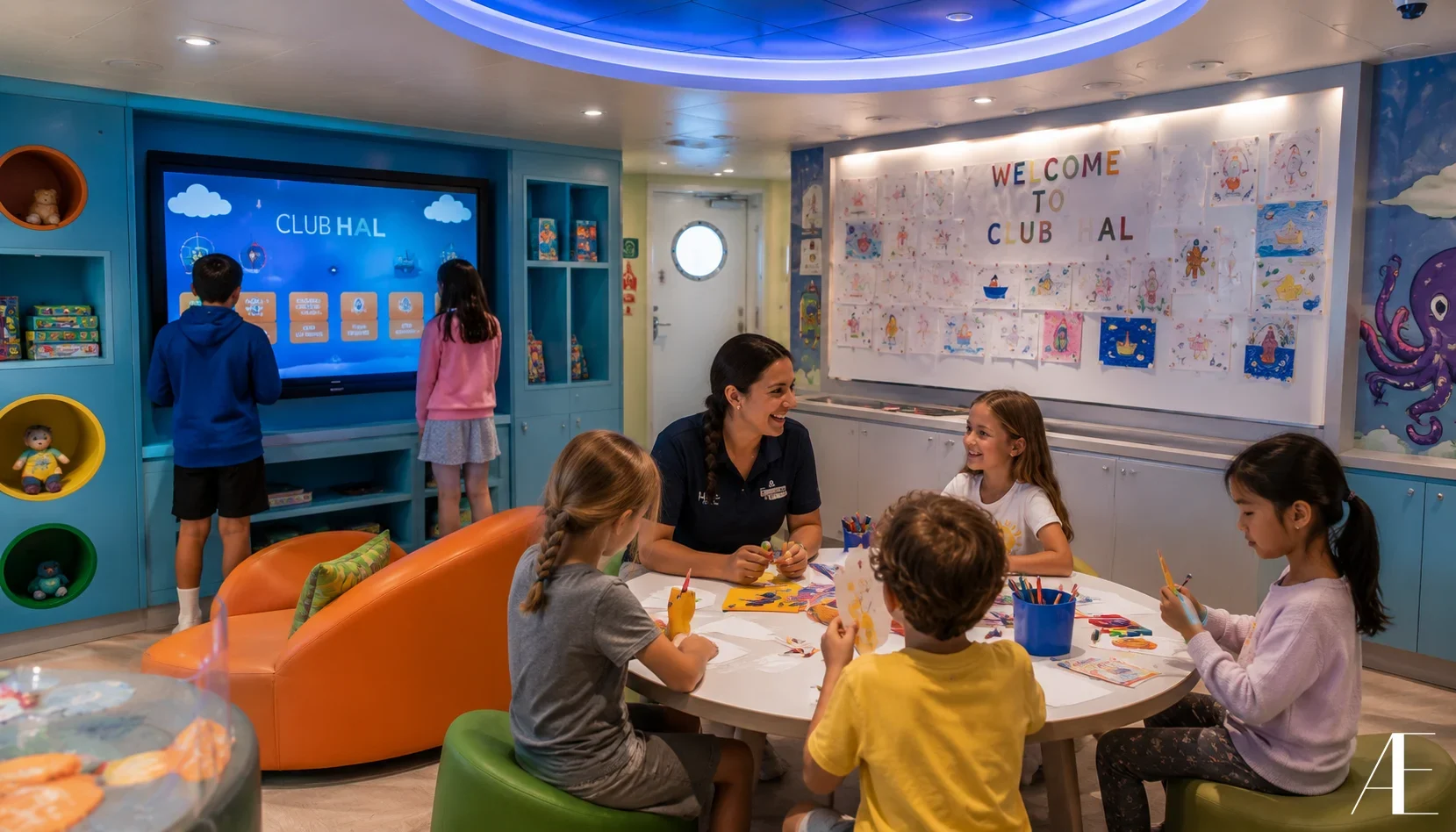
An honest assessment: Club HAL exists and is competently operated, but Holland America is not a children's cruise line. The programme provides age-grouped activities and supervised spaces for younger guests, but the depth of programming, dedicated spaces and onboard infrastructure are significantly below what Royal Caribbean, Disney or Norwegian offer. HAL does not pursue the family market as a primary demographic.
Where HAL works for families: multigenerational travel where the adults are the primary audience and teenagers or young adults simply join; families with older teenagers who share the adults' interest in music, art or enrichment; multigenerational Alaska cruisetours where the experience is primarily ashore.
What It Actually Feels Like Onboard
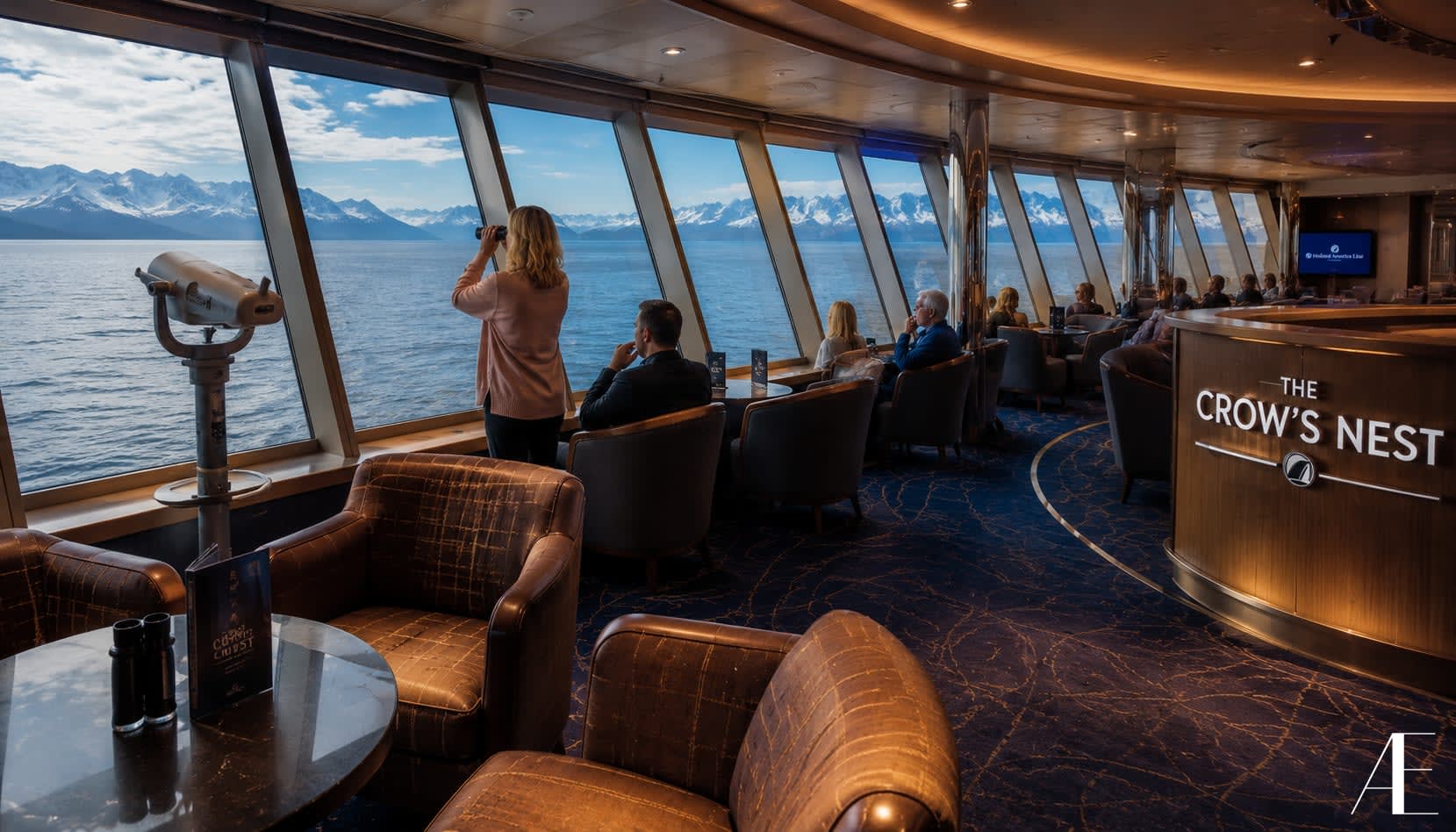
The most consistent client observation about Holland America, across all ship classes and all itineraries, is that the ship "feels calm." Not empty. Not boring. Calm. The public spaces are not congested. The entertainment is not relentlessly amplified. The Crow's Nest observation lounge at the bow of each ship. a forward-facing glass-enclosed lounge with panoramic views, is one of the finest viewing spaces in mainstream cruising, particularly on scenic itineraries.
This atmosphere is the product of deliberate choices: guest-to-crew ratios that allow attentive service, public space design that discourages bottlenecks, an entertainment programme that offers options rather than obligations, and a pricing model that has historically attracted a guest demographic that wants the same thing.
When selling HAL, sell the atmosphere as explicitly as you sell the Music Walk or the Denali Lodge. It is why clients return.
The Itineraries and Destinations
Holland America sails to all seven continents and operates one of the most geographically diverse itinerary programmes in mainstream cruising. Understanding the portfolio by region allows agents to match clients to the right programme and to connect HAL's specific strengths to each itinerary type.
Alaska : The Brand-Defining Programme
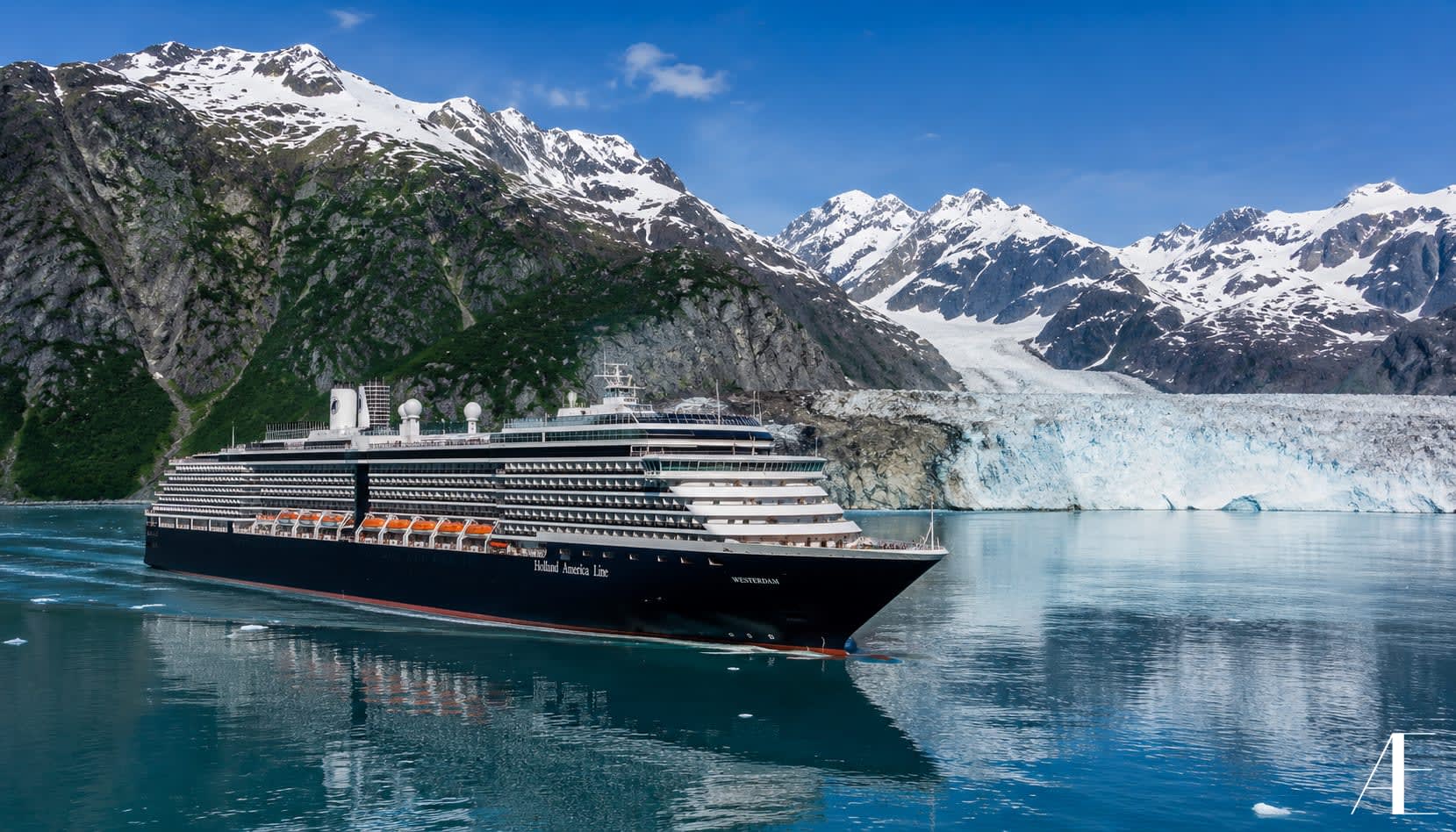
Alaska is the most important single destination in Holland America's portfolio and deserves the full treatment in the following section. The essentials here: HAL has sailed Alaska for nearly 80 years, operates more ships in the region than any other premium mainstream line, and pairs the ocean programme with proprietary land infrastructure including the Holland America Denali Lodge and the McKinley Explorer rail cars. Seven ships operate in Alaska for the 2026 season, with departures from Seattle, Vancouver and San Francisco.
Caribbean
Year-round Caribbean sailing from Fort Lauderdale, Tampa, San Diego and New Orleans. Eastern Caribbean itineraries centre on St. Maarten, Puerto Rico, Grand Turk and the Dominican Republic. Western Caribbean includes Belize, Honduras, the Cayman Islands and Jamaica. Southern Caribbean sailings reach Aruba, Curaçao, Bonaire and Trinidad.
HAL's Caribbean product is solid but not its strongest differentiated offering. That said, the culinary programme and the Music Walk elevate the Caribbean experience meaningfully above comparable lines at the same price.
For Canadian clients considering a winter escape: HAL's Caribbean from Fort Lauderdale positions well as a fly-cruise from Montreal, Toronto or Vancouver. The 7-day Caribbean at competitive base-fare pricing with Have It All is a straightforward package to build.
Mediterranean
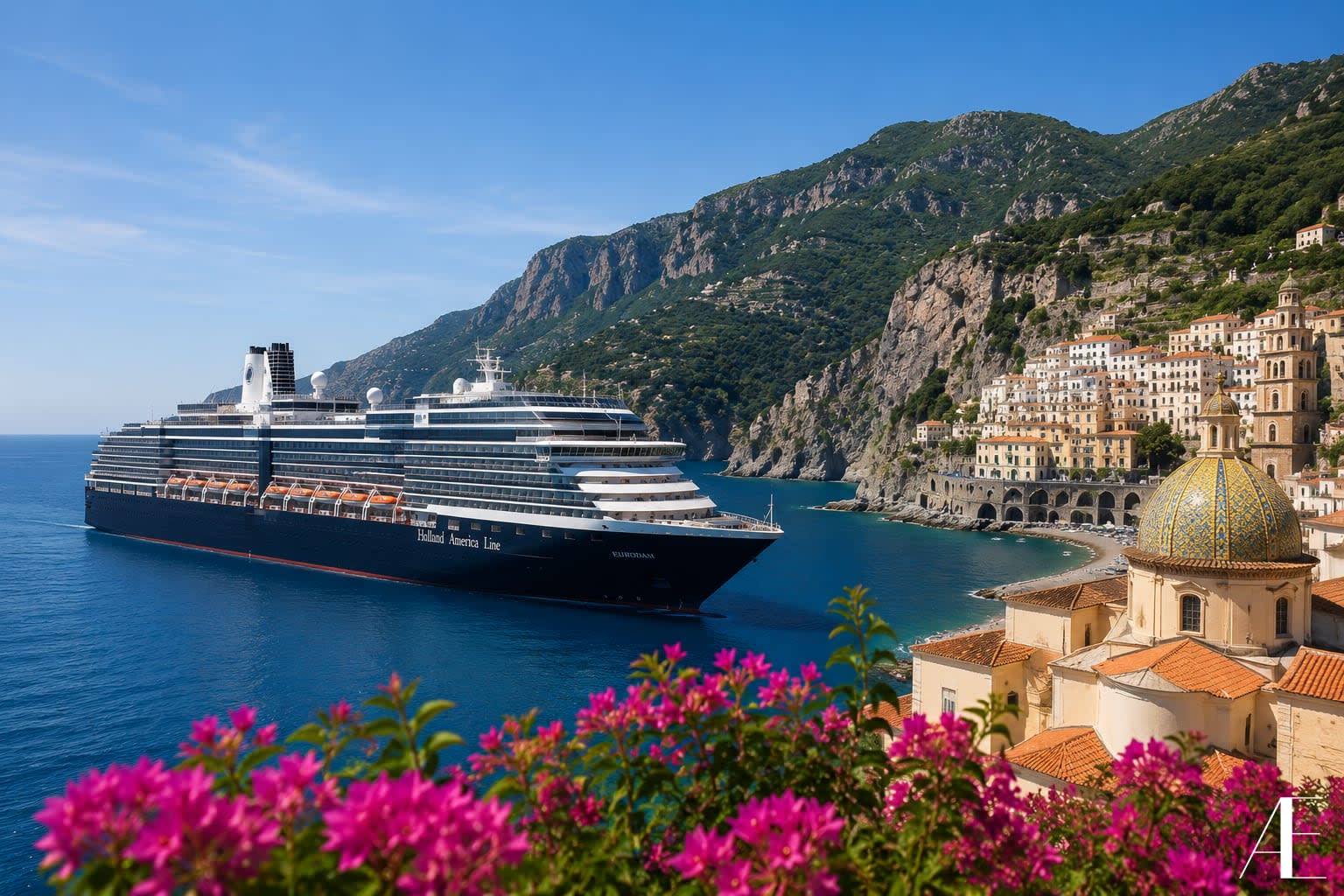
Spring through autumn deployment with itineraries centred on Western Mediterranean (Barcelona, Rome, Florence/Livorno, Monte Carlo, Marseille, Lisbon), Eastern Mediterranean (Athens, Dubrovnik, Kotor, Santorini, Crete) and Grand Mediterranean combinations.
HAL's Mediterranean positioning is competitive but not uniquely differentiated from lines like Celebrity, Princess or MSC at the upper tier. The music and culinary arguments remain strong. The art collection, with its European and Dutch heritage themes, is more resonant in European waters. The EXC Port Expert programme includes historians whose knowledge of Mediterranean history is particularly well-deployed on these itineraries.
Northern Europe and the British Isles
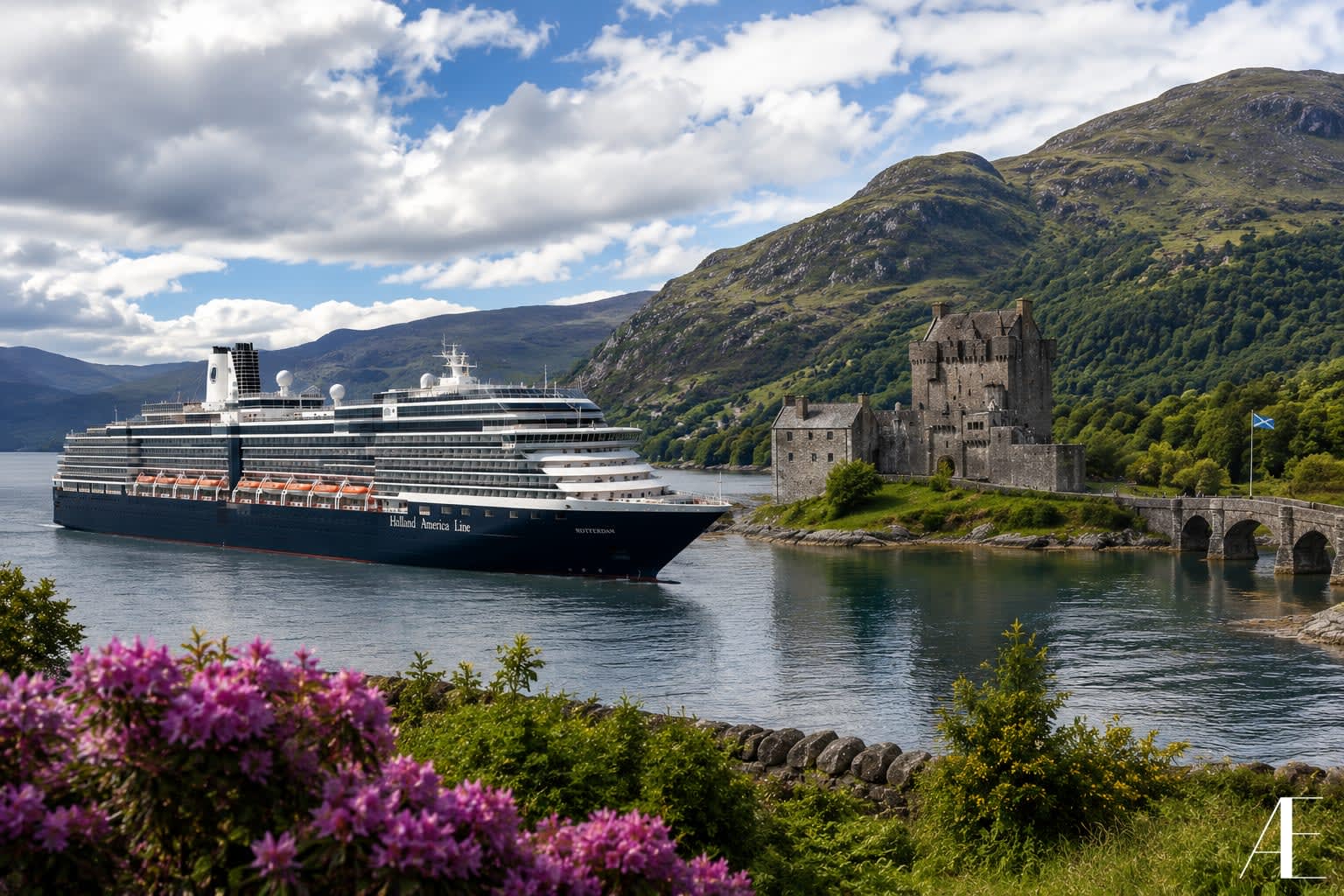
Holland America has a long and coherent Northern Europe programme covering the Norwegian fjords, Iceland, the British Isles, the Baltic capitals and the Arctic. The Dutch heritage connection makes Northern Europe itineraries particularly resonant.
British Isles itineraries include Edinburgh (Leith/Rosyth), Liverpool, Cobh (Cork), Dublin, Belfast and southern England ports including Southampton and Portsmouth. These are popular with Canadian clients of British and Irish ancestry and pair well with a pre-cruise extension in London.
Norwegian fjords itineraries are among the most scenically dramatic in the HAL portfolio and represent excellent Verandah cabin selling: the fjord landscape is best experienced from a private balcony as the ship navigates through narrow passages. The daylight hours in the Norwegian summer — 20-plus hours of light in some ports — are worth explaining to clients who have not travelled at this latitude.
Grand Voyages and Legendary Voyages
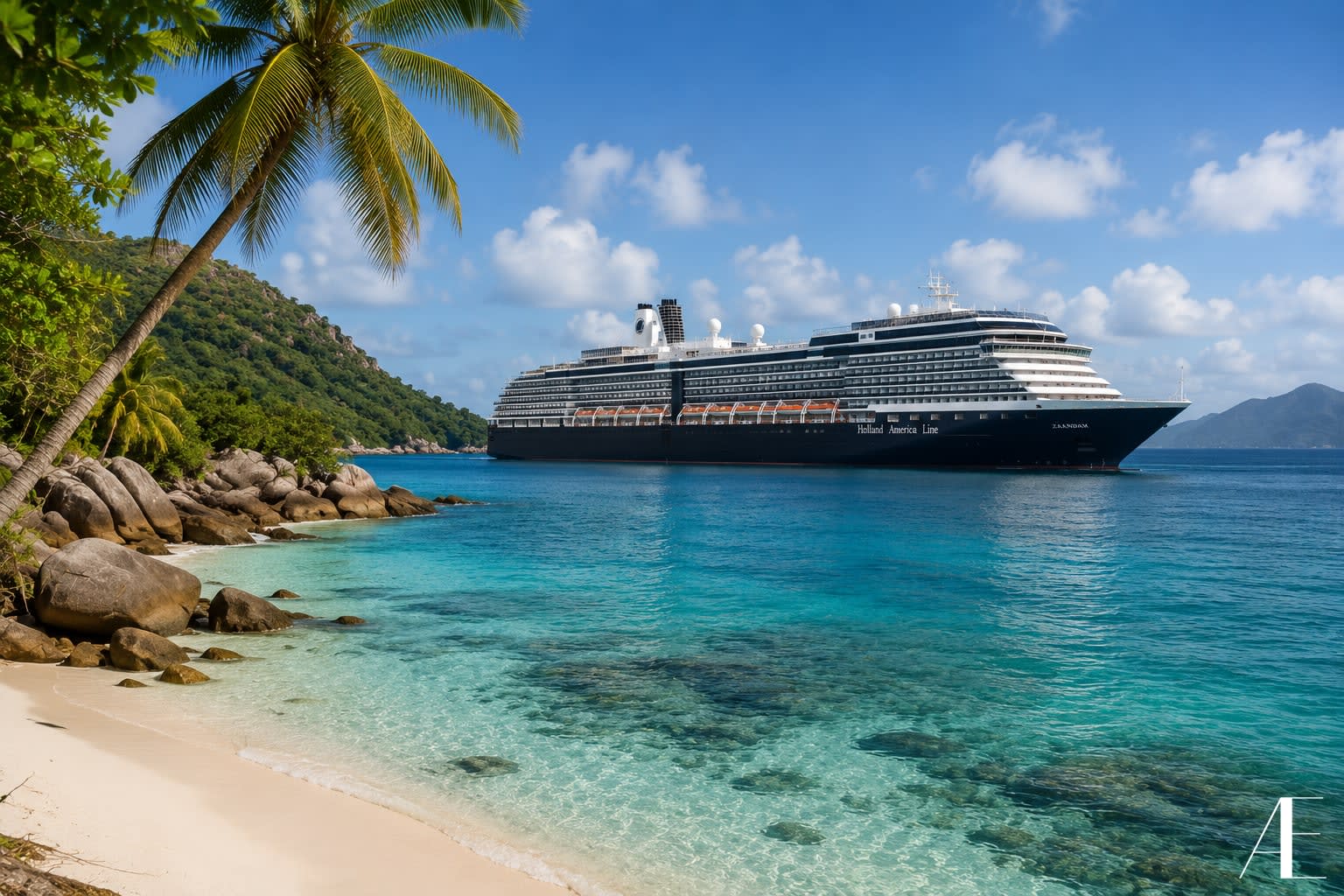
Holland America's extended voyage programme is one of the most developed in the industry. Legendary Voyages run from approximately 30 to 60 days, linking multiple regions in single continuous sailings. Grand Voyages extend to 100 days or more, including the annual Grand World Voyage of approximately 128 days.
The Grand World Voyage is Holland America's flagship product: a single circumnavigation departing Fort Lauderdale in January each year, calling at Caribbean, South American, Pacific, Asian, Indian Ocean, African and European ports over four-plus months. The Music Walk, the art collection and the EXC programme are at their most valuable on these extended sailings, because sea days are numerous and onboard quality becomes the primary product rather than the secondary one.
Agents who identify a client considering a Grand Voyage should understand that this is a specialised sale. Pricing is per-day rather than per-voyage and the booking infrastructure involves different terms than shorter sailings.
Other Regions
| Region | Notes |
|---|---|
| Canada and New England | Fall foliage itineraries from New York or Boston. Strong Canadian market relevance; select sailings embark or disembark in Montreal or Quebec City. |
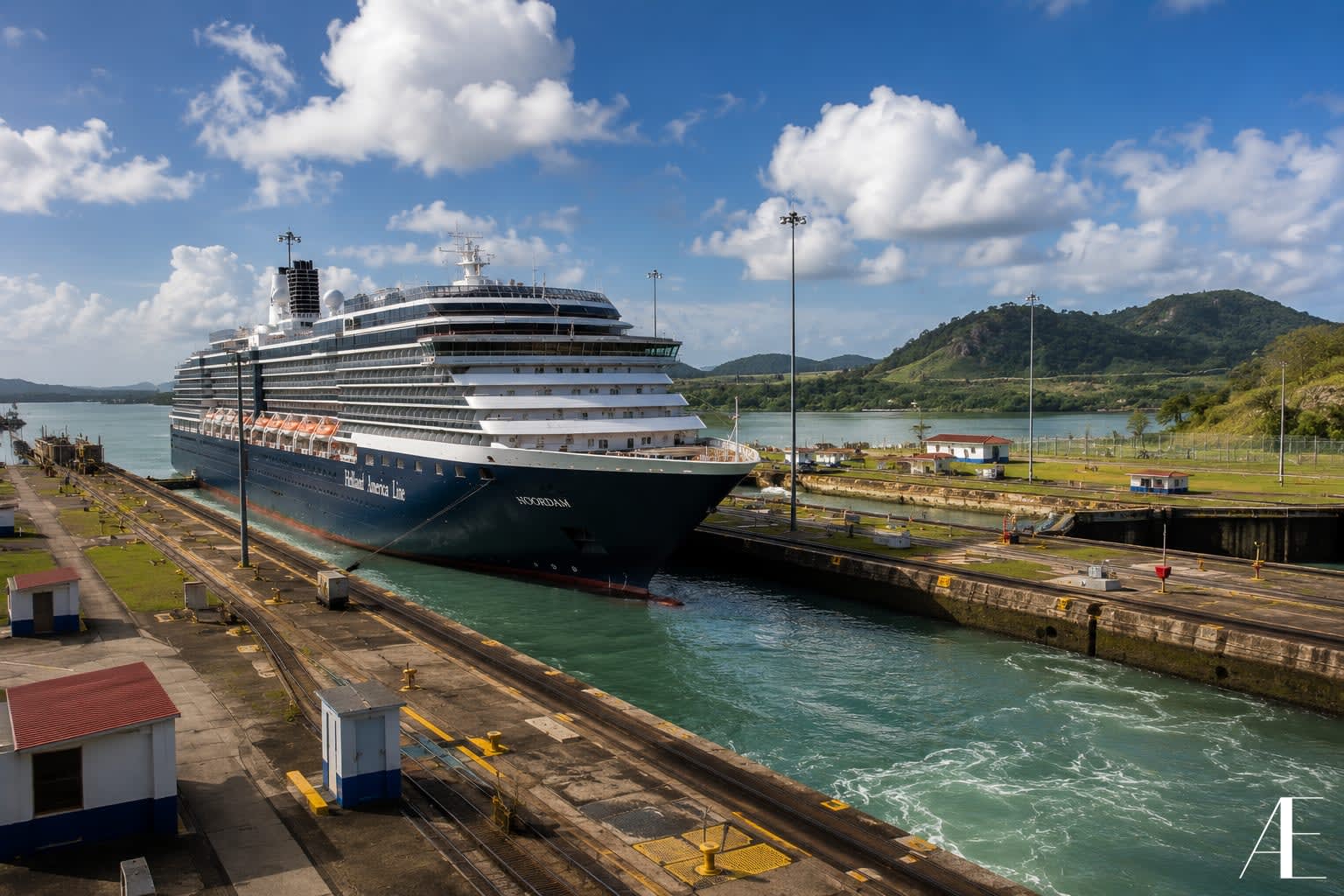
| Panama Canal | Full transit and partial transit itineraries, typically in shoulder season. Often sold as repositioning sailings with strong value pricing. |
| South America | South American summer sailings including Buenos Aires, Montevideo, Rio de Janeiro and circumnavigations of South America. |
| Asia | Late winter and spring deployment including Japan cherry blossom season, Southeast Asia and trans-Pacific repositioning sailings. |
| Australia and New Zealand | Late-year southern hemisphere summer deployment, often connected with Pacific Island itineraries. |
| Central America | Year-round from San Diego and Fort Lauderdale, covering Costa Rica, Panama, Belize and the Mexican Pacific coast. |
The Alaska Deep Dive
Alaska is not just a Holland America itinerary. It is the product through which the brand has built its identity for nearly eight decades, and it is the area where HAL has more depth, more infrastructure and more specialist knowledge than any other cruise line operating in the region. For agents in Canadian markets, Alaska is the single most important HAL product to understand thoroughly.
Nearly 80 Years of Continuous Alaska Operation
Holland America began Alaska sailings in the late 1940s, making it the longest continuously operating cruise line in the region by a substantial margin. The relationships built over eight decades with Alaska port communities, wildlife organisations, the National Park Service, the Alaska Railroad and the state tourism infrastructure are genuine and specific. HAL has a depth of local knowledge and operational partnership that newer entrants to the Alaska market cannot replicate regardless of their ship count.
The practical result: HAL consistently offers shore excursions, On Location events and ranger-led programmes in Alaska that other lines cannot access. The Denali concession, in particular, involves a long-standing relationship with the National Park Service that took decades to establish and cannot be duplicated by a competitor entering the market.
Alaska Itinerary Types
7-Day Inside Passage
The most popular Alaska itinerary in the HAL portfolio. Typically round-trip from Seattle or Vancouver, or one-way between the two, calling at Juneau, Skagway, Glacier Bay National Park and Ketchikan. The Glacier Bay day is the centrepiece: the ship spends a full day navigating into the Bay with a National Park Service ranger onboard providing commentary. Ships deployed for 2026: Koningsdam, Nieuw Amsterdam, Westerdam, Zuiderdam.
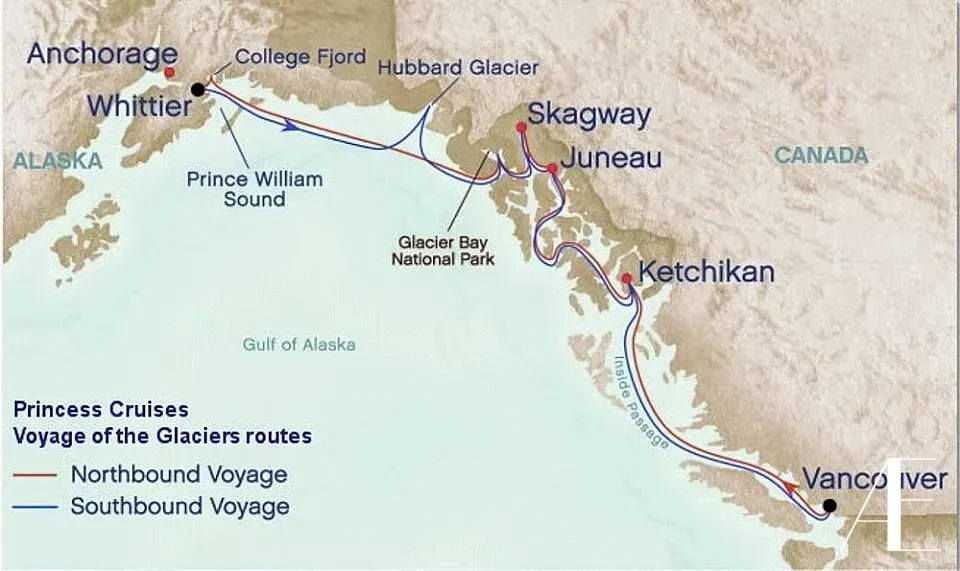
Voyage of the Glaciers
A variant of the 7-day programme that adds Hubbard Glacier — the largest tidewater glacier in North America — to the itinerary. One-way sailings connecting Anchorage (Seward) and Vancouver or Seattle. The Hubbard Glacier is particularly dramatic for calving: large sections of ice regularly break from the glacier face into the sea, creating a visual and auditory experience clients describe as among the most powerful of any destination.
Glacier Bay Guarantee
Holland America guarantees a Glacier Bay viewing day on relevant Alaska itineraries. HAL holds one of a limited number of concessions from the National Park Service allowing cruise ships to enter Glacier Bay, and the operating protocols require a dedicated day within the Bay rather than a brief transit.
The Holland America Denali Lodge
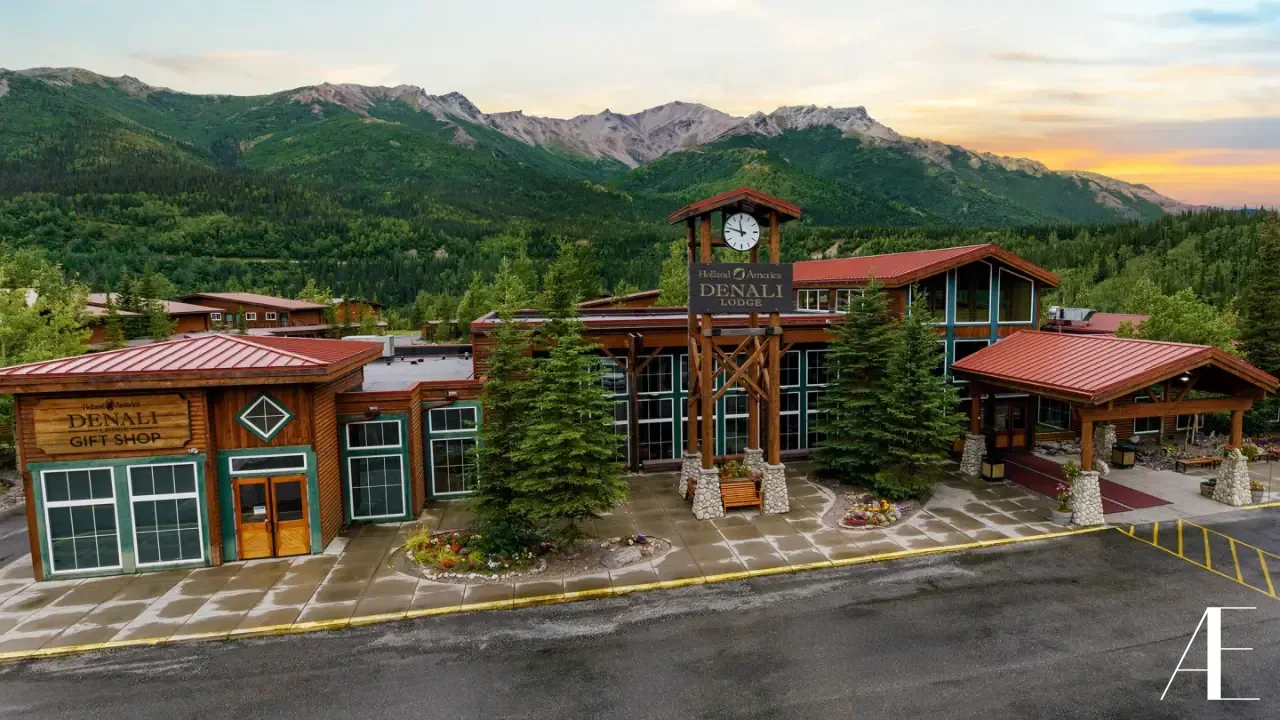
The Denali Lodge is the anchor of the Alaska land programme and the physical asset that no competitor can replicate. Located at the entrance to Denali National Park, the lodge provides panoramic views of the Alaska Range and direct wildlife access from the property. Moose, caribou, grizzly bears, wolves and Dall sheep are regularly visible from the lodge grounds.
The lodge was formerly known as McKinley Chalet Resort and was rebranded as Holland America Denali Lodge in 2024 as part of a significant repositioning and investment programme. A USD $70 million multi-year renovation is underway through 2027:
- 2026 improvements: 48 remodelled guest rooms, a new coffee shop and a remodelled Karstens Public House with expanded indoor and outdoor seating
- 2027 completion: a new 120-room guest building and a new restaurant concept
The lodge is not simply a hotel at the end of a cruise. It is a fully programmed destination with naturalist guides, interpretive hikes, wildlife viewing expeditions and cultural programming related to the Denali region and Athabascan culture.
The McKinley Explorer Glass-Dome Rail

The McKinley Explorer is Holland America's fleet of glass-dome rail cars that transfer guests between the ship at Seward or Anchorage and the Denali Lodge in a single seamless day. The rail journey runs through the Alaska Range, crossing rivers, glacial valleys and boreal forest on the Alaska Railroad with unobstructed panoramic views from the dome seating.
The glass-dome format matters: the dome seating provides 270-degree viewing above the train body, allowing guests to see both sides of the landscape and the sky simultaneously. Moose, bears, Dall sheep and bald eagles are regularly visible from the rail cars.
Agents should frame the rail transfer as an experience rather than a logistics step. The McKinley Explorer day is frequently cited by HAL Alaska guests as one of the best days of the entire cruisetour.
White Pass and Yukon Route Railroad

Selected Alaska itineraries include an excursion on the White Pass and Yukon Route narrow-gauge railroad from Skagway. The route climbs from sea level to the 2,865-foot White Pass Summit in under 28 miles, following the same path used by Klondike Gold Rush prospectors in 1898. The engineering achievement is genuinely impressive, and the views over the Lynn Canal and coastal mountains are exceptional.
The White Pass is one of the most historically resonant excursions in Alaska, directly connecting the Skagway port day to the Gold Rush narrative that shaped the entire region.
The Alaska, Denali and Yukon Cruisetour
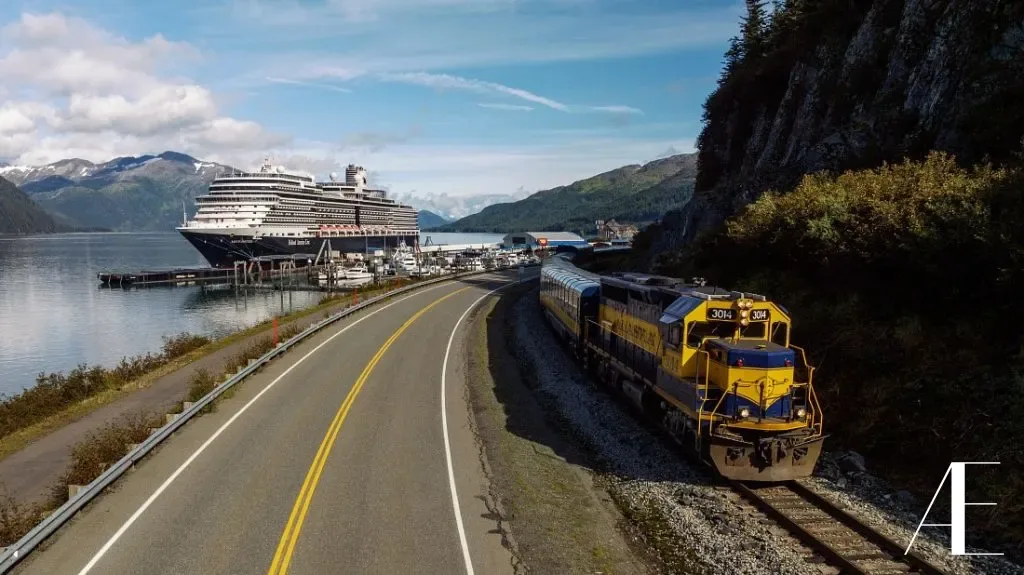
Launched for the 2026 season, this is the most ambitious land programme in the HAL Alaska portfolio. The 13-day itinerary begins with a flight from Anchorage to Fairbanks, then adds a flight to Dawson City in the Yukon, followed by a land journey to Denali before boarding a 7-day cruise.
Three complimentary tours are included in the programme price:
- Riverboat Discovery in Fairbanks: a multi-deck sternwheeler tour of the Chena and Tanana rivers with Athabascan cultural demonstrations
- Klondike Gold Tour in Dawson City: covering the 1898 gold rush sites, the historic downtown and the Dredge No. 4 National Historic Site
- Tundra Wilderness Tour in Denali: a full day's interpretive bus tour into the national park, the only wheeled vehicle access into the park interior
This programme should be presented to any client who asks about Alaska and indicates they want more than a cruise alone. The combination of Fairbanks, the Yukon and Denali with a 7-day glacier cruise creates an Alaska experience that addresses every dimension of the destination: gold rush history, indigenous culture, arctic wildlife, wilderness landscape and coastal scenery. No other cruise line currently offers an equivalent.
The Great Bear Rainforest Itinerary
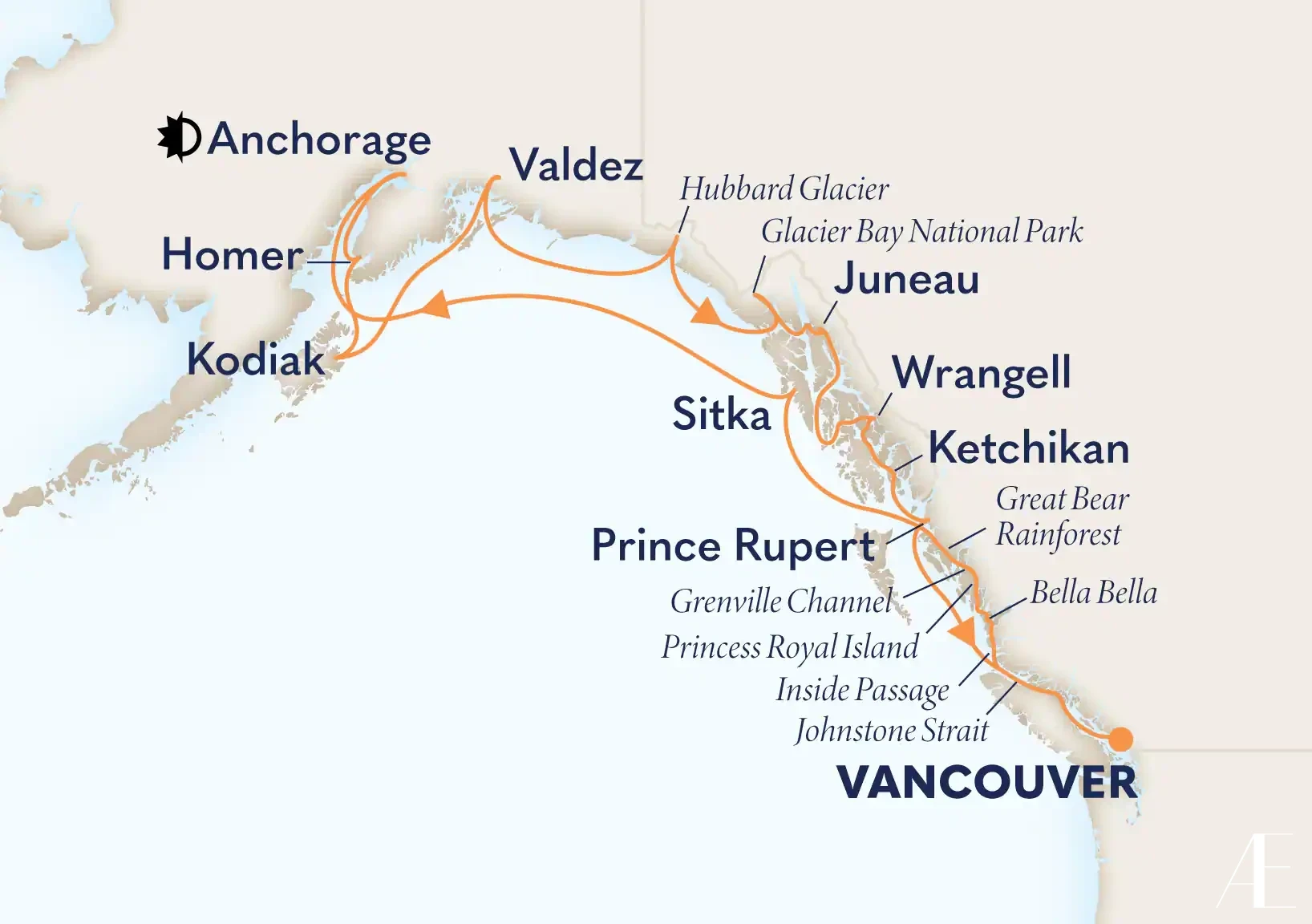
Zaandam operates an 18-day Great Bear Rainforest and Alaskan Explorer itinerary in 2026, focused on the remote ecosystems of northern British Columbia and southeast Alaska. The Great Bear Rainforest is one of the last intact temperate rainforests on earth, covering 6.4 million hectares of the BC coast. It is home to the Spirit Bear, a rare white phase of the black bear found only in this region — the rarest bear subspecies in the world.
Zaandam's small size (1,432 guests) is essential to this programme: the ports and anchorages in the Great Bear Rainforest cannot accommodate larger vessels. The intimacy of the ship is a feature rather than a limitation.
The Mariner Society Guide
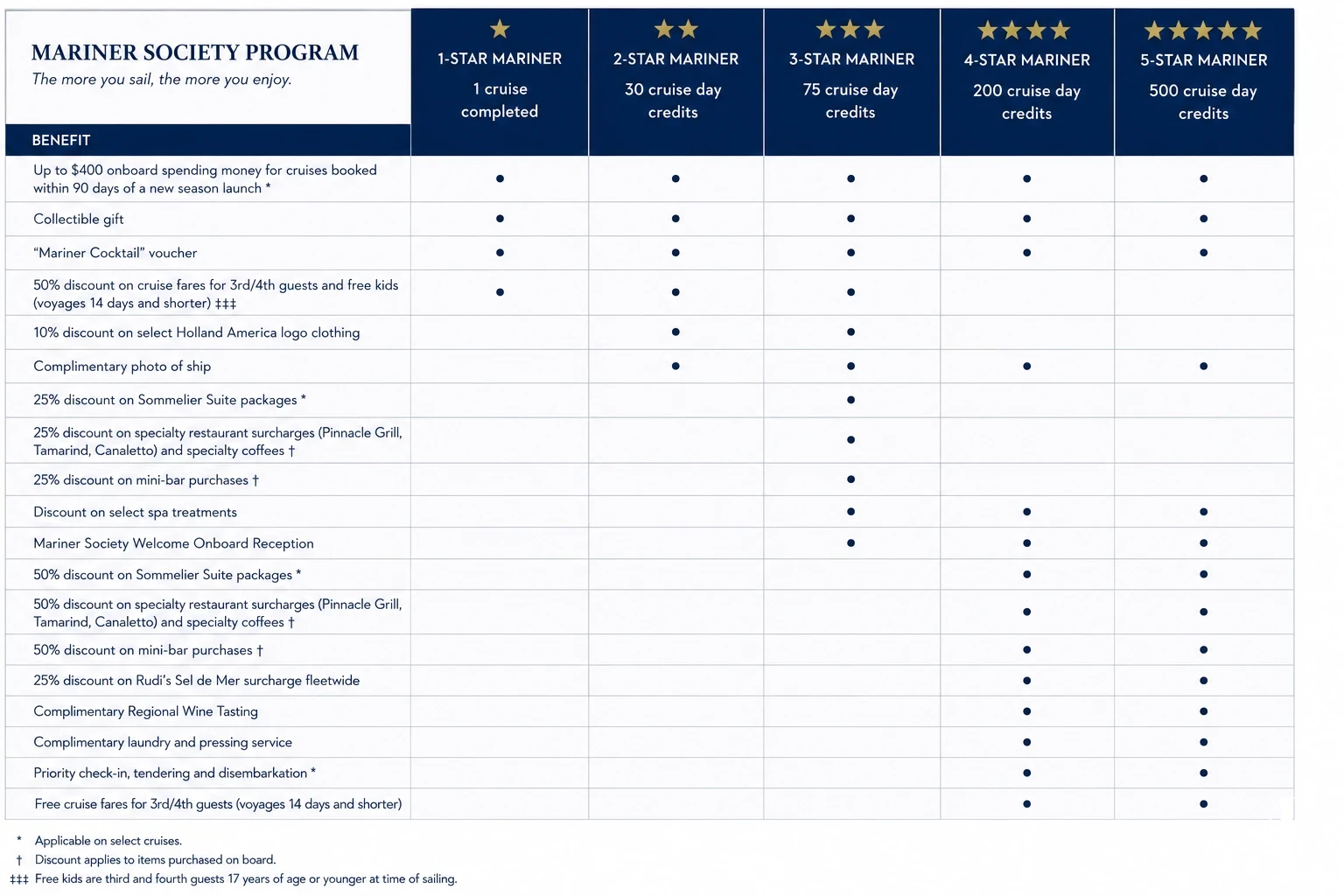
The Mariner Society is Holland America's guest loyalty programme, operating across four tiers based on days sailed. For agents, understanding the programme serves two purposes: identifying returning guests who may have specific tier benefits that affect their booking, and using loyalty benefits as a closing tool for fence-sitting clients comparing HAL to competitors.
Tier Structure
Key Benefit Details
Early booking bonuses: When select sailings open for sale, Mariner Society members receive advance notification and onboard credit bonuses for booking within the early window. These can reach USD $400 per stateroom at the 4-Star level and can stack with other promotional offers in certain cases. For agents with Mariner Society client databases, monitoring new sailing releases and notifying relevant clients is a genuine service differentiator.
Priority boarding and disembarkation: Neptune Suite guests and upper-tier Mariner Society members receive coordinated priority handling. On busy embarkation days at Seattle, Fort Lauderdale or Vancouver, the time savings can be significant.
Onboard Mariner Society events: Exclusive cocktail parties and events hosted by the Captain or Hotel Director, restricted to loyalty members. These have genuine social value for guests who cruise frequently and provide a sense of community that long-voyage guests particularly appreciate.
How HAL Loyalty Compares to Competitors
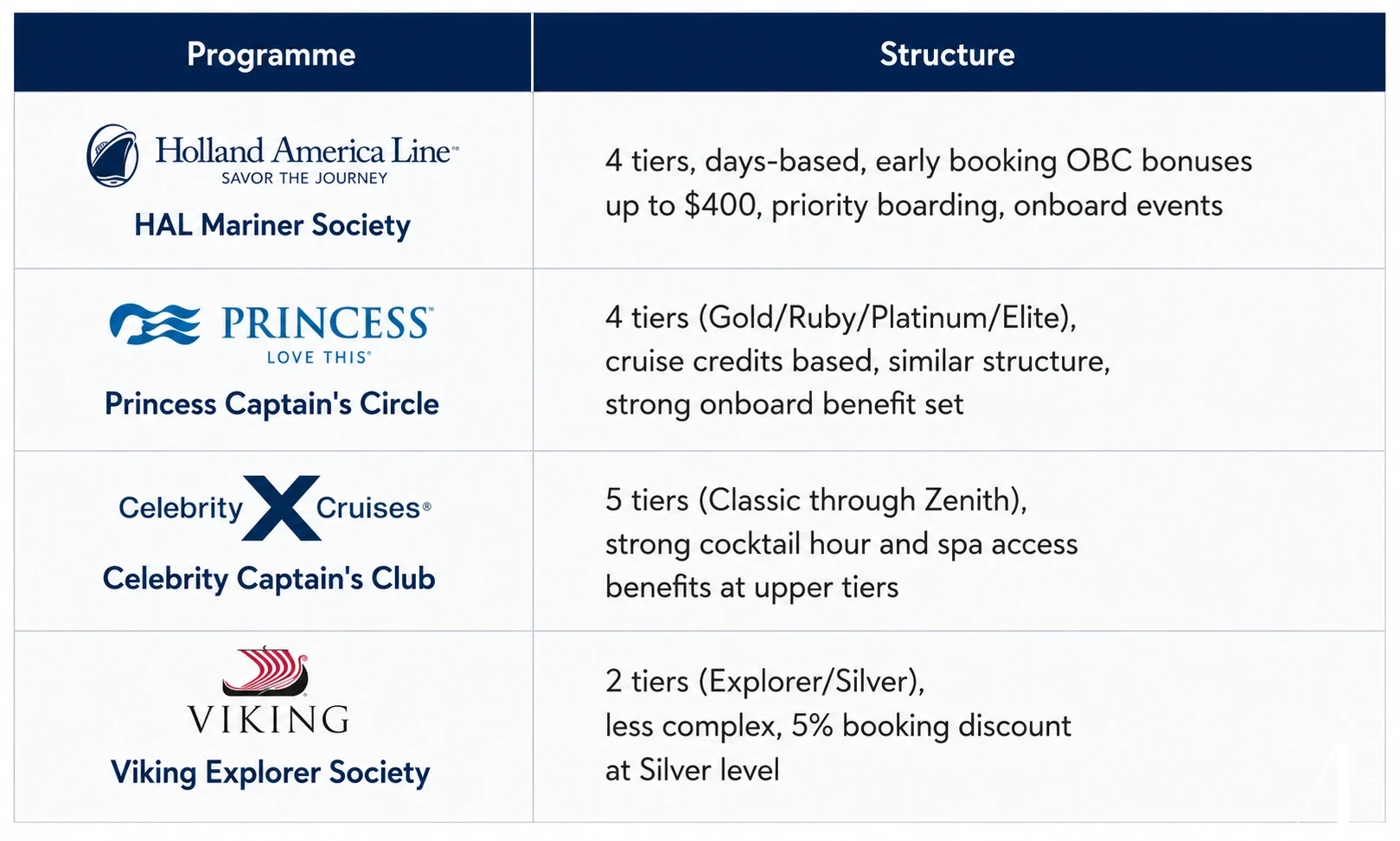
For clients who already have Mariner Society status, remind them at booking. For clients considering their first HAL sailing, frame the programme as an ongoing relationship: every day sailed builds toward the next tier, and the early booking bonuses at upper tiers have genuine monetary value.
The Differents Clients
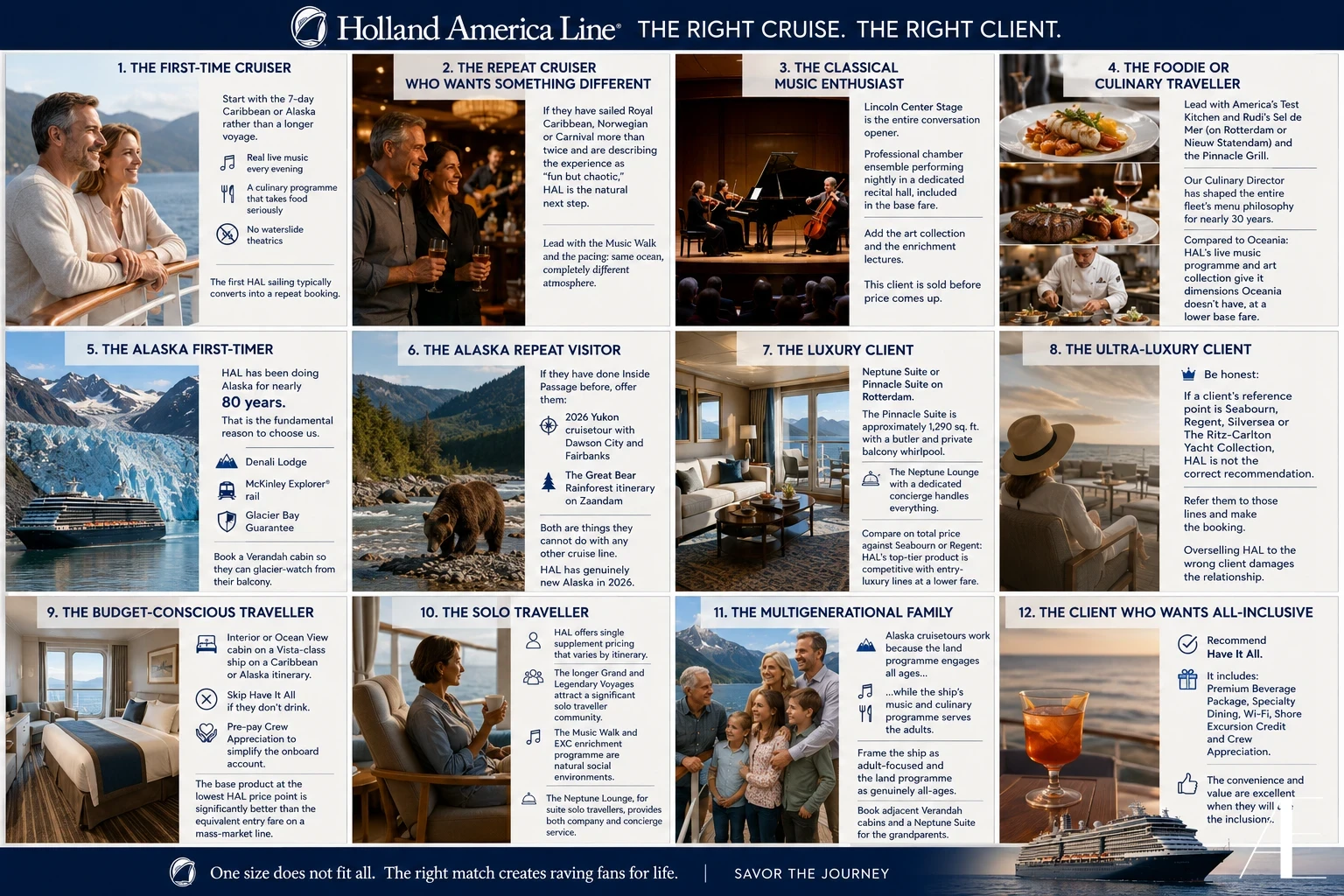
For each client type below: is HAL the right recommendation, and how do you pitch it? These are 2-3 sentence selling frameworks, not extended descriptions. Use them mid-call.
The first-time cruiser
Start with the 7-day Caribbean or Alaska rather than a longer voyage. Frame HAL as a genuinely grown-up introduction to cruising: real live music every evening, a culinary programme that takes food seriously, and no waterslide theatrics to navigate around. The first HAL sailing typically converts into a repeat booking.
The repeat cruiser who wants something different
If they have sailed Royal Caribbean, Norwegian or Carnival more than twice and are describing the experience as "fun but chaotic," HAL is the natural next step. Lead with the Music Walk and the pacing: same ocean, completely different atmosphere.
The classical music enthusiast
Lincoln Center Stage is the entire conversation opener. Tell them what it is specifically — a professional chamber ensemble performing nightly in a dedicated recital hall, included in the base fare — and let the concept do the work. Add the art collection and the enrichment lectures. This client is sold before price comes up.
The foodie or culinary traveller
Lead with America's Test Kitchen and Rudi's Sel de Mer (on Rotterdam or Nieuw Statendam) and the Pinnacle Grill. Explain that the culinary director has shaped the entire fleet's menu philosophy for nearly 30 years. Compare directly with Oceania if they raise it: HAL's live music programme and art collection give it dimensions Oceania doesn't have, at a lower base fare.
The Alaska first-timer
HAL has been doing Alaska for nearly 80 years. That is not a fact to mention in passing; it is the fundamental reason to choose it. The Denali Lodge, the McKinley Explorer rail and the Glacier Bay guarantee are three things no other line offers in combination. Book a Verandah cabin so they can glacier-watch from their balcony.
The Alaska repeat visitor
If they have done Inside Passage before, offer them the 2026 Yukon cruisetour with Dawson City and Fairbanks, or the Great Bear Rainforest itinerary on Zaandam. Both are things they cannot do with any other cruise line. HAL has genuinely new Alaska in 2026.
The luxury client
Neptune Suite or Pinnacle Suite on Rotterdam. The Pinnacle Suite is approximately 1,290 square feet with a butler and private balcony whirlpool. The Neptune Lounge with a dedicated concierge handles everything. Compare on total price against Seabourn or Regent: HAL's top-tier product is competitive with entry-luxury lines at a lower fare.
The ultra-luxury client
Be honest: if a client's reference point is Seabourn, Regent, Silversea or The Ritz-Carlton Yacht Collection, HAL is not the correct recommendation. Refer them to those lines and make the booking. Overselling HAL to the wrong client damages the relationship.
The budget-conscious traveller
Interior or Ocean View cabin on a Vista-class ship on a Caribbean or Alaska itinerary. Skip Have It All if they do not drink. Pre-pay Crew Appreciation to simplify the onboard account. The base product at the lowest HAL price point is significantly better than the equivalent entry fare on a mass-market line.
The solo traveller
HAL offers single supplement pricing that varies by itinerary. The longer Grand and Legendary Voyages attract a significant solo traveller community with established social customs. The Music Walk and EXC enrichment programme are natural social environments for solo guests. The Neptune Lounge, for suite solo travellers, provides both company and concierge service.
The multigenerational family
Alaska cruisetours work because the land programme engages all ages while the ship's music and culinary programme serves the adults. Frame the ship as adult-focused and the land programme as genuinely all-ages. Book adjacent Verandah cabins and a Neptune Suite for the grandparents.
The client who wants all-inclusive
Have It All plus pre-paid Crew Appreciation gets very close. Run the numbers together and compare to Viking or Oceania at their full-inclusion base fares. The gap is typically smaller than the client assumes, and HAL offers live music and a larger ship at a similar all-in price.
The client who wants a lively atmosphere
Define "lively" before responding. If they mean a party culture, HAL is not correct and another line is the better recommendation. If they mean evening entertainment and social atmosphere, the BB King's Blues Club and the Music Walk deliver exactly that — at a more refined pitch than Norwegian or Royal Caribbean.
The client who says "I don't want to cruise with old people"
Respond directly: the median HAL guest is in their late 50s to early 60s, not 80. That is also the median for Celebrity, Viking and many Princess itineraries. The question is not age but attitude: HAL guests are curious, engaged and sociable. If they want a twenty-something party ship, book them elsewhere honestly.
The client who has done Celebrity or Princess
HAL sits at a comparable price point to both but offers a distinctly different atmosphere. The Music Walk is HAL's answer to Celebrity's Edge design innovation. The America's Test Kitchen and art collection create an enrichment environment neither Celebrity nor Princess has matched. If they want something that feels meaningfully different from where they have been, HAL delivers that.
The Common Client Objections
Client says: "Isn't Holland America for old people?"
Agent answers: The median HAL guest is in their late 50s to early 60s — similar to Celebrity Cruises or Princess on most itineraries. The brand attracts guests who want cultural depth and live music over waterpark infrastructure, which is a preference, not an age. The music, art and culinary programme are specifically designed for engaged, curious travellers who want to feel enriched at sea. Ask your client what they want from the experience, and let the product answer the question.
Client says: "Holland America isn't all-inclusive. I want everything included."
Agent answers: With Have It All at $60 per person per day plus pre-paid Crew Appreciation, HAL covers beverages, Wi-Fi, specialty dining and shore excursion credit in a single pre-paid package. Run the numbers together and compare to Viking or Oceania at their full-inclusion base fares. The gap is typically smaller than the client assumes, and HAL offers the Music Walk, the art collection and a more active entertainment programme alongside it.
Client says: "Norwegian or Royal Caribbean has better entertainment."
Agent answers: Better is subjective, but different is accurate. Norwegian and Royal Caribbean invest in Broadway productions, ice shows and themed park attractions. Holland America invests in professional musicians performing live every evening, including a Lincoln Center partnership, and a culinary enrichment programme with America's Test Kitchen. If your client defines entertainment as spectacle, Royal Caribbean is correct for them. If they define it as quality music and genuine enrichment, HAL has no competitor at this price point.
Client says: "The ships are old."
Agent answers: Three of the eleven ships were built between 2016 and 2021, including the flagship Rotterdam delivered in 2021. The Vista-class ships from 2002 to 2006 have been refurbished and are older, but they serve itineraries where the destination dominates the ship. If ship newness matters to your client, book them on a Pinnacle-class vessel. Rotterdam in particular is as well-finished a ship as anything in the premium mainstream segment.
Client says: "I can get a better price on another line."
Agent answers: You may be right on the base fare. Compare total prices including beverages, Wi-Fi, gratuities and specialty dining. HAL's Have It All package at $60 per person per day changes the calculation. Also compare what the entertainment and enrichment programme delivers: Lincoln Center Stage, BB King's Blues Club and America's Test Kitchen are not available at any price on the lines that undercut HAL's base fare.
Client says: "My friend said the food was just okay."
Agent answers: Ask where they ate. The main Dining Room is well above mainstream cruise average, but the clearest food argument is the specialty programme: Pinnacle Grill, Rudi's Sel de Mer, Tamarind and the America's Test Kitchen demonstration events. Clients who engage with the specialty programme consistently rate HAL's food well above comparable lines. It is worth one specialty dinner to discover that.
Client says: "I don't want a big ship."
Agent answers: HAL's largest ships carry 2,668 guests, which is significantly smaller than Royal Caribbean's Icon-class at 7,000-plus or Norwegian's Breakaway class at 4,000-plus. The Vista-class and Rotterdam-class ships range from 1,432 to 1,964 guests and offer a genuinely intimate experience. The Zaandam at 1,432 guests is small enough to access ports that no other cruise line can reach in Alaska and Central America.
Client says: "Viking is better value, isn't it?"
Agent answers: Viking includes one shore excursion per port and uses smaller ships with an adults-only policy. HAL offers a larger ship with more amenities, the Music Walk entertainment programme (which Viking does not have), and a comparable total price when Have It All is applied. The choice is genuinely preference-based: Viking's quieter, more stripped-back atmosphere is perfect for some clients. HAL's live music, art collection and more varied onboard options serve a different preference. Which does your client value more?
Client says: "Is Alaska worth it in September?"
Agent answers: September is excellent for Alaska and often better than July for certain experiences. Crowds are thinner, the fall colours in the interior are exceptional, and the wildlife is active: brown bears are feeding heavily before hibernation, which is the best time for bear viewing. The weather is wetter than July but the light is warmer and lower. Glacier viewing is equally dramatic. The Denali interior is also more accessible in early September before seasonal closures begin.
Client says: "Why should I book through you rather than directly with Holland America?"
Agent answers: HAL's direct pricing is the same as the trade price, the line does not discount to the public below what agents can offer. What you get through an agent is advocacy: someone who knows the difference between a Koningsdam Alaska sailing and a Zaandam Great Bear Rainforest itinerary, who can identify the right cabin category for your specific needs, who will call the line if something goes wrong, and who will be there for the next booking. The booking is free to make directly; the expertise is not.
How HAL Compares to Competiton
Agents need to know not just why HAL is good, but precisely when to recommend it over a specific competitor and when to recommend the competitor instead.
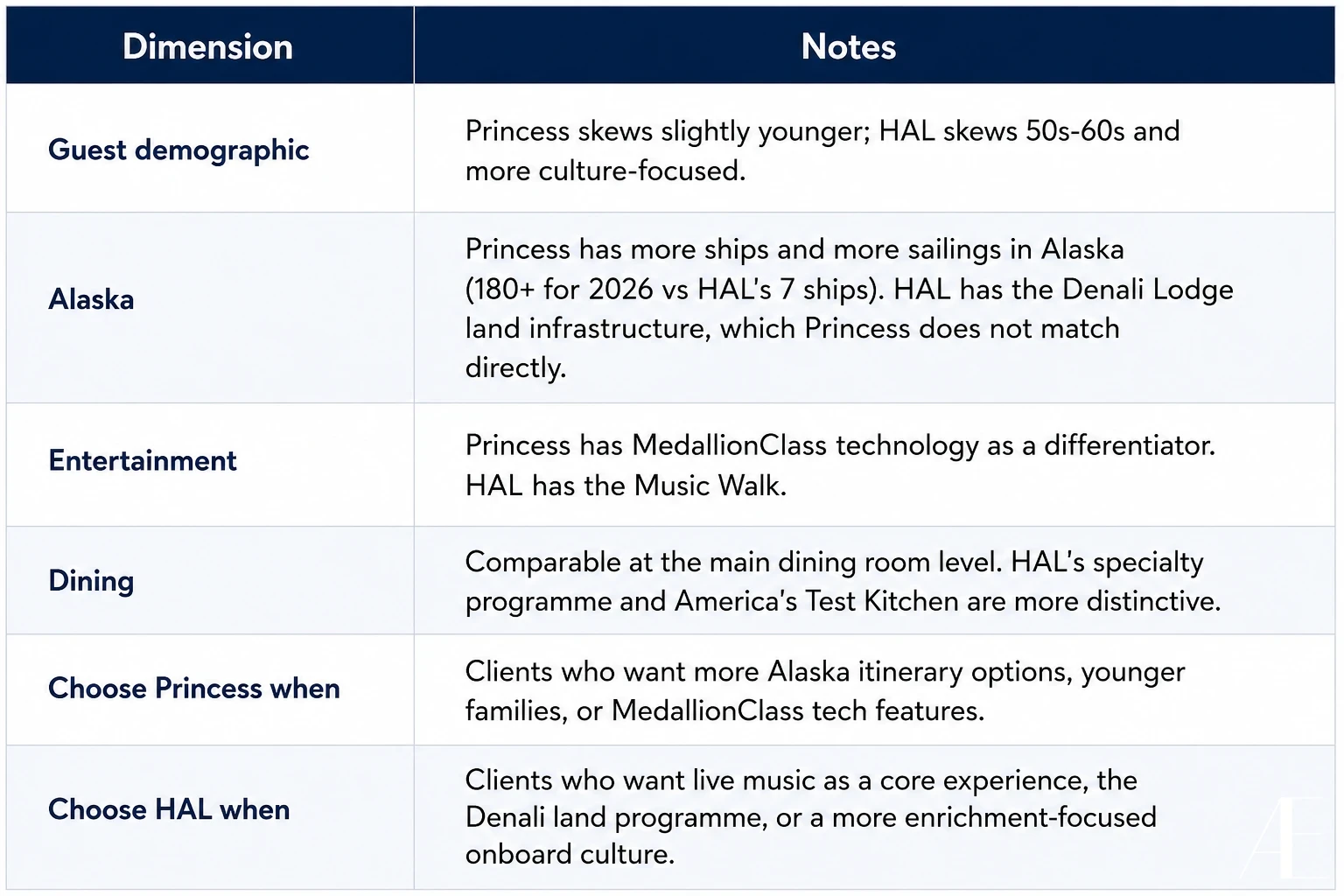
HAL vs. Princess Cruises
The most common comparison in the market. Both are Carnival Corporation brands, both operate heavily in Alaska, and both sit in the premium mainstream tier.
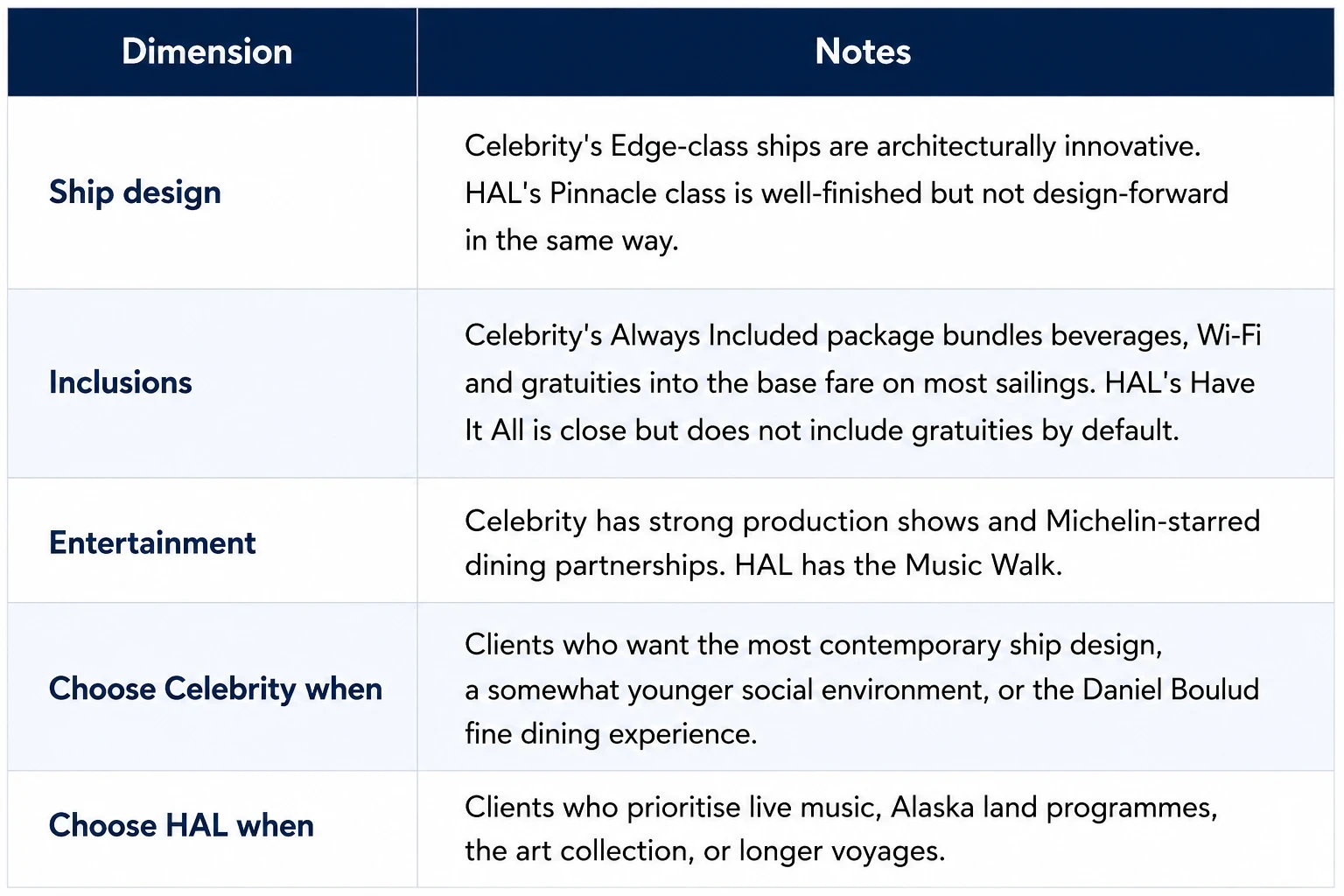
HAL vs. Celebrity Cruises
Celebrity sits at a comparable price tier with a younger-skewing demographic and a design-forward product philosophy.
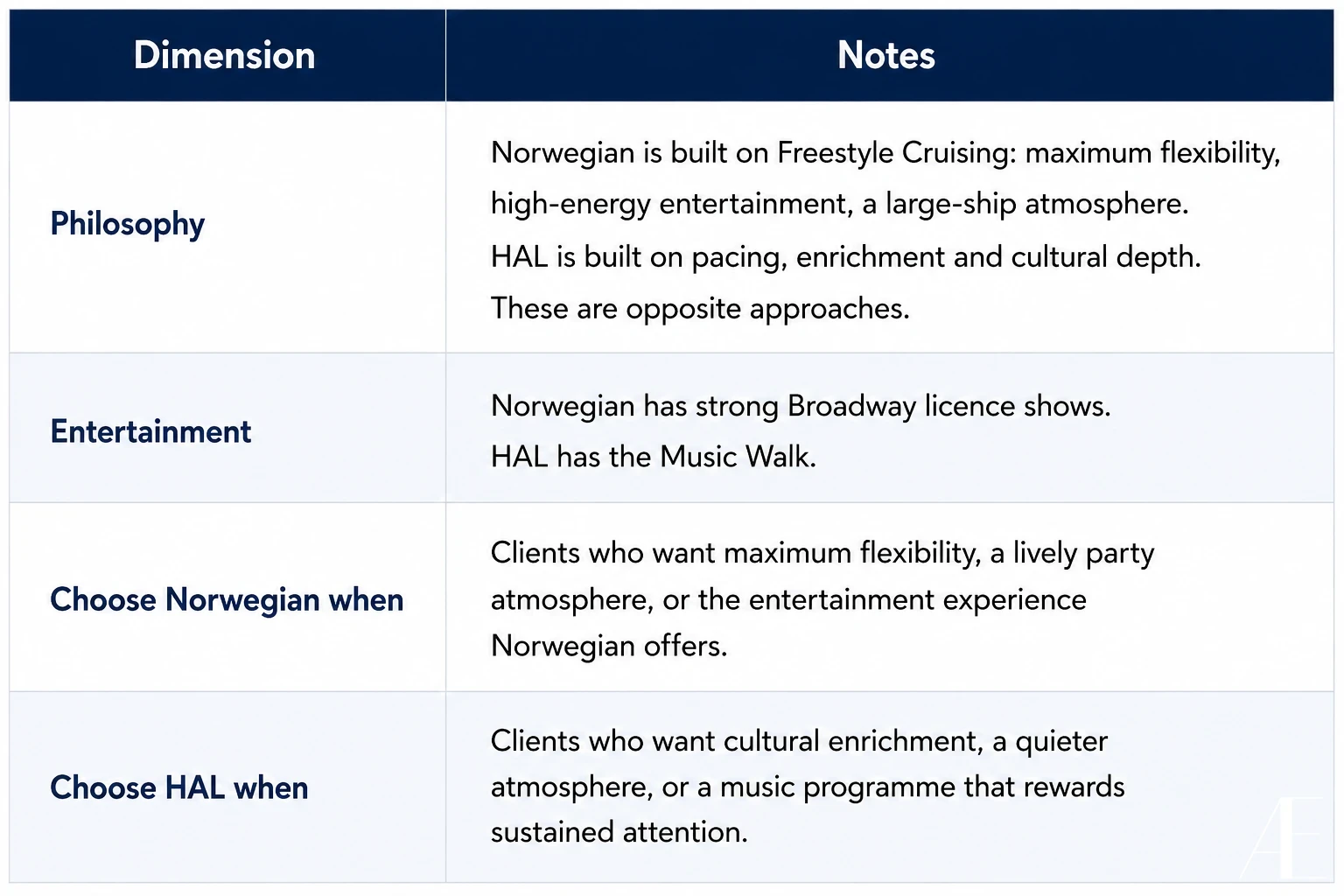
HAL vs. Norwegian Cruise Line
These two lines serve genuinely different markets and the comparison rarely requires extended nuance.
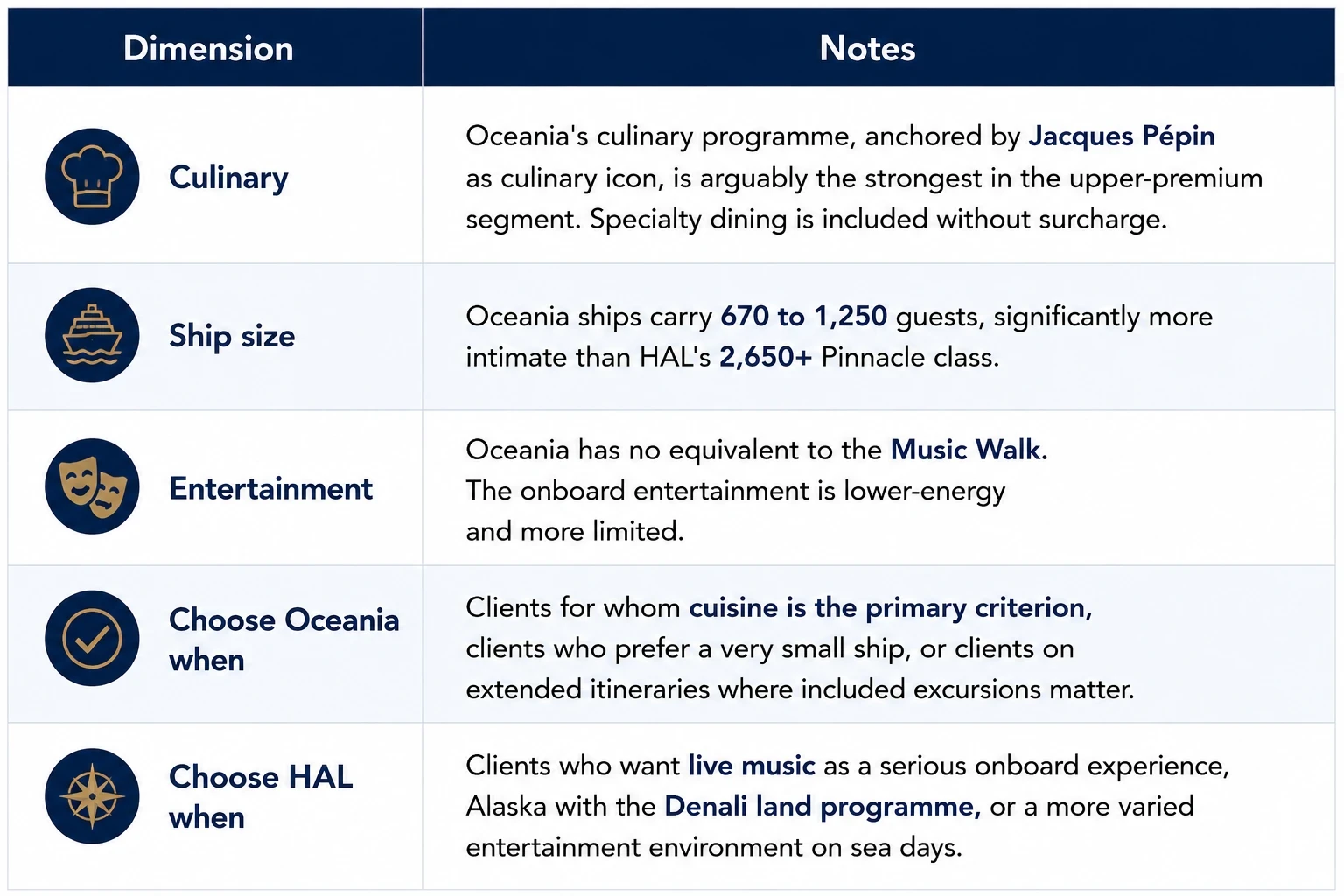
HAL vs. Oceania Cruises
This is the most nuanced comparison and the one that requires the most careful handling. Oceania sits above HAL in the market and serves a directly adjacent demographic.
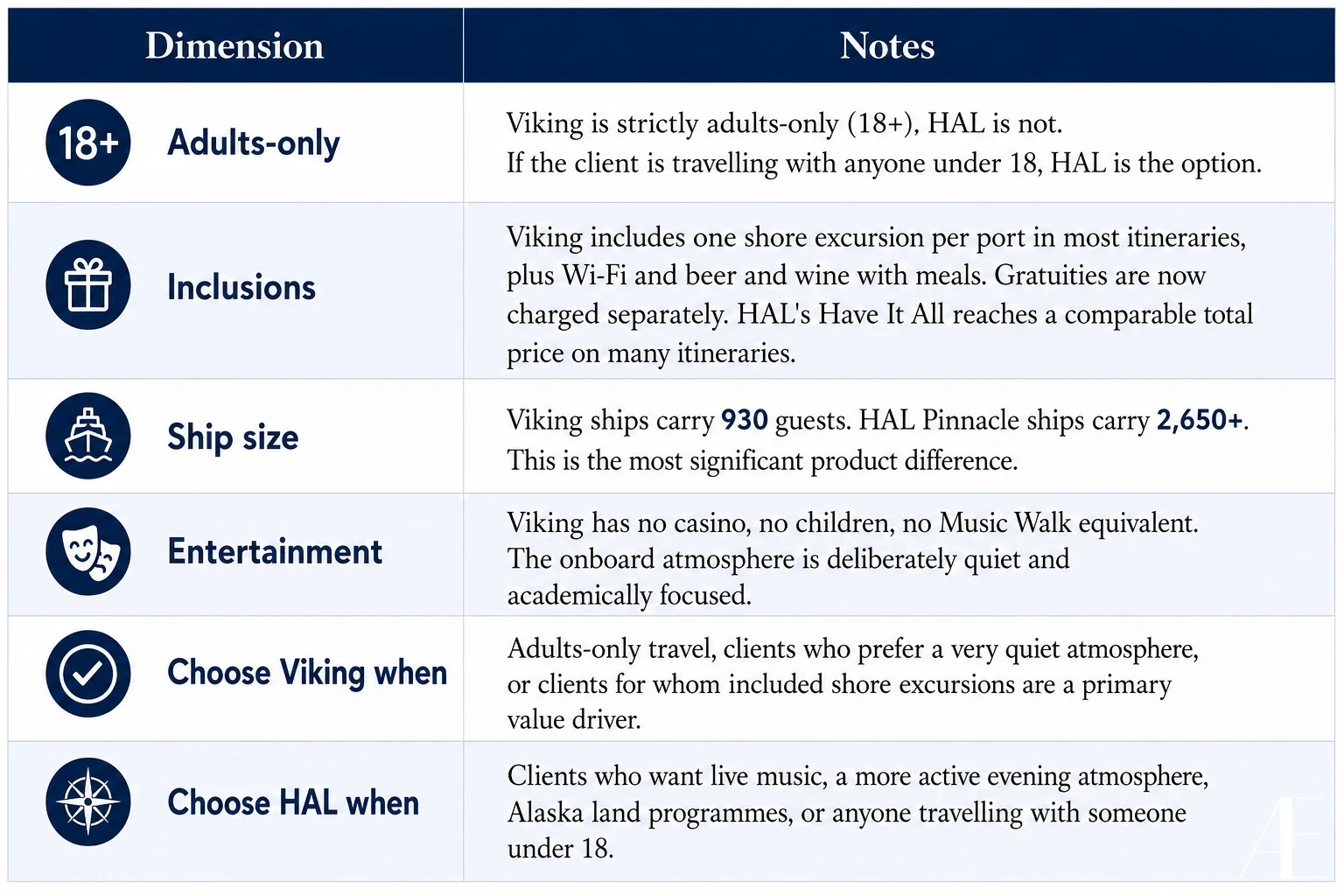
HAL vs. Viking Ocean
The most common direct comparison among Canadian clients considering a step up from mainstream cruising.
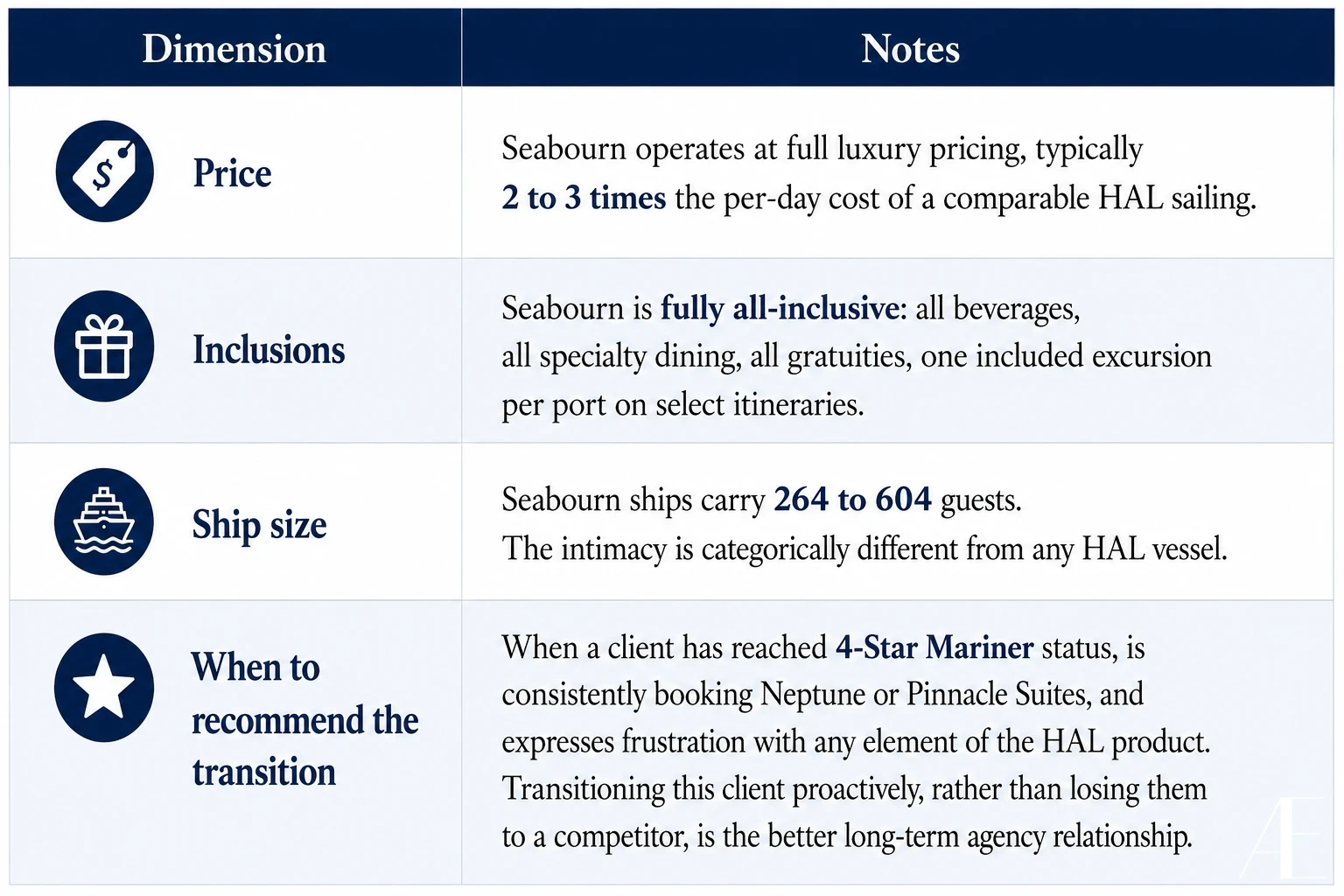
HAL vs. Seabourn
Seabourn is also a Carnival Corporation brand, positioned significantly above HAL in the luxury tier.
The Step-Up Conversation
Holland America occupies the ideal position in the market for step-up travel: above mainstream, below luxury, at a price that feels attainable. There are two step-up conversations worth knowing:
From mainstream to HAL: The client has sailed Royal Caribbean, Norwegian or Carnival multiple times and wants more cultural depth, less noise, or a meaningfully different onboard atmosphere. HAL is the correct step.
From HAL to Oceania/Viking/Seabourn: The client has sailed HAL multiple times, has upper Mariner Society status, and is describing moments of frustration with the ship size, crowd dynamics or specific service limitations. Have the conversation proactively: "Based on what you've described, I want to tell you about a few options that might be exactly what you're looking for at the next level." This is the conversation that builds the long-term relationship.
The Practical Information
Polar Online: The Agent Portal
Polar Online (OneSourceCruises.com) is Holland America's primary agent booking and management portal. Every agent handling HAL should have an active account. Key functions:
- Real-time pricing and availability for all itineraries and cabin categories
- Booking creation, modification and cancellation
- Group booking management and group deposit tracking
- Have It All package application and pre-cruise add-on management
- Crew Appreciation pre-payment
- Shore excursion and specialty dining pre-booking for clients
- Commission tracking and payment history
- FAM trip and training opportunity registration
- Marketing materials and image library
Polar Online also provides access to the Mariner Society client lookup, allowing agents to verify a client's loyalty tier and history before booking. Knowing their tier allows for more personalised service and ensures any early booking bonuses are properly applied.
Commission Structure
Holland America pays commission to travel agencies on the base cruise fare. Standard industry commission is in the 10-16% range for cruise.
Agents with preferred supplier relationships through consortia such as Virtuoso, Signature Travel Network or Travel Leaders Group may have enhanced commission arrangements or additional amenity programmes.
Commission is paid approximately 30 days after sailing. Have It All packages and pre-cruise add-ons are generally commissionable at the same rate as the base fare, though this should be verified at the agency level.
Group Booking Policies
Minimum group size for most HAL group bookings is 8 staterooms. Benefits include:
- One complimentary berth per a defined number of paid staterooms
- Group amenities including onboard credit or cocktail party
- Group booking holds that allow cabins to be reserved before full deposits are collected
- Dedicated group coordinator at Holland America for larger groups
Family reunion groups, alumni travel groups and affinity groups (music societies, book clubs, cultural organisations) are a natural fit for Holland America given the onboard enrichment programme.
The Navigator App
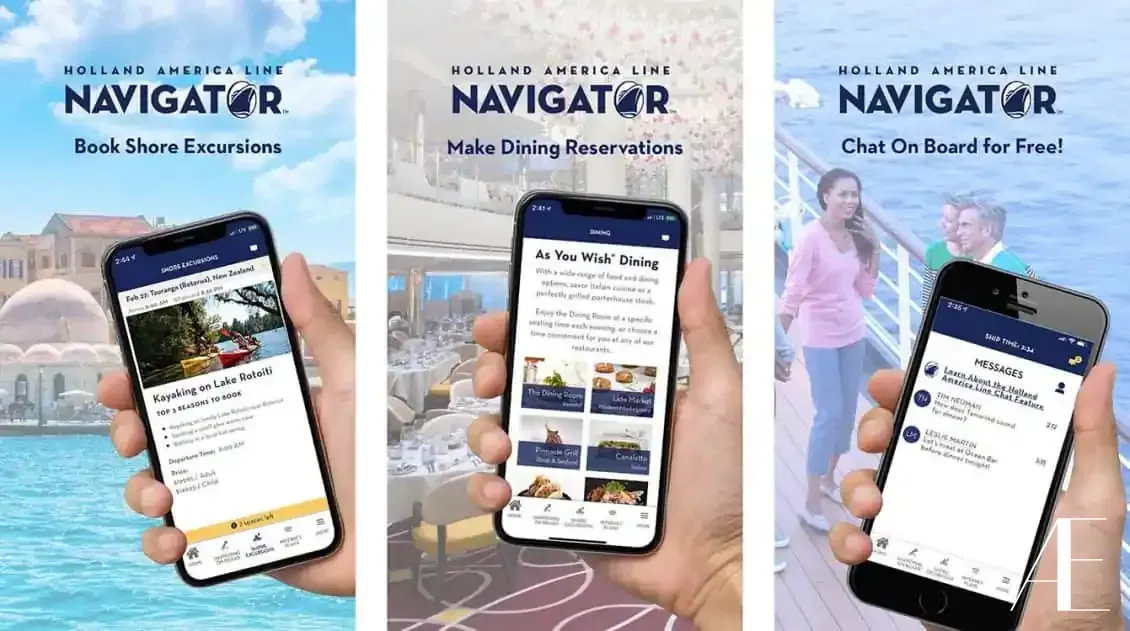
Holland America's Navigator app is the primary guest-facing tool for the onboard experience. Functions include: daily programme and entertainment schedule, dining and specialty restaurant reservations, shore excursion browsing and booking, onboard account management, messaging with ship services and ship deck plans.
Brief clients to download the app before sailing and create an account. The app significantly improves the onboard experience by centralising information and eliminating queues at service desks.
Embarkation Day Briefing Points
Agents who brief clients before embarkation dramatically improve the client experience. Standard briefing points:
- Download and set up the Navigator app before arrival at the terminal
- Specialty restaurant reservations: go directly to the restaurant after embarkation, or call from the cabin — prime slots book out on the first afternoon
- America's Test Kitchen hands-on classes: book at the cooking studio as soon as onboard
- Neptune Lounge guests: introduce yourself to the Neptune Concierge within the first hour onboard
- BB King's Blues Club: arrive 15 minutes before the set starts for a good seat
- Muster drill: complete e-muster on the Navigator app before the sail-away
The Conversation Starters
These are the details clients remember, repeat to their friends and bring up when they see you again. Ten accurate and genuinely surprising facts about Holland America Line.
1. There Have Been Seven Ships Named Rotterdam
The name Rotterdam has been used for seven successive Holland America ships since 1872. The current Rotterdam (2021) is the seventh. Each has represented the state of the art of its era: the first Rotterdam was a transatlantic emigrant steamer; the fifth Rotterdam, launched in 1959, was one of the most celebrated ocean liners of the postwar era and is now preserved as a hotel ship in Rotterdam harbour. The seventh Rotterdam, the 2021 Pinnacle-class vessel, is the only active ship in cruising to carry a name used continuously by the same company for 150 years.
2. Holland America Ships Carried the People Who Built Modern North America
Between the 1880s and the 1920s, Holland America ships transported more than a million European emigrants to the United States and Canada. Many of those who passed through Ellis Island arrived on NASM vessels. The Polish, Lithuanian, German, Dutch, Russian and Scandinavian emigrants who became the grandparents and great-grandparents of tens of millions of modern North Americans crossed the Atlantic specifically on this company's ships. When you tell a client that Holland America has been part of North American history for 150 years, this is what you mean.
3. The Prinsendam Rescue: One of the Greatest Peacetime Sea Rescues in History
In October 1980, the Holland America ship Prinsendam caught fire in the Gulf of Alaska, 250 kilometres from land, in 21-degree Celsius water. All 524 passengers and crew were evacuated by lifeboat, helicopter, and US Coast Guard and Canadian Armed Forces vessels. Not a single life was lost. The rescue involved four ships, two helicopters and a coordination effort across international waters that set the modern standard for maritime emergency response. The Prinsendam sank two days after the rescue. It remains one of the most complete and improbable rescues in the history of ocean travel.
4. Rudi Sodamin's "Happy Face" Presentations
Holland America's longtime culinary director Rudi Sodamin developed a signature presentation style using food as a canvas: arranging ingredients into expressive faces, figures and scenes on plates and in the buffet. The tradition appears fleet-wide, particularly in the Lido Market, where elaborate seasonal compositions in food appear regularly. Sodamin has published cookbooks documenting the technique and the philosophy behind it. Guests who encounter the happy face presentation for the first time almost universally smile before eating, which was precisely the point.
5. The Crow's Nest Was There Before the Observation Lounge Was Invented
The Crow's Nest, the forward observation lounge at the top of each Holland America ship, takes its name from the nautical term for the elevated lookout platform on traditional sailing ships. HAL first placed an observation lounge in the bow position on the SS Prinsendam in 1973 and has incorporated it into every ship class since. The forward observation position provides a viewing angle impossible from any other public space: straight ahead into the voyage, with the bow below and the horizon ahead. On Alaska glacier approaches, on fjord transits and on dawn arrivals in port, the Crow's Nest becomes the most valuable room on the ship.
6. The BB King Partnership Has a Specific Origin Story
The BB King's Blues Club partnership was not a generic licensed agreement. Holland America's entertainment team approached the BB King organisation specifically because they wanted authentic blues, not a blues-themed concept, but a genuine musical programme with trained musicians performing the real catalogue. The original negotiations required agreement on musician quality, setlist standards and performance frequency before any branding agreement was reached. The result is an onboard venue that regularly employs working professional musicians who would otherwise be performing in clubs ashore, at a standard that genuinely warrants the name on the door.
7. The Art Collection Is Actually Organised
The 1,920-plus works of art across the fleet are not selected by a hotel decorator from a catalogue. Each ship's collection is thematically organised by a fleet historian and acquisitions team working from a defined curatorial brief tied to the ship's name and heritage. The Zuiderdam's collection focuses on the art of Zeeland and the southern Netherlands. The Westerdam's focuses on Dutch contact with the Americas. The Rotterdam's, the most recently assembled, draws on the 150-year history of the company itself. Walking the ship with the thematic guide available at the art desk onboard is a genuine museum experience.
8. The Mariner's Dream Mattress Was Developed Specifically for HAL
Holland America developed the Mariner's Dream bed system in a multi-year partnership with a sleep specialist, testing mattress constructions, pillow combinations and linen weights specifically for the motion environment of a ship at sea. The euro-top mattress design used across the fleet is not an off-the-shelf hospitality product. It is the most consistently praised element of the HAL stateroom experience across all cabin categories and all ship classes, and it generates more unprompted positive client comments than almost any other onboard feature.
9. The Denali Lodge Was a Working Chalet Before HAL aquired It
The property now known as Holland America Denali Lodge operated as the McKinley Chalet Resort for decades before Holland America's parent company acquired it as part of the Westours purchase in 1989. The site was originally developed as a wilderness retreat for independent travellers visiting what was then called Mount McKinley National Park. HAL's investment has transformed it into a purpose-built programme facility — now undergoing USD $70 million in renovation — but the lodge's origins as a genuine wilderness outpost predate the cruise industry's Alaska involvement by decades.
10. The Seventh Rotterdam Has a Heritage Challenge Built Into It
When Holland America announced the seventh Rotterdam in 2021, the naming presented a genuine design challenge: how do you honour 150 years of a name without simply producing a nostalgic replica? The design team's solution was to incorporate specific visual references to each previous Rotterdam — a particular rail detail from the fifth Rotterdam's famous ocean liner profile, a colour palette from the third, a navigational instrument display referencing the first — distributed as details throughout the ship that most guests pass without recognising. The Rotterdam (2021) is simultaneously the most modern ship in the fleet and the most historically dense, if you know where to look.
ÆRIA Voyages Academy
Professional resources for travel agents who want to sell with complete confidence.
© 2026 ÆRIA Voyages. All rights reserved.
The content, text, and images contained in this guide are the exclusive property of ÆRIA Voyages and are protected by copyright law.
No part of this material may be reproduced, distributed, transmitted, or republished in any form or by any means without the prior written permission of ÆRIA Voyages.
This guide is intended solely for the professional use of registered ÆRIA Voyages Academy members.


Member discussion