
Edinburgh: The Complete Agent's Guide
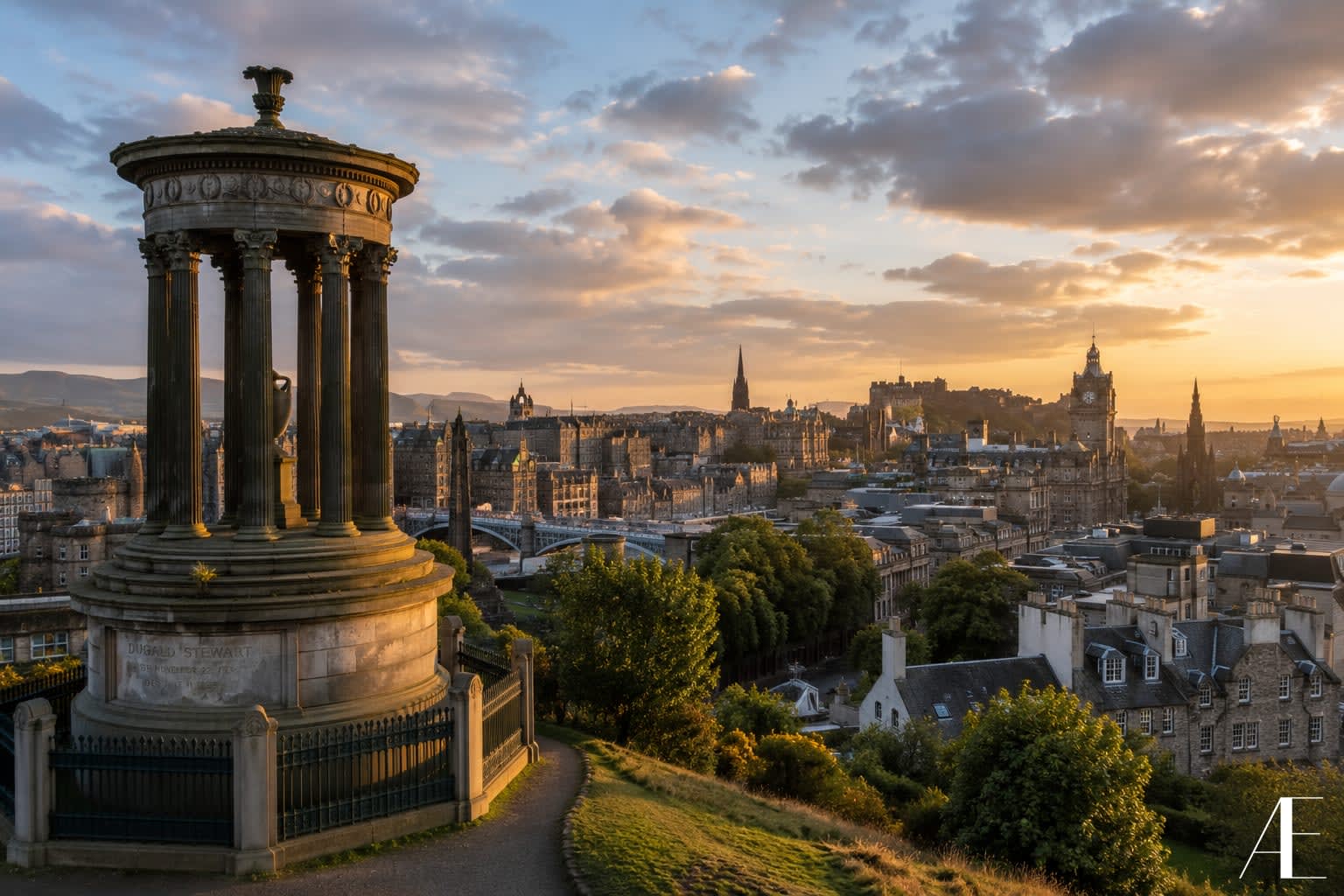
The Destination Overview
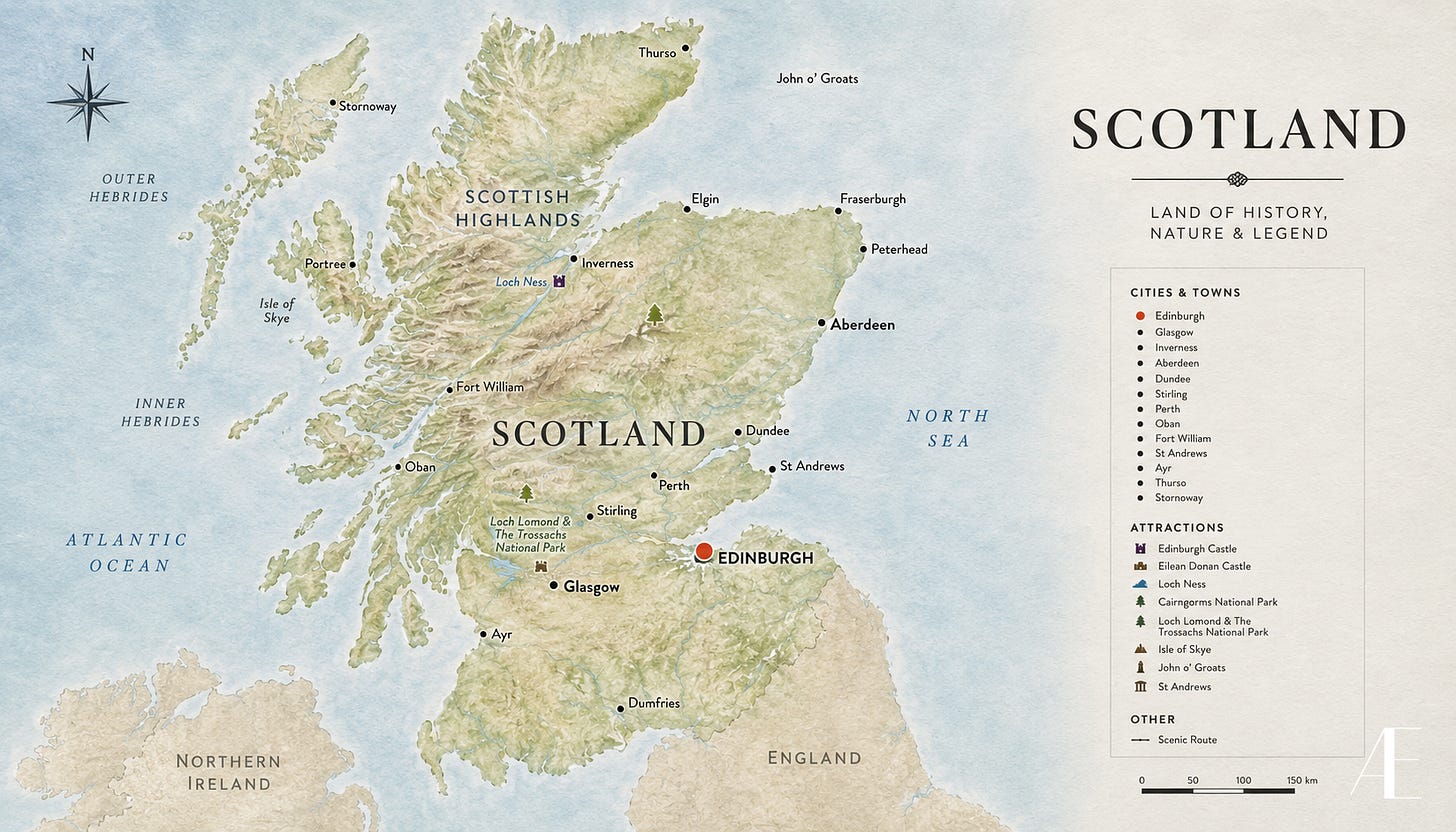
Edinburgh is the capital of Scotland: a compact, extraordinarily beautiful city built on and around a series of volcanic hills, combining one of Europe’s best-preserved medieval old towns with a sweeping 18th-century neoclassical new town, both UNESCO World Heritage Sites.
It sits on the southern shore of the Firth of Forth, approximately an hour’s drive from Glasgow, three hours by rail from London. The city of around 540,000 people punches well above its weight in culture, gastronomy, history and atmosphere. It is, in many ways, the ideal European city break: walkable, safe, dramatically beautiful, and inexhaustibly interesting. Its August festival season transforms it into the world’s largest live performance venue. Outside festival season, it offers one of the most rewarding city experiences in the British Isles with none of the crowds of London.
Quick reference guide
- Country / Region: Scotland, United Kingdom
- Time zone: GMT (BST, UTC+1, late March to late October)
- Currency: British Pound Sterling (GBP / £)
- Language: English (Scottish accent). Gaelic signage in some areas.
- Best airports Edinburgh Airport (EDI). Glasgow Airport (GLA), 45 min by road, useful for some itineraries.
- From Montreal (YUL): ~7.5 hrs direct (Air Transat seasonal; year-round via London, Dublin, Amsterdam, Paris)
- From Toronto (YYZ): ~7–8 hrs, typically via London Heathrow, Dublin, or Amsterdam
- From New York (JFK/EWR): ~7 hrs non-stop (British Airways, occasionally others)
- Visa: Canadian citizens: No visa required.
- ETA (Electronic Travel Authorization) for canadian citizens: required for air entry to the UK as of 2024. Apply at gov.uk/eta.
- Visa: American citizens No visa required for stays under 6 months.
- ETA (Electronic Travel Authorization) for US citizen: required as of 2025: apply at gov.uk/eta.
- One-line client pitch: “It’s what London would be if it were still the most dramatic city in Britain: half a million people, two UNESCO sites, a castle on a volcano, and the world’s greatest arts festival. And your clients will be able to walk everywhere.”
The History that Shaped Edinburgh
The Volcanic Foundation
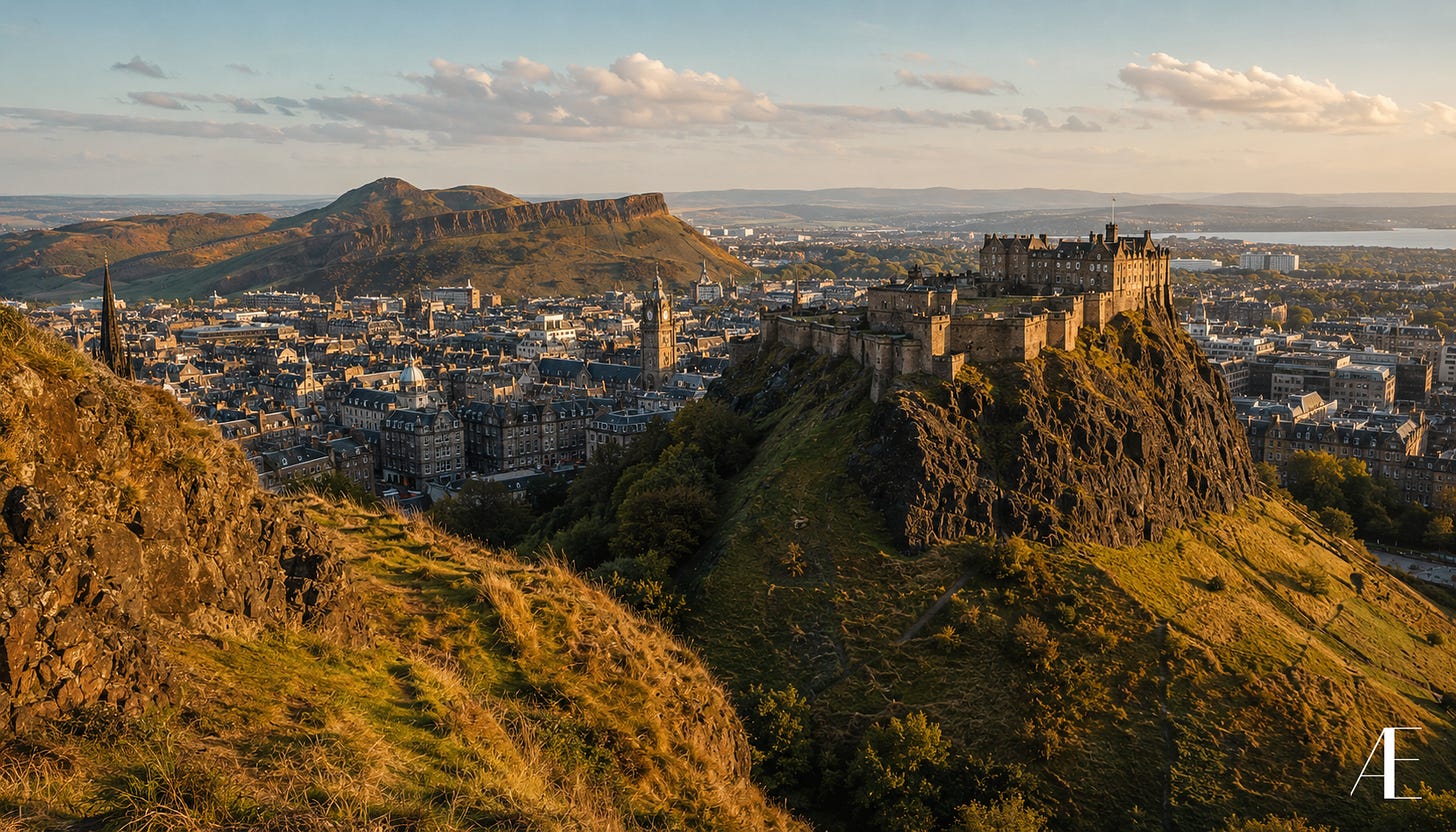
Edinburgh’s story begins not with people but with geology. The city is built on and around a series of volcanic plugs, the hardened magma cores of ancient volcanoes that erupted between 340 and 360 million years ago. The most dramatic of these is Castle Rock, the steep-sided plug on which Edinburgh Castle stands. Arthur’s Seat, the highest point in the city, is the remains of a more complex volcano. The volcanic rock’s hardness meant it resisted the glaciers of successive Ice Ages while the surrounding softer rock was scraped away, producing the distinctive ridge-and-tail geography that defines Edinburgh: the Old Town running down the “tail” of the Castle Rock ridge, the New Town on the opposite hill, Princes Street Gardens in the drained valley between.
This geography is not incidental. It explains why the Old Town was built where it was, why it grew so tall (there was nowhere else to build), why the city was so naturally defensible, and why the visual drama of Edinburgh is like no other European capital.
Early Settlement and the Kingdom of Scotland
Human settlement on Castle Rock dates to at least the Iron Age. The rock is believed to have been called “Din Eidyn” (the hillfort of Eidyn) by the Gododdin, a Brittonic people who held it until the 7th century, when it was captured by the Northumbrian Angles. The name Edinburgh is almost certainly a corruption of this original Brittonic name through the Old English “Eadwinesburh.”
The town around the castle grew through the 11th and 12th centuries under the Scottish crown. David I (reigned 1124–1153) granted Edinburgh its first royal burgh charter and established Holyrood Abbey at the foot of what would become the Royal Mile, the double anchor of royal power that would define the city’s physical structure for the next eight centuries. Under the medieval Scottish kings, Edinburgh gradually displaced Perth as the administrative and then political capital of Scotland.
The Wars of Scottish Independence
The late 13th and early 14th centuries brought the defining crisis of Scottish national identity. The death of the child queen Margaret in 1290 left Scotland without a clear heir, and the resulting succession dispute invited the intervention of Edward I of England, who used it as an opportunity to assert control over Scotland. Edinburgh Castle was captured by the English, held, retaken, destroyed by its own Scottish garrison to prevent re-capture, rebuilt... and so this cycle continued.
Two figures from this period are inescapable in Edinburgh. William Wallace, the commoner knight who defeated the English at the Battle of Stirling Bridge in 1297 before being captured, tried and executed in London in 1305, is commemorated by the Wallace Monument visible on its hill from much of central Scotland. Robert the Bruce, crowned King of Scots in 1306 and the victor of the decisive Battle of Bannockburn in 1314, is the figure who secured, at least for three centuries, the independence that Wallace had fought for. Both figures are present throughout the city in statues, museum displays and the consciousness of Scottish visitors. When clients visit Stirling as a day trip from Edinburgh, these are the stories that animate the landscape.
For agents: clients who visit Edinburgh Castle will find the Scottish Crown Jewels (the Honours of Scotland), which are the oldest crown jewels in the British Isles and survived the Wars of Independence partly through extraordinary subterfuge. That story is worth knowing and worth sharing.
Mary Queen of Scots
No single figure haunts Edinburgh more persistently than Mary Queen of Scots (1542–1587), and she divides visitors as she divided contemporaries. Mary became Queen of Scotland at six days old, following her father James V’s death at Solway Moss. She was raised at the French court, married the French dauphin, became briefly Queen of France, then returned to Scotland in 1561 as a Catholic queen in a Protestant country, presiding over a court of extraordinary cultural sophistication while the Protestant reformer John Knox thundered against her from the pulpit of St Giles’ Cathedral three hundred metres away.
Her apartments in the Palace of Holyroodhouse are where she witnessed the murder of her Italian secretary David Rizzio, stabbed 56 times by her husband Lord Darnley’s co-conspirators in 1566, allegedly in front of Mary herself, heavily pregnant at the time. Darnley died in a house explosion the following year in circumstances that have never been fully explained. Mary’s subsequent marriage to the Earl of Bothwell, widely suspected of Darnley’s murder, destroyed her support. She was forced to abdicate, imprisoned, escaped to England, where Elizabeth I held her prisoner for nineteen years before having her executed in 1587.
For agents: the Mary Queen of Scots narrative is one of the most compelling in the city and touches every major site on the Royal Mile. Clients who know it arrive at Holyroodhouse in a completely different way. It is also the story that connects Edinburgh to the broader British history that many Canadian and American clients already find fascinating.
The Reformation
John Knox returned to Edinburgh in 1559 after years of exile and imprisonment (including eighteen months as a French galley slave) and proceeded to oversee the most dramatic religious transformation in Scottish history. The Scottish Reformation of 1560 abolished the authority of Rome, established Presbyterianism as the national religion, stripped the churches of their art and decoration, and fundamentally altered the character of Scottish society and education for centuries.
The physical consequences are visible throughout Edinburgh. St Giles’ Cathedral on the Royal Mile was stripped of its altars and interior decoration. Greyfriars Kirkyard and its church are a direct product of the Reformation’s new relationship with burial and public worship. The ruins of Holyrood Abbey, visible in the grounds of the palace, were damaged during the Reformation upheaval. Many of the closes and old buildings of the Royal Mile were associated with religious institutions that were dissolved.
Knox himself is buried under what is now the car park of St Giles’ Cathedral: parking space number 23, marked by a small plaque. This detail alone is worth the moment it takes to share.
The Act of Union
Scotland and England shared a monarch from 1603, when James VI of Scotland inherited the English throne as James I. But the countries remained legally distinct. The Act of Union of 1707 abolished the Scottish Parliament, which had sat in Edinburgh since 1639, and merged Scotland into the United Kingdom of Great Britain, a decision still contested in Scottish memory.
What followed was, paradoxically, one of the most remarkable intellectual flowerings in European history. The Scottish Enlightenment of the 18th century produced a concentration of thinkers of global significance out of a country of fewer than two million people: David Hume (philosophy), Adam Smith (economics, whose Wealth of Nations still shapes political debate), James Hutton (who invented the science of geology in Edinburgh), Joseph Black (who discovered carbon dioxide), and James Watt (who developed the steam engine). The New Town, built from 1767 onwards, was in many ways the physical expression of Enlightenment confidence: rational, geometrically ordered, elegant, optimistic.
For agents: the Old Town and New Town are not simply architectural contrasts. They represent two centuries of history: medieval necessity (build up, build dense, survive) versus Enlightenment ambition (plan, order, beautify). A client who understands this walks between them differently.
The Highland Clearances
A chapter of Scottish history that many clients will not know, and that is essential context for understanding modern Scottish identity. Following the Jacobite defeat at Culloden in 1746 (Bonnie Prince Charlie’s failed attempt to reclaim the British throne), the Highland clan system was systematically dismantled by the British government. In the following century, landowners, both Scottish and English, cleared the Highland glens of their populations to make way for sheep, which were more profitable. Hundreds of thousands of Highlanders were evicted, emigrated (many to Canada, particularly Nova Scotia and Cape Breton), or died.
For agents working with Canadian clients of Scottish descent: this is their story. Cape Breton, Prince Edward Island, and parts of Nova Scotia were settled in large part by Highland Clearances emigrants. The National Museum of Scotland covers this history intelligently. It can be the most personal part of an Edinburgh visit for the right client.
The Modern City
Edinburgh recovered its parliament in 1999, when the Scottish Parliament was re-established following devolution. The new Scottish Parliament Building at Holyrood, opposite the Palace, was designed by the Catalan architect Enric Miralles and opened in 2004, to considerable controversy (about both its design and its cost, which ran ten times over budget). It is a remarkable building and worth visiting.
The city today is a prosperous, cosmopolitan capital with one of the fastest-growing economies in the UK. Leith, once a deprived port district, has undergone the most extraordinary transformation of any urban area in Scotland over the past twenty years. The tension between Edinburgh as a historic showcase and Edinburgh as a living, evolving city is one of the things that makes it more interesting than a simple museum-piece destination.
The Geography & Neighbourhoods
The Overall Geography
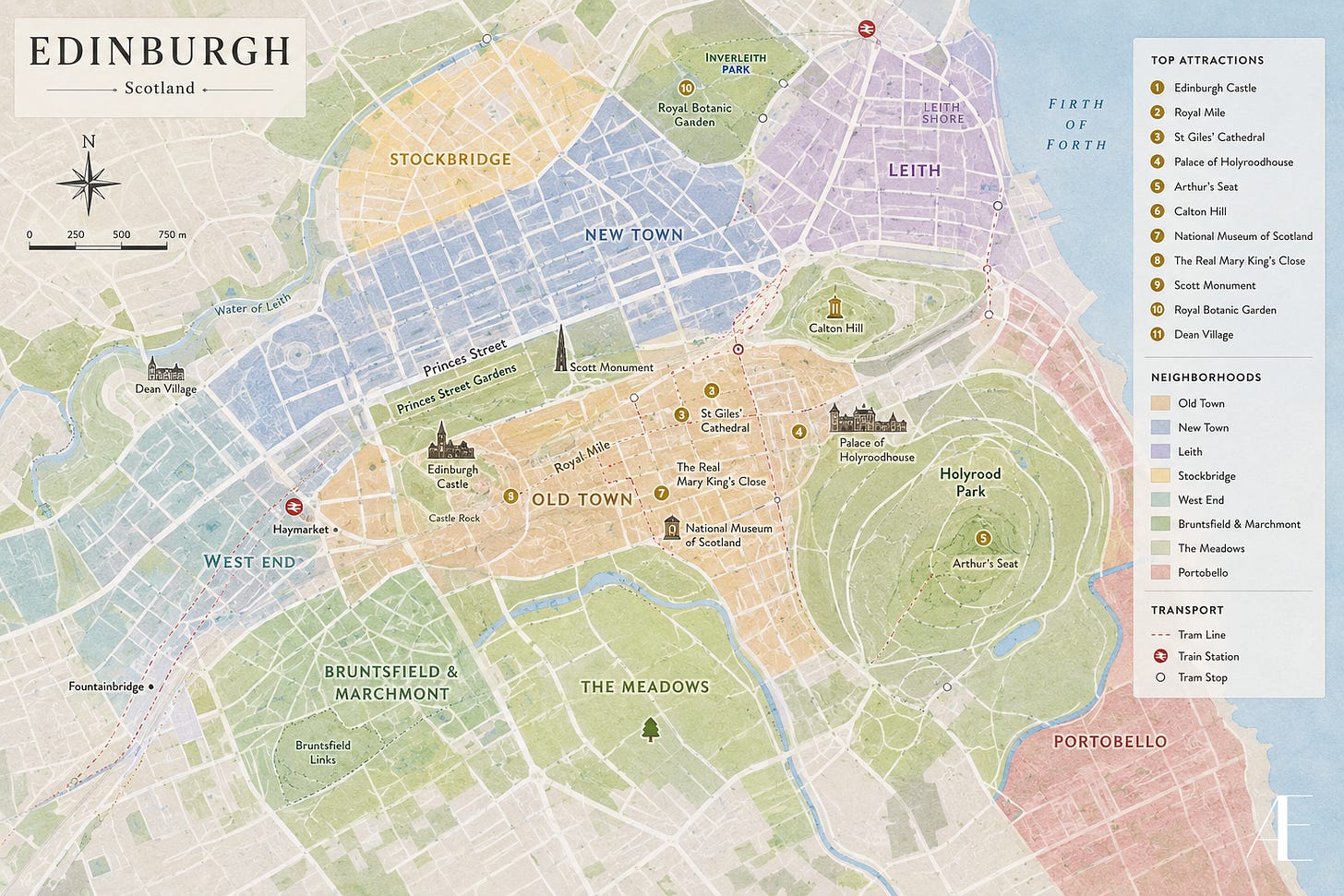
Edinburgh sits on the southern shore of the Firth of Forth, an estuary that opens into the North Sea. To the north, across the water, lies the county of Fife. The Pentland Hills rise to the south and southwest. The city itself is built on a series of volcanic hills and ridges, which gives it a dramatically three-dimensional quality unlike most flat European cities.
The two axes that define Edinburgh’s centre are:
- The Royal Mile (east–west), running from Edinburgh Castle at the top to Holyroodhouse at the bottom
- Princes Street / George Street (east-west), the main commercial and social arteries of the New Town, running parallel to the Royal Mile on the ridge above the valley
Everything the majority of visitors need is within comfortable walking distance of these two axes.
The Old Town
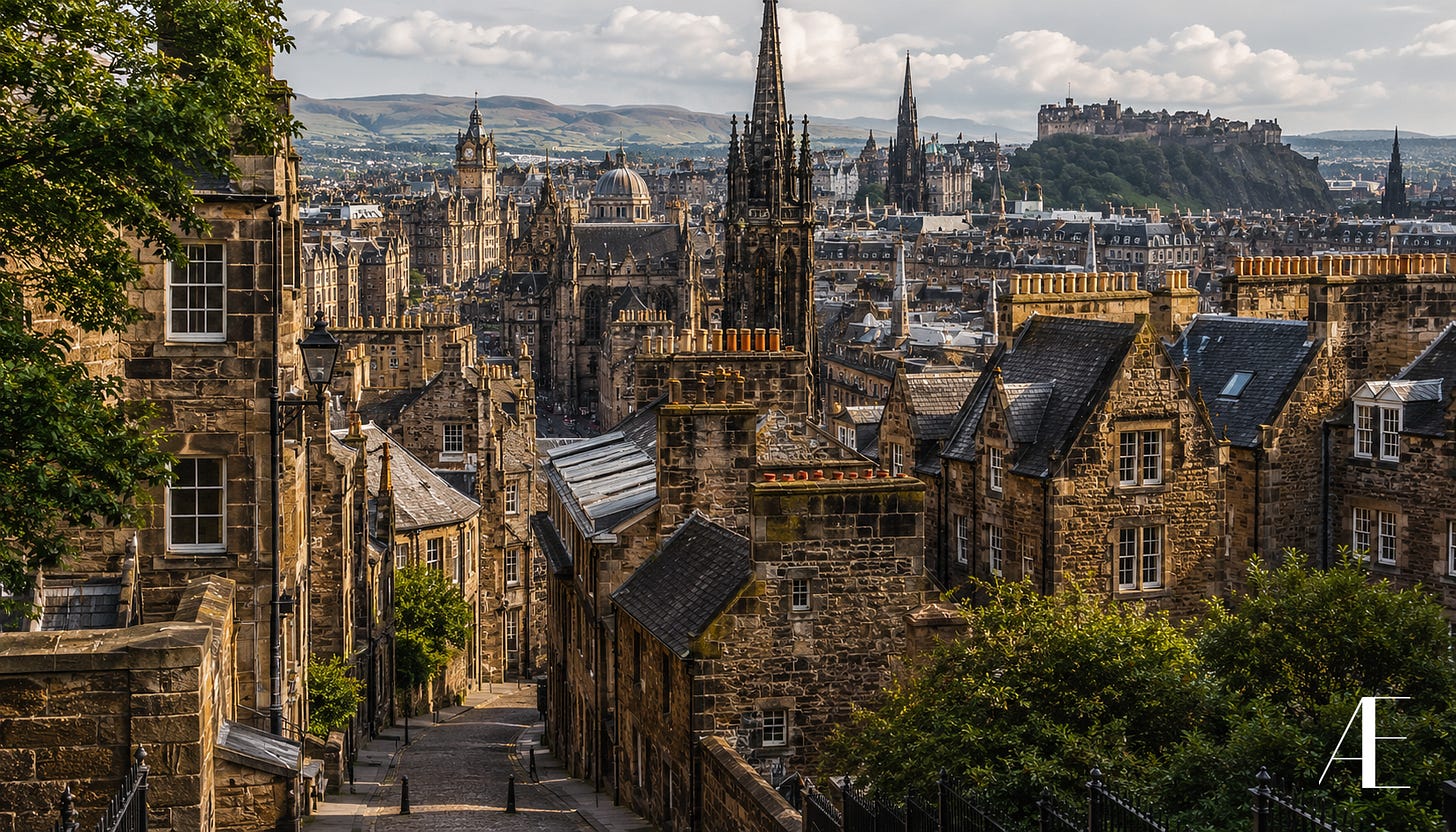
The medieval heart of the city, built along the ridge running down from Castle Rock. The Royal Mile runs through its centre, flanked by a dense network of “closes,” narrow medieval alleyways that lead to hidden courtyards, staircases and the remains of ancient buildings. The buildings here were, in the 16th and 17th centuries, among the tallest in the world: tenements of twelve to fifteen storeys built on the ridge because there was nowhere else to go.
Character: Historic, dramatic, tourist-dense in summer, but genuinely atmospheric at any hour. The closes reward exploration. The pubs are among the oldest in Scotland.
Who it’s right for: Every client. First-time visitors should be based here or very close to it.
What it’s known for: Edinburgh Castle, the Royal Mile, Grassmarket, Victoria Street, Greyfriars Kirkyard, St Giles’ Cathedral, Mary King’s Close.
The New Town
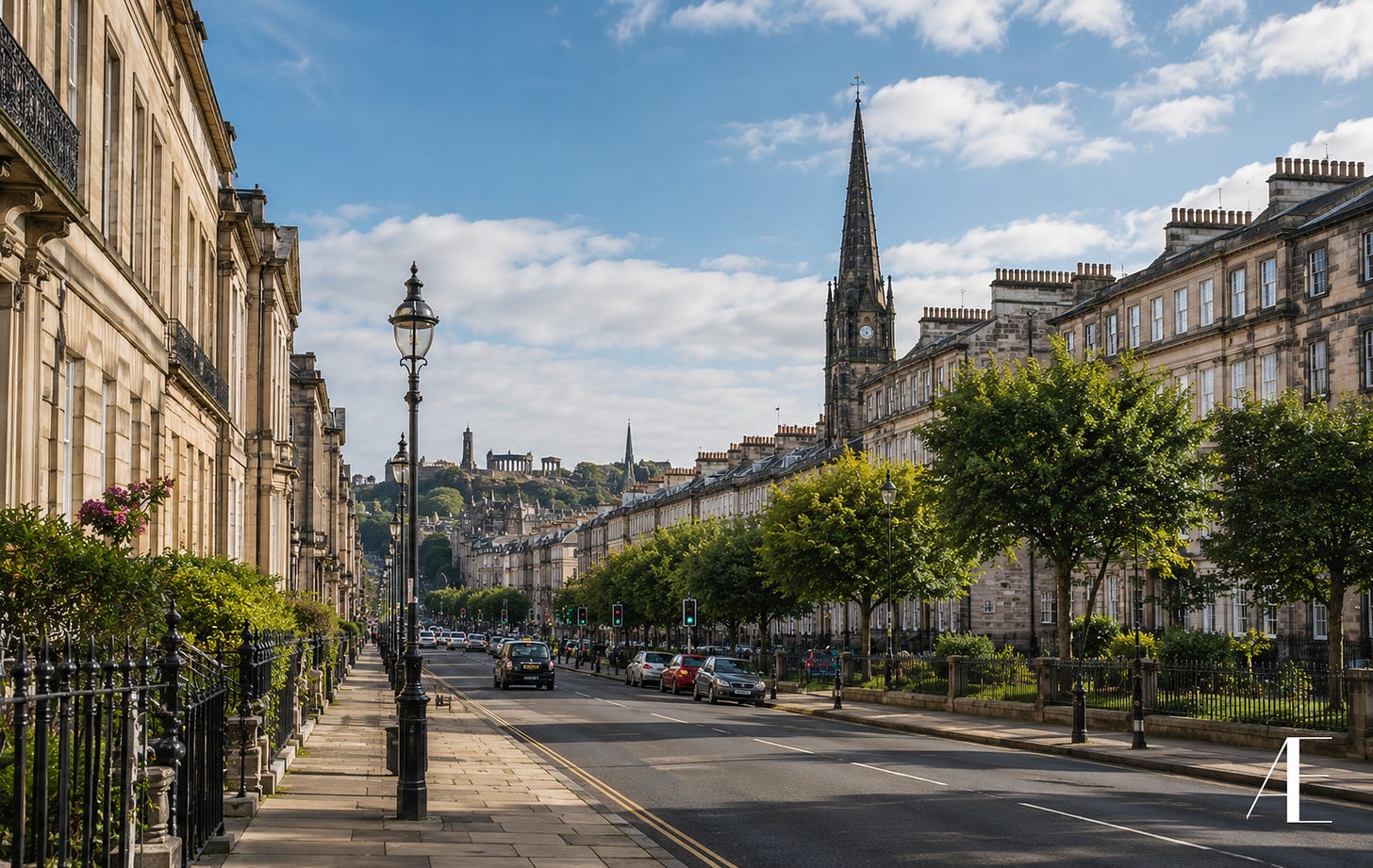
Built from 1767 on the principles of Enlightenment planning: wide streets, uniform sandstone facades, private gardens, clear sightlines. George Street is the main social artery; Thistle Street and Rose Street run parallel and contain some of the city’s best independent restaurants and bars. Princes Street faces the castle across the gardens.
Character: Elegant, calmer than the Old Town, home to the best restaurants and wine bars. Feels more genuinely inhabited.
Who it’s right for: Repeat visitors, clients who want calm, clients interested in architecture, shoppers.
What it’s known for: Georgian architecture, the Scottish National Gallery, the Scottish National Portrait Gallery, independent shops and restaurants, Charlotte Square (Georgian House).
Grassmarket and Cowgate
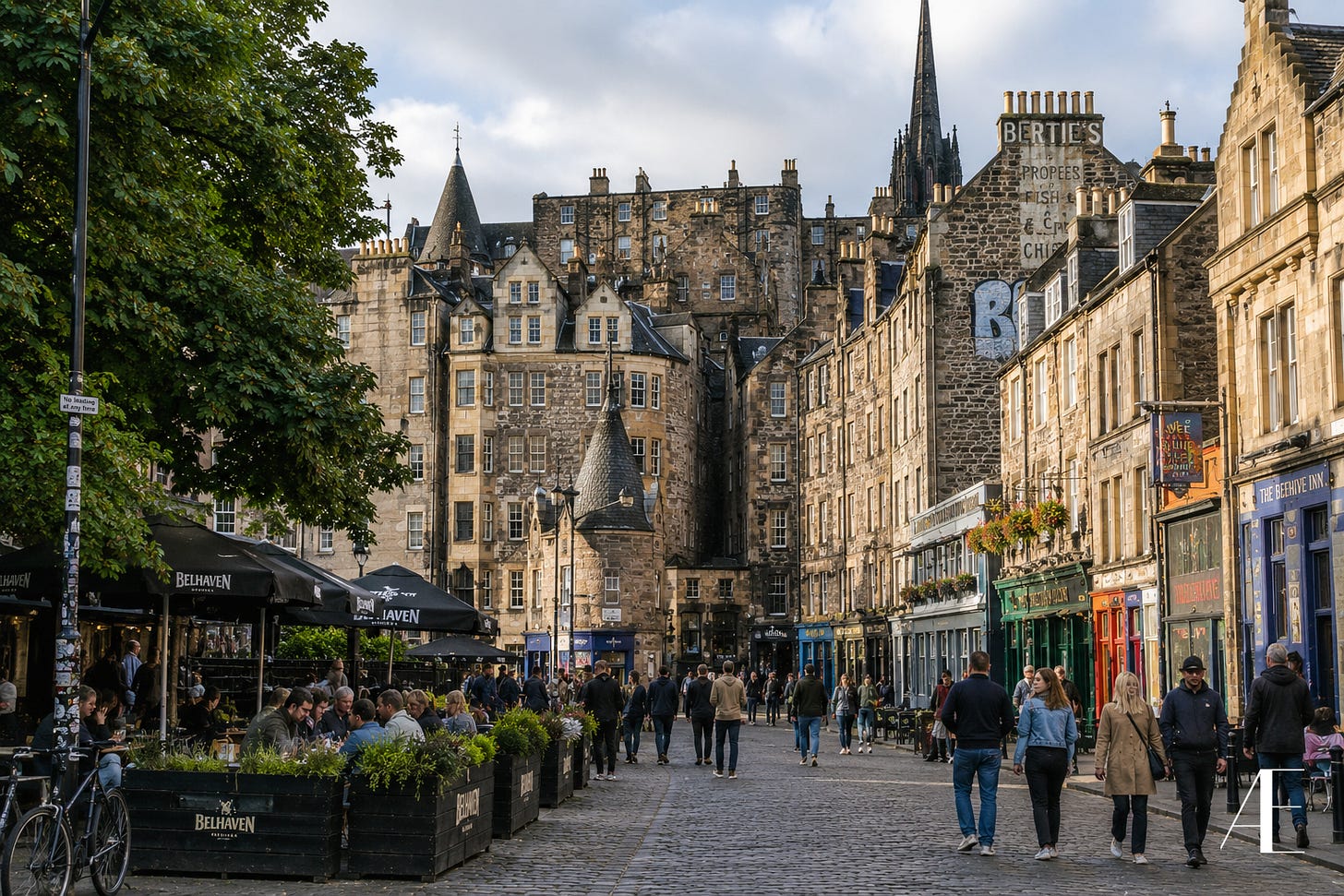
At the foot of the castle, this former marketplace was where public executions took place until the 18th century; the gallows stood at the east end. Today it’s one of the liveliest evening areas of the Old Town, with a concentration of pubs, whisky shops and restaurants beneath the castle rock. The Cowgate, running parallel below, is the student nightlife hub: darker, louder, less polished.
Character: Lively, characterful, excellent for evening. The castle view from here is extraordinary.
Who it’s right for: Clients who like atmosphere and pub culture. Not for those wanting quiet.
Leith
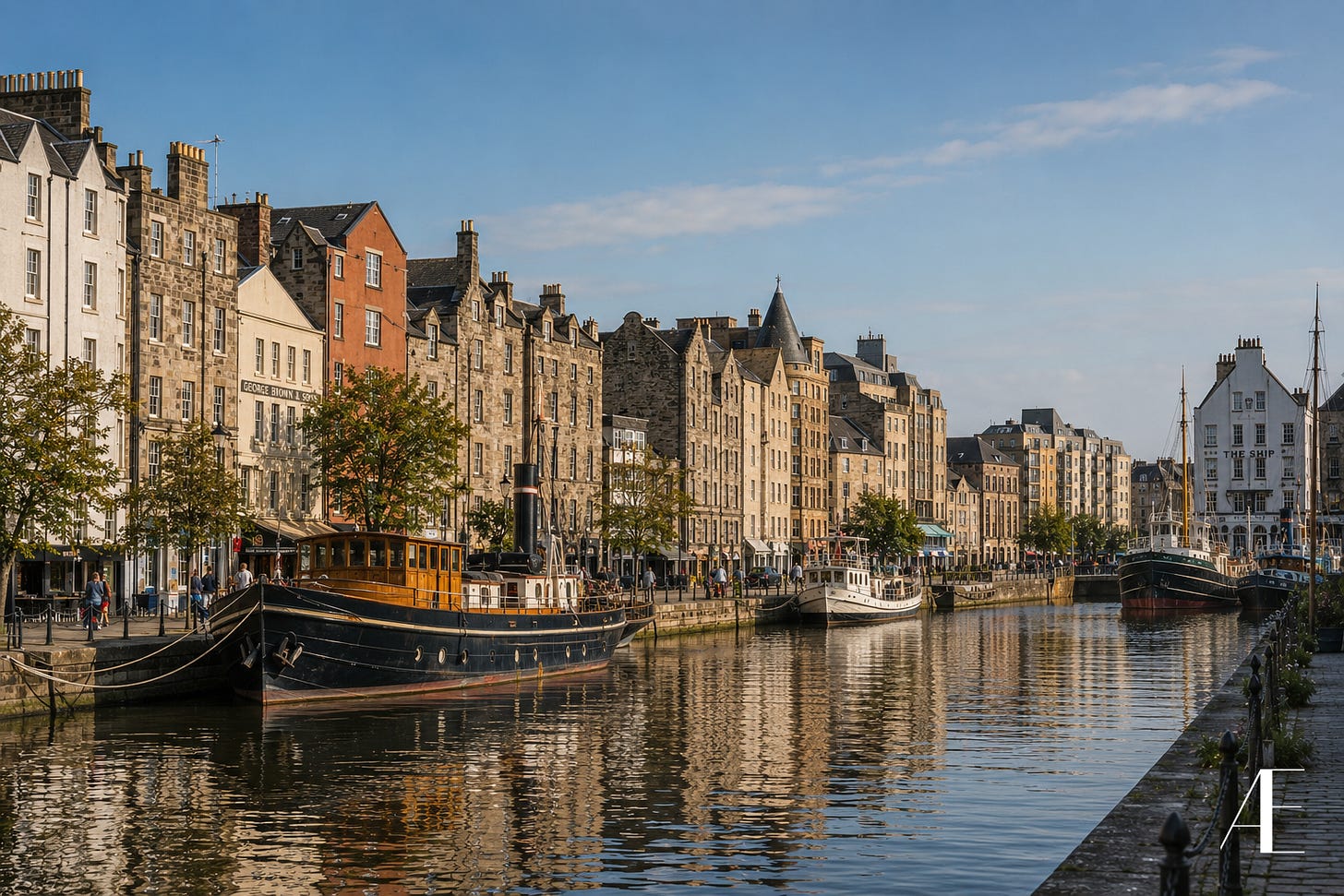
Edinburgh’s former port, at the mouth of the Water of Leith, administratively separate until 1920 and culturally distinct still. Leith underwent decades of decline after the collapse of the dockside industries, and has been completely transformed since the late 1990s. Today it has the city’s most interesting food scene, its best wine bars, its most creative independent businesses, and the Royal Yacht Britannia.
Character: Genuine, creative, food-focused, local. Far less touristy than the Old Town.
Who it’s right for: Foodies, repeat visitors, clients who want to see the city as it really lives. A must-visit for the right client, not just a side trip.
Getting there: Tram from Princes Street (approx. 15 min) or taxi (approx. 10 min). Walkable in 40–45 minutes along the Water of Leith walkway, one of the finest walks in the city.
Stockbridge
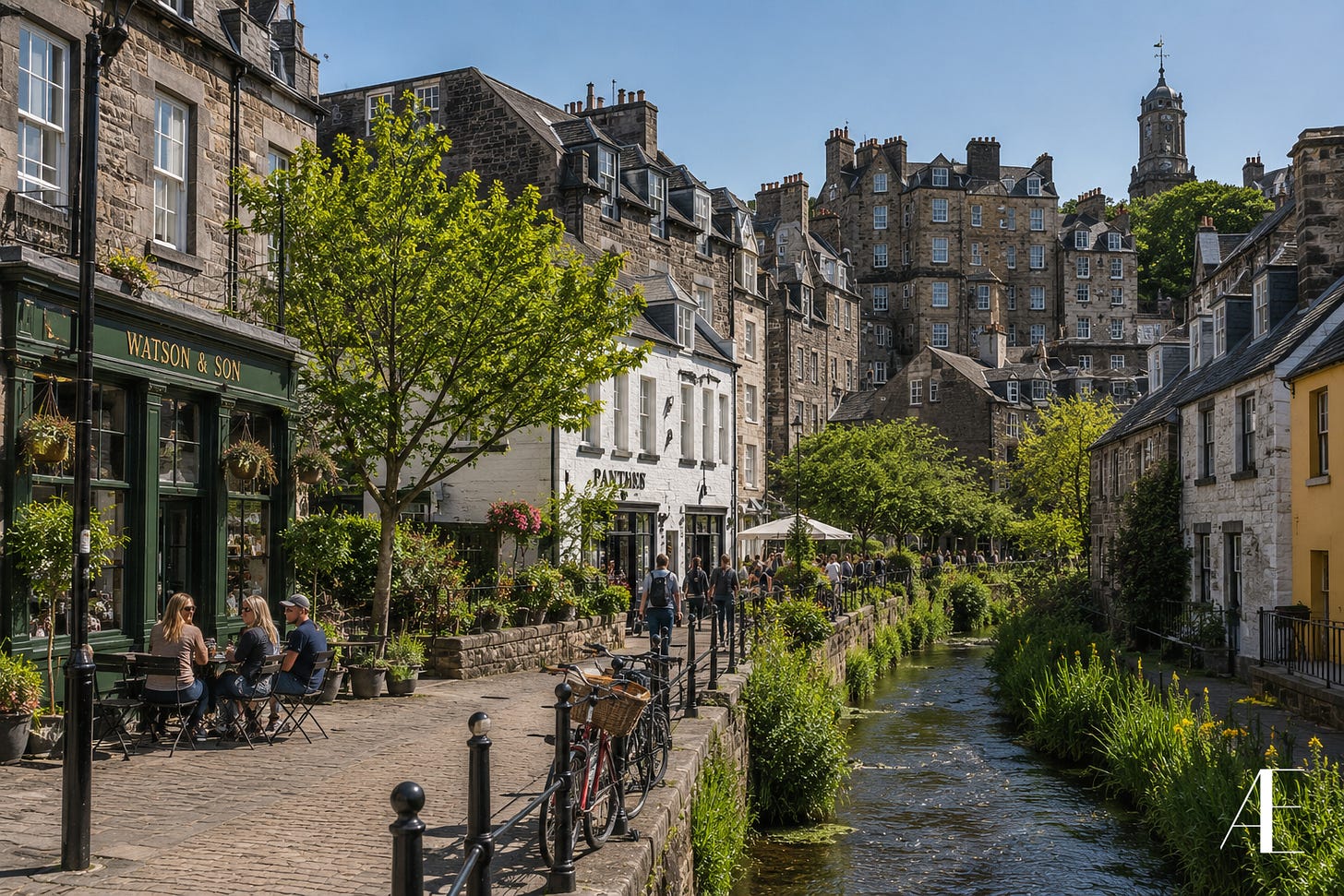
A residential village-within-the-city on the north side of the New Town, straddling the Water of Leith. Independent shops, excellent cafes, a Sunday farmers’ market by the river, Dean Village (a beautifully preserved 19th-century milling settlement five minutes’ walk away), the Royal Botanic Garden Edinburgh.
Character: Residential, leafy, local. One of the most pleasant areas in Edinburgh for aimless walking.
Who it’s right for: Clients who want to see the city beyond the tourist circuit. Best enjoyed on a Sunday.
Southside and Marchmont
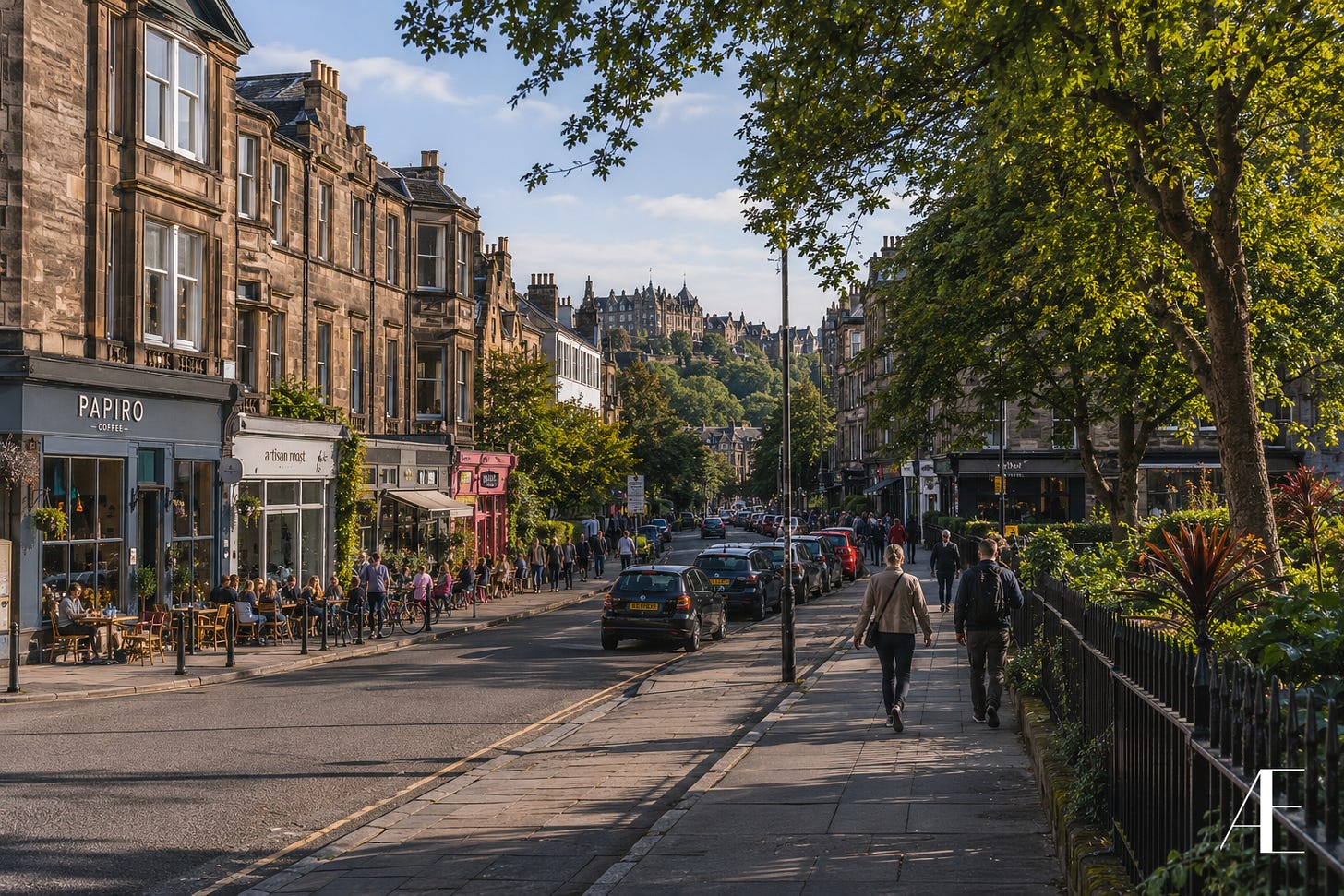
The university quarter south of the Old Town: Victorian residential streets, the Meadows (a large public park separating the Old Town from the suburbs), a concentration of literary cafes and independent bookshops. Less visually dramatic than the rest of the centre, but genuinely representative of how Edinburgh residents actually live.
Who it’s right for: Clients interested in authentic daily Edinburgh. Not a priority for short stays.
Morningside and Bruntsfield
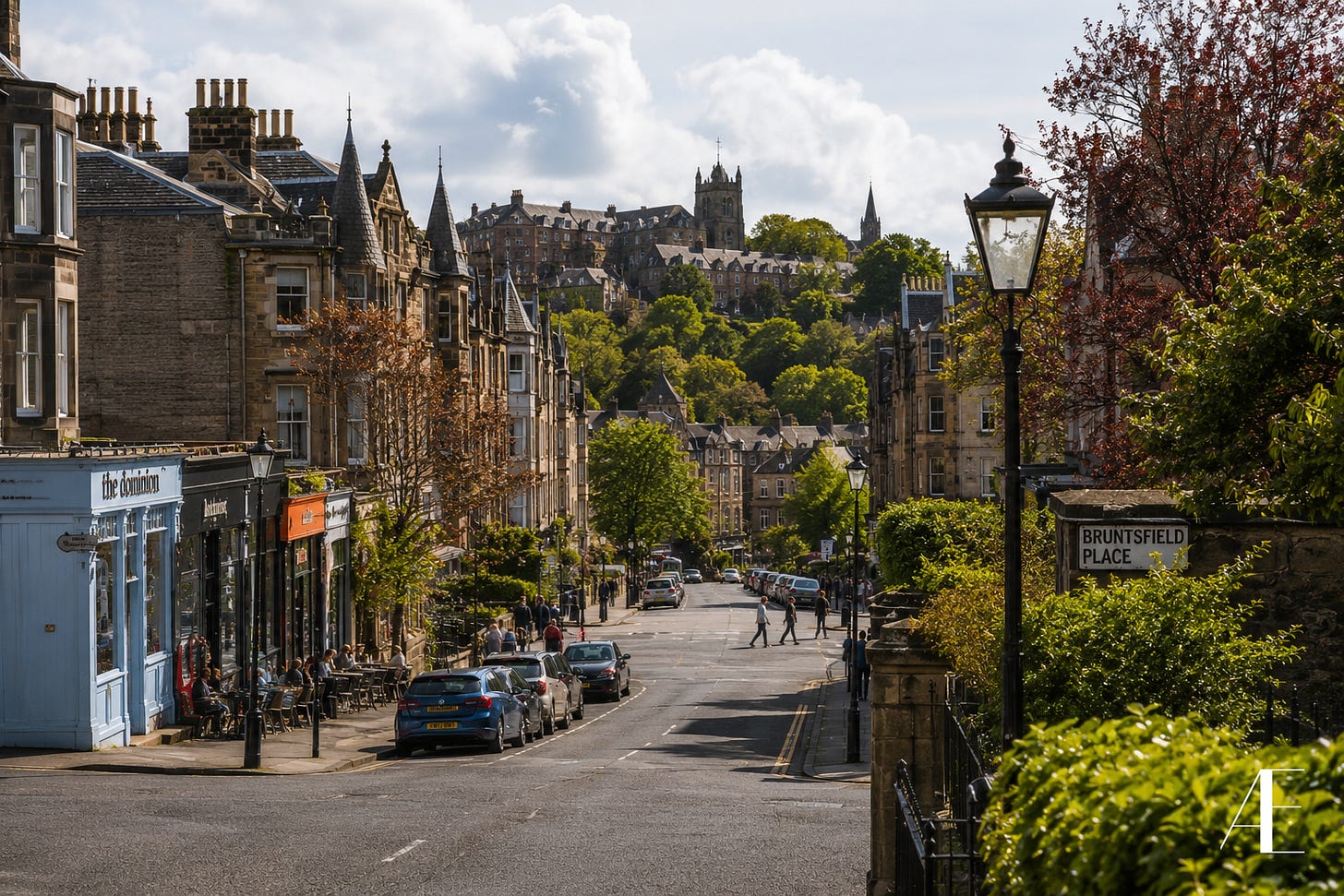
Affluent residential suburbs south of the Meadows: independent cafes, specialist food shops, relaxed dining. The Edinburgh middle class at its most characteristic.
Who it’s right for: Very much a local experience. Relevant for extended stays (7+ days) or clients with specific accommodation here.
Where to Stay for Different Client Types
- First-timers, all client types: Old Town or within 5 min of Princes Street
- Luxury clients: Old Town (Witchery, Balmoral) or New Town (Balmoral, Scotsman)
- Food-focused clients: Leith or New Town
- Quiet, residential feel: New Town (West End) or Stockbridge
- Budget-conscious: New Town (Code Hostel, Rose Street) or Southside
- Families: New Town or Old Town (easy to walk everywhere, no need for car)
What Is Walkable vs. What Requires Transport
Fully walkable from the Old Town or New Town:
- Edinburgh Castle → Holyroodhouse (20 min walk down the Royal Mile)
- Arthur’s Seat (30–40 min walk from Holyroodhouse)
- Greyfriars Kirkyard, Victoria Street
- New Town (10 min from Old Town across Princes Street)
- Scottish National Gallery (at the foot of The Mound)
- Stockbridge (20 min from New Town)
- Grassmarket and Cowgate
Requires tram or taxi:
- Leith / Royal Yacht Britannia (15 min tram, 10 min taxi)
- Edinburgh Airport (30 min tram from Princes Street)
Requires taxi, bus or tour:
- Cramond (beach and Roman fort, 8 km northwest)
- Royal Botanic Garden Edinburgh (15 min walk from Stockbridge or 20 min from centre)
The Overhyped and the Overvisited
- The Elephant House café (George IV Bridge) is marketed as the “birthplace of Harry Potter” but this is not accurate: Rowling did most of her early writing elsewhere. Worth passing, not worth queueing.
- Victoria Street can be extremely crowded in summer; visit early morning for the best experience.
- The Royal Mile between 10am and 4pm in July–August is genuinely overwhelming. Clients should be advised to explore it in the early morning or evening, or to use the closes that run parallel.
The Cruise Connection
The Ports
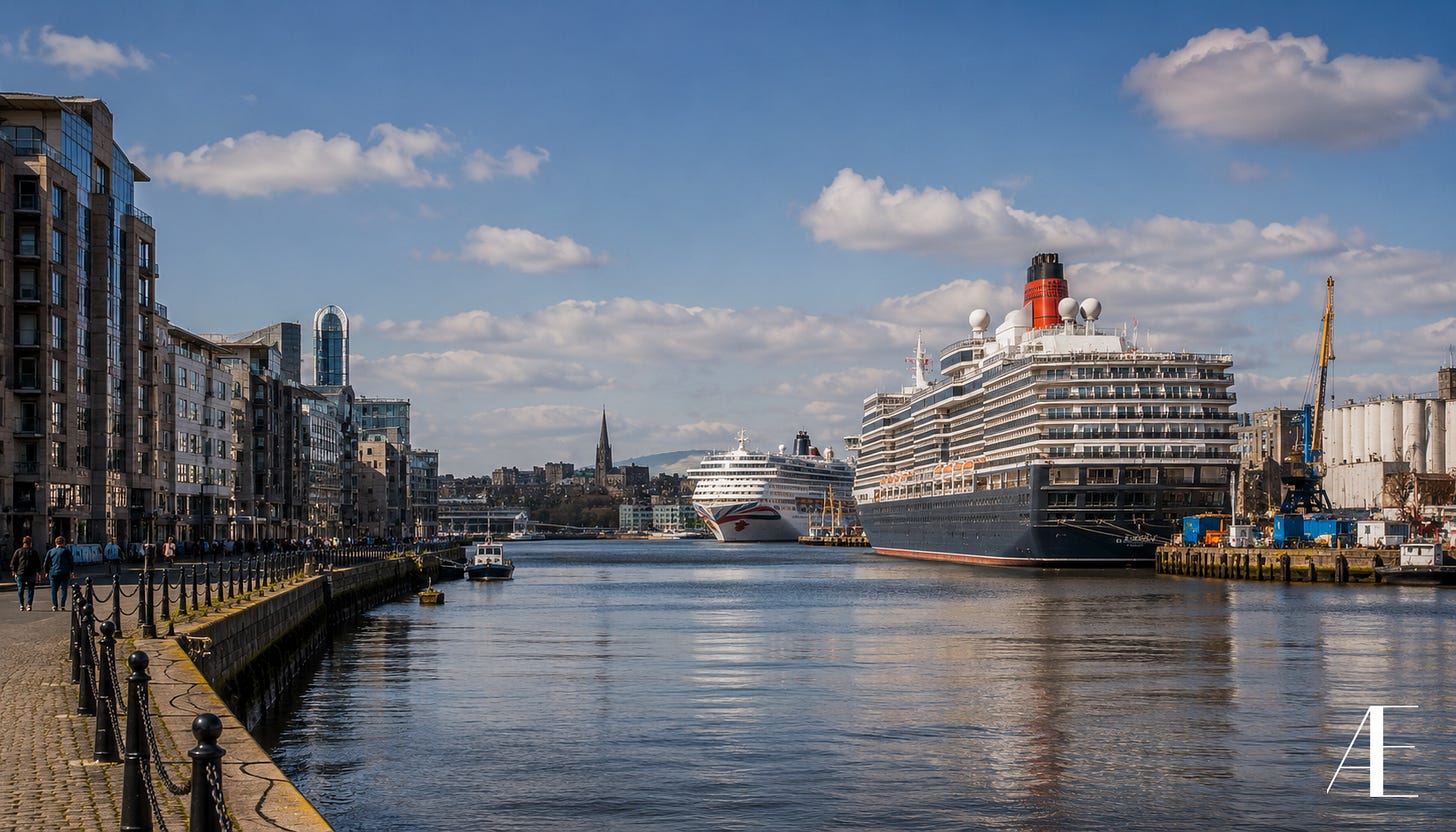
Edinburgh cruise calls can use several different arrival points: Leith, Newhaven, South Queensferry and Rosyth. Agents must confirm the exact port on the cruise documents, because transfer time, tendering, mobility access and shore-excursion planning vary significantly.
Port of Leith (Edinburgh)
Operated by Forth Ports
- Location: Leith docks, approximately 3 km from Edinburgh city centre
- Type: Docking port (no tender required for most calls)
- Transfer time to city centre: Approximately 15 minutes by shuttle or taxi. The tram stop at Newhaven (15 min walk from the berths) connects to Princes Street in approximately 20 minutes.
- Port facilities: Forth Ports operates Ocean Terminal as the primary cruise terminal. Ocean Terminal is itself a large shopping centre; basic terminal facilities including taxi rank, tour bus pickup. The Royal Yacht Britannia is berthed here, and clients can walk directly from the ship.
- Typical call duration: Most calls are full day (8:00–18:00 or 7:00–19:00). Some overnight calls in summer. Rarely a half-day only.
- Best season for cruise calls: May–September. Peak summer (July–August) is very busy in the city; June and September offer better balance.
- Notes for agents: Leith is one of the main Edinburgh cruise arrival points and is especially convenient for clients who want easy access to the city centre, the Royal Yacht Britannia or guided shore excursions.
South Queensferry
- Location: On the Firth of Forth, west of Edinburgh, near the Forth Bridge
- Type: Tender port. Larger ships commonly anchor in the Firth of Forth and tender passengers ashore at South Queensferry.
- Transfer time to city centre: Approximately 30–45 minutes by coach, taxi or excursion transfer, depending on traffic.
- Port facilities: Facilities are more limited than at a full cruise terminal. Guests are typically tendered ashore, then transferred by coach, taxi, private guide or cruise-line excursion.
- Typical call duration: Usually full-day port calls, though the tender operation means guests should allow extra time for disembarkation and return to the ship.
- Notes for agents: South Queensferry is especially important for larger cruise ships. It offers beautiful views of the Forth Bridge and is a common Edinburgh call for major cruise lines, including Norwegian Cruise Line, Virgin Voyages, Princess, Holland America, Celebrity and others, depending on the season. The tender process matters. For clients with mobility limitations, tight private tour schedules or anxiety about returning to the ship on time, this must be discussed clearly before travel.
Port of Rosyth
Located in Fife, north of the Forth
- Location: Rosyth, 20 km northwest of Edinburgh city centre (across the Forth)
- Transfer time to city centre: 35–45 minutes by coach or taxi, depending on bridge traffic. The Forth Bridge road crossing can cause delays.
- Type: Docking port. Primarily used for larger vessels that cannot access Leith.
- Notes for agents: Rosyth is less central than Leith and Newhaven but offers docking rather than tendering. The longer transfer time is worth noting for clients with mobility concerns, limited port time or independently arranged excursions.
Newhaven
A smaller berth within the Port of Leith
- Location: North Edinburgh, close to Leith and the Firth of Forth waterfront
- Type: Tender or harbour call, depending on the ship and operational arrangements.
- Transfer time to city centre: Approximately 20–30 minutes by shuttle, taxi or tram connection, depending on traffic and where guests are transferred from.
- Notes for agents: Newhaven is often treated as an Edinburgh cruise call, but it should not simply be assumed to be the same as Leith. It may involve different arrival logistics, pickup points and mobility considerations. Always verify whether the ship is docking or tendering, and confirm the exact meeting point for excursions.
The key practical point: When a client’s cruise itinerary says “Edinburgh,” never assume the ship is arriving directly in the city. Confirm whether the call is at Leith, Newhaven, South Queensferry or Rosyth. The difference between docking and tendering, and the difference between a 15-minute and a 45-minute transfer, can significantly affect shore-excursion planning, mobility comfort and how much time clients actually have in Edinburgh.
Cruise Lines That Call Here
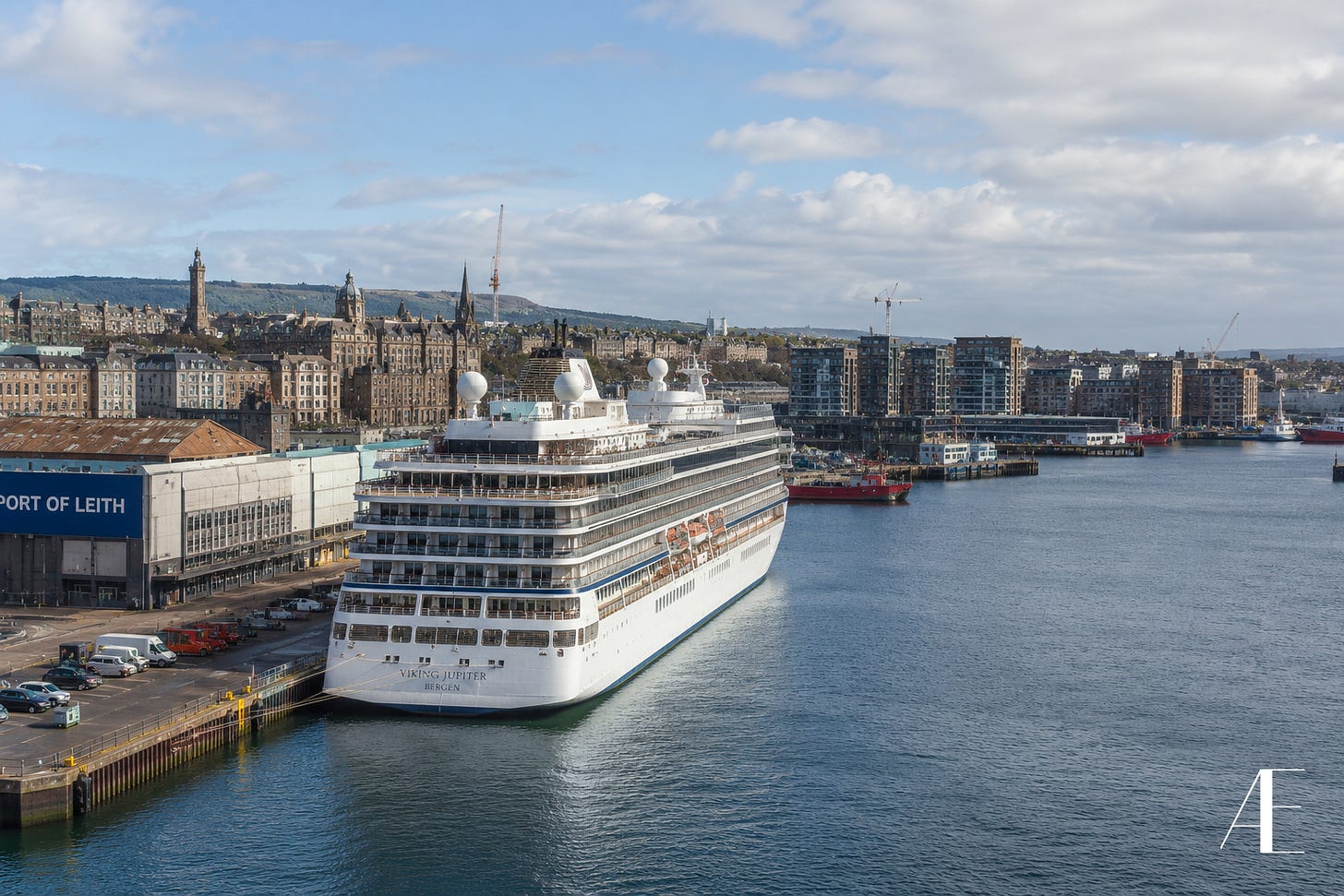
Edinburgh is not served by one single cruise setup. Depending on the ship, date and berth allocation, cruise lines may use Leith, Newhaven, South Queensferry or Rosyth. Agents should avoid assuming that “Edinburgh” means Leith. Larger ships frequently use South Queensferry, where guests tender ashore near the Forth Bridge before transferring into the city.
Cunard Line
- Itineraries: Queen Mary 2, Queen Anne, and Queen Victoria include Edinburgh (Leith) on World Voyage segments, British Isles sailings, and Northern Europe itineraries. Edinburgh is frequently included in the popular “British Isles” summer voyages departing Southampton.
- Port type: Port of call. Southampton is the home port for British Isles itineraries.
- Time allocated: Typically 8–10 hours (full day).
- Included vs. extra: Cunard offers shore excursions bookable through the ship. City highlights and whisky tours are among the most popular. No exclusive Edinburgh arrangements.
- Agent note: Cunard’s British Isles clientele often has strong interest in Scottish history and the Royal connection (the ship may call near the Royal Yacht Britannia, moored in Leith, a particularly apt coincidence worth mentioning).
P&O Cruises
- Itineraries: Arvia, Iona, Britannia, Aurora, and Arcadia operate British Isles itineraries from Southampton that regularly include Edinburgh (Leith). Summer season only.
- Port type: Port of call.
- Time allocated: Full day, typically 8–10 hours.
- Agent note: P&O’s British market means many passengers have their own strong opinions about Scotland. Edinburgh is one of the most popular ports on P&O’s British Isles routes.
Viking Ocean Cruises
- Itineraries: Viking includes Edinburgh on Northern Europe and British Isles itineraries. Check specific seasonal departures.
- Port type: Port of call.
- Time allocated: Full day.
- Agent note: Viking’s destination-focused itineraries typically allow more time per port than mass-market lines. Edinburgh benefits from this. Viking clients are usually very engaged with culture and history: the ideal Edinburgh client profile.
Celebrity Cruises
- Itineraries: British Isles itineraries, typically from Southampton, include Edinburgh (Leith). Eclipse, Silhouette and other ships have operated these routes.
- Port type: Port of call.
- Time allocated: Full day.
- Agent note: Celebrity clients tend to be active and independent. Many will prefer to arrange their own exploration rather than ship excursions.
Princess Cruises
- Itineraries: British Isles and Northern Europe itineraries from Southampton include Edinburgh (Leith).
- Port type: Port of call.
- Time allocated: Full day.
- Agent note: Similar profile to Celebrity; strong Canadian and American client base, and Edinburgh fits the market very well.
Silversea
- Itineraries: British Isles luxury itineraries, Northern Europe sailings.
- Port type: Port of call.
- Time allocated: Full day. Silversea typically allocates generous port time.
- Agent note: Silversea clients in Edinburgh will want private guides, exclusive access, and the finest tables in Leith. The Kitchin (book well in advance), private castle access options, and curated whisky experiences are appropriate.
Holland America Line
- Itineraries: Northern Europe and British Isles itineraries include Edinburgh (Leith).
- Port type: Port of call.
- Time allocated: Full day.
- Agent note: HAL’s older demographic responds particularly well to the history and Royal Yacht. Manageable walking distances and accessible terrain (outside the castle climb) suit many HAL passengers.
MSC Cruises
- Itineraries: British Isles itineraries from European home ports include Edinburgh.
- Port type: Port of call.
- Time allocated: Full day.
- Agent note: MSC’s European-oriented clientele is growing. Edinburgh is a strong draw on these itineraries.
Norwegian Cruise Line (NCL)
- Itineraries: Norwegian Cruise Line includes Edinburgh on selected British Isles, Northern Europe, and Scotland-focused itineraries. NCL commonly markets the call as Edinburgh (South Queensferry), and ships may anchor in the Firth of Forth with guests tendered ashore near the Forth Bridge.
- Port type: Port of call, often tendering at South Queensferry.
- Time allocated: Full day, typically 8–10 hours depending on itinerary.
- Agent note: NCL’s Edinburgh call is especially important to verify operationally because “Edinburgh” may mean South Queensferry rather than Leith. This affects transfer time, tendering, private tour timing, and mobility planning. NCL clients often respond well to Edinburgh Castle, Royal Mile highlights, whisky experiences, and St Andrews excursions for golf-oriented travellers.
Virgin Voyages
- Itineraries: Virgin Voyages includes Edinburgh on selected British Isles and Northern Europe sailings. Valiant Lady has appeared on South Queensferry cruise schedules, with guests tendering ashore for Edinburgh-area visits.
- Port type: Port of call, typically tendering at South Queensferry when operating larger-ship Edinburgh calls.
- Time allocated: Full day.
- Agent note: Virgin Voyages attracts a younger, adult-only, experience-driven clientele than many traditional British Isles operators. Edinburgh works well for clients interested in food, nightlife, independent exploration, photography, whisky, festivals, and less traditional shore experiences. Confirm the tender arrangements carefully, especially for clients arranging private guides or restaurant reservations in the city.
Fred. Olsen Cruise Lines
- Itineraries: One of the British-focused lines with the strongest Scottish presence. Bolette, Balmoral and other vessels operate Scottish and British Isles itineraries with significant time in Scottish ports. Rosyth is used for larger vessels.
- Port type: Port of call, sometimes turnaround.
- Time allocated: Full day, occasionally overnight.
- Agent note: Fred. Olsen’s almost entirely British market and strong Scottish itinerary focus make Edinburgh one of the line’s most significant ports. Clients often have strong personal connections to Scotland.
Hebridean Island Cruises
- Vessels: Hebridean Princess and Hebridean Sky (the latter operating under a different brand).
- Itineraries: Specialist small-ship Scottish operator. Edinburgh (Leith or Newhaven) is occasionally used as a home port or port of call.
- Port type: Home port or port of call depending on itinerary.
- Agent note: Hebridean Princess holds a Royal Warrant: it has been chartered by the Royal Family. Maximum 50 passengers. All-inclusive. The premium Scottish small-ship experience. Appropriate for the highest-tier clients who want Scotland in depth, not just Edinburgh.
Selling the Port Call
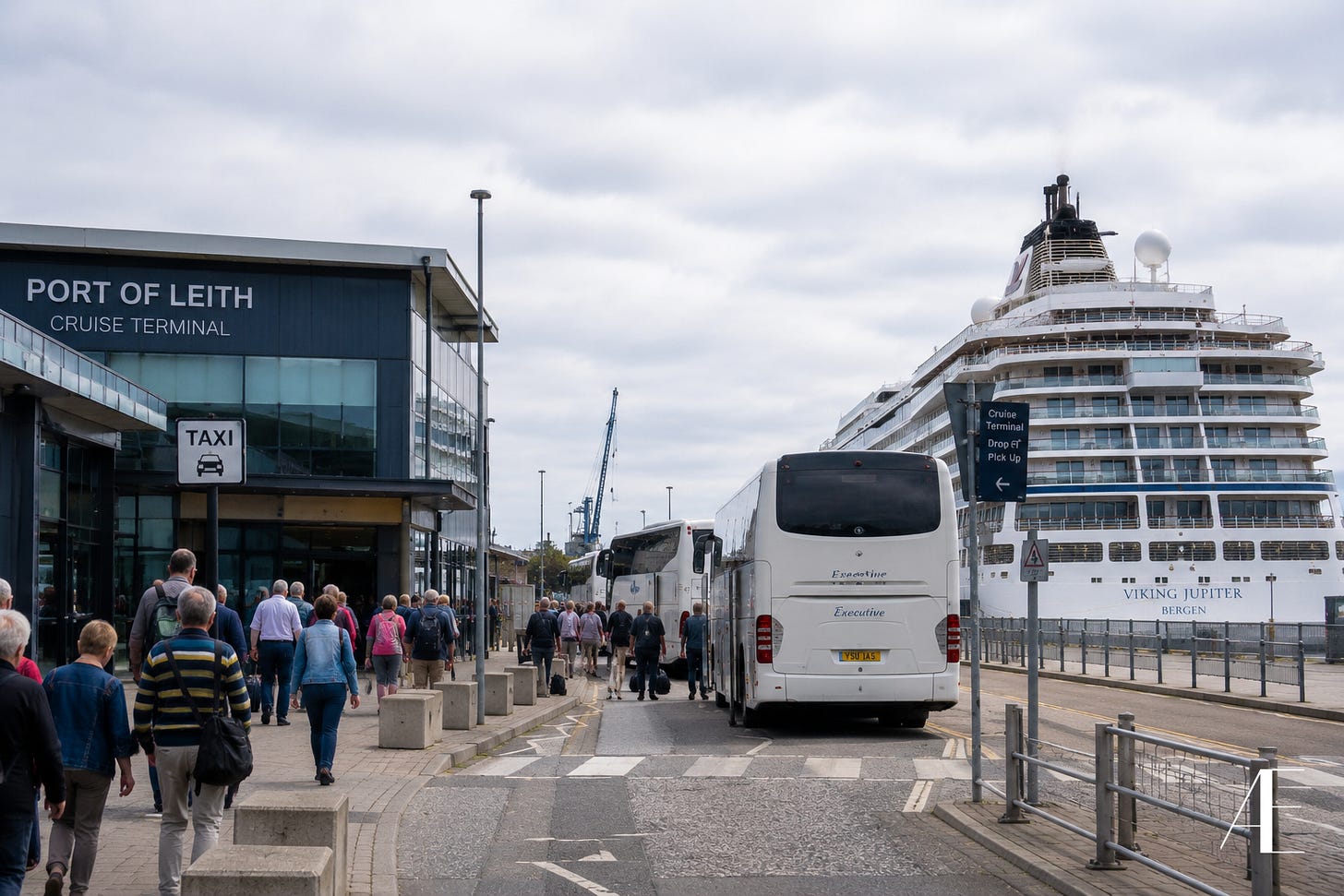
What is realistically possible in a half-day port call (4–5 hours ashore)?
Half-day port calls are uncommon in Edinburgh, but they do occur. With 4–5 hours:
- Edinburgh Castle: 2 hours (allow at minimum 1.5 hours, 2.5 for thorough visit). This is the priority.
- Walk the upper Royal Mile (Lawnmarket, High Street): 30–45 min
- Lunch in the Grassmarket or a Royal Mile pub: 45 min
- Return to port
Alternatively: Skip the castle and do the Royal Mile, Greyfriars Kirkyard, and the lower Royal Mile to Holyroodhouse: more walkable, less queuing. The castle requires 2+ hours to do justice.
Practical reality: Edinburgh Castle requires booking in advance. On busy summer cruise days, clients who haven’t pre-booked may face significant queues or unavailability. This is the single most important thing agents need to communicate to cruise clients before embarkation.
What is realistic in a full day port call (8–10 hours ashore)?
- Edinburgh Castle (2–2.5 hours, pre-booked)
- Walk the Royal Mile, visit Greyfriars Kirkyard, explore a close or two (1.5 hours)
- Lunch in the Grassmarket or Leith (45 min–1 hour)
- Afternoon: Palace of Holyroodhouse OR Royal Yacht Britannia in Leith (both are excellent, difficult to do both thoroughly in one afternoon)
- Calton Hill for evening views (30 min) before returning to ship
Best shore excursions offered by the major lines:
- City highlights tour: Standard, covers the major sites by coach. Efficient but not deep. Suitable for clients who cannot walk long distances.
- Edinburgh Castle and Royal Mile walking tour: The most consistently recommended option. Gets clients into the castle with a guide who provides context.
- Scotch whisky tour: Combines the Scotch Whisky Experience with an optional distillery visit (Glenkinchie, 25 km outside Edinburgh, is the closest). Excellent for the right client.
- Loch Ness and the Highlands day trip: Available on some full-day calls. Significant drive time; only appropriate if the call is 9+ hours and there is a true touring interest.
What agents should book independently vs. through the ship:
- Book independently: Edinburgh Castle (cheaper and more flexible via Historic Scotland direct). Royal Yacht Britannia (ticket.royalyachtbritannia.co.uk). Scotch Whisky Experience (scotchwhiskyexperience.co.uk).
- Book through the ship: Coach-based tours for clients with mobility limitations. Loch Ness day trips (logistics are complex).
- Self-guided: The Royal Mile, Greyfriars Kirkyard, Princes Street Gardens, Calton Hill: all free and straightforward without a guide.
The insider detail that makes the agent look good: The One O’Clock Gun fires from Edinburgh Castle every day at 1:00 PM precisely, except Sundays. It has done so since 1861. Clients on the castle esplanade at 12:58 should move to the Half Moon Battery for the best viewpoint. Tell them this before they go. They will mention it for the rest of the trip.
What to warn clients about:
- Cobblestones: The Royal Mile and most Old Town streets are heavily cobbled. Wheelie luggage is impractical; heels are ill-advised.
- The castle climb: The approach to the castle from the Esplanade is steep. Clients with significant mobility limitations should be advised; there are alternative transport options within the castle complex but the entrance approach itself involves a gradient.
- Distances are deceptive: The Royal Mile looks short on a map but takes far longer on foot than it appears, especially when exploring the closes.
- Summer crowds: In July and August, the Royal Mile between 10am and 4pm is extraordinarily crowded. Early mornings or evenings are significantly better.
- Weather: Even in summer, clients should carry a waterproof. The Edinburgh weather is famously changeable.
The Attractions & Experiences
Edinburgh Castle
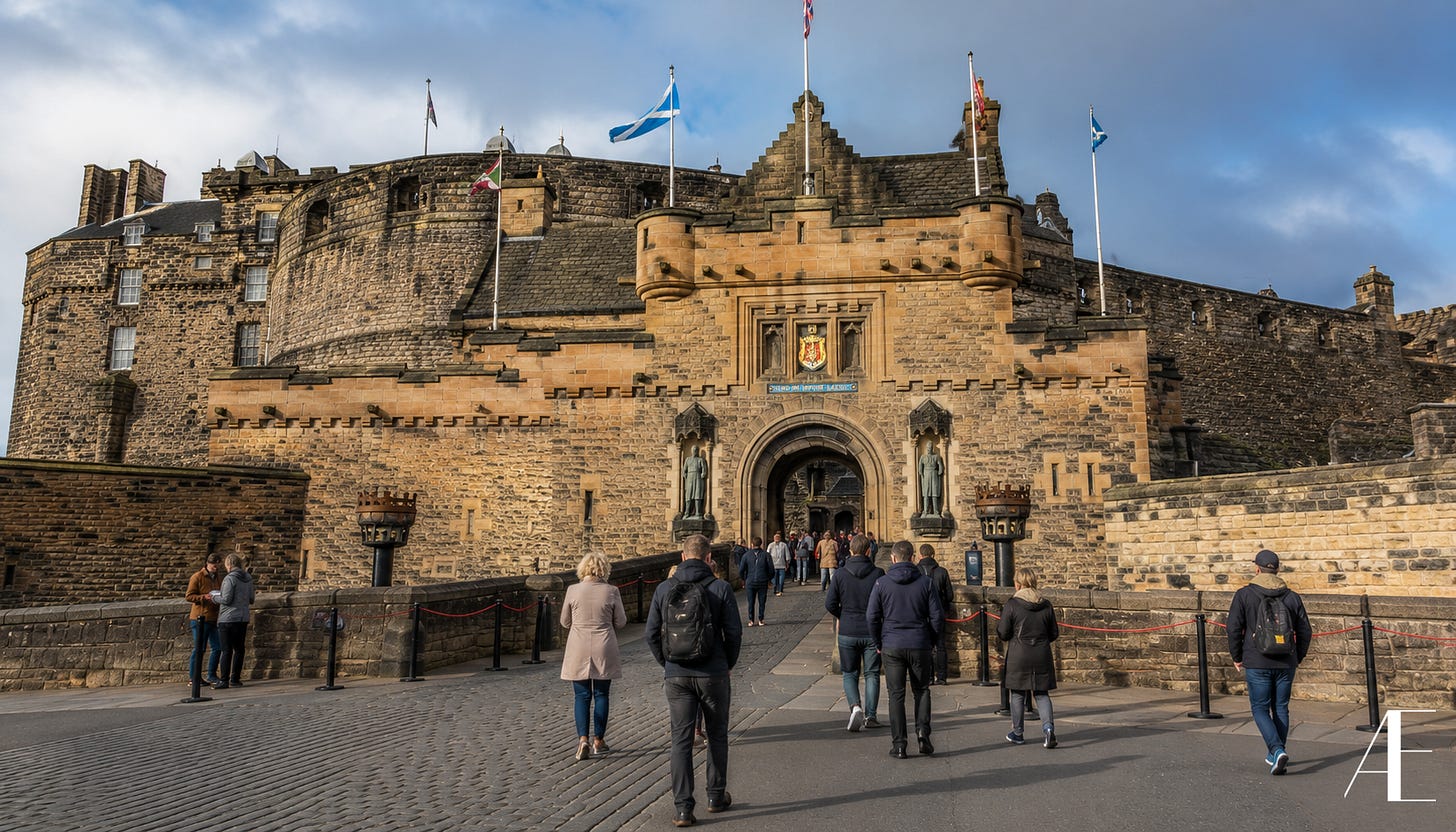
What it is and why it matters
The most visited monument in Scotland (approximately 2.2 million visitors annually) and one of the most strategically significant fortresses in British history. Built on a volcanic plug that has been occupied since the Iron Age, the castle served as a royal residence, a military headquarters, a prison (French and other prisoners during the Napoleonic Wars were held here), and a working army garrison until 1923. It remains a military installation; the Scottish Division is headquartered here and the castle is formally garrisoned.
The crown jewels of Scotland, the Honours of Scotland (crown, sceptre and sword of state), are on permanent display in the Crown Room. They are the oldest crown jewels in the British Isles, predating the English crown jewels by more than a century (the English jewels were melted down and destroyed during the Commonwealth; the Scottish ones survived by being hidden in a church in Dunnottar). Also in the Crown Room: the Stone of Destiny, on which Scottish (and later British) monarchs are crowned, returned to Scotland in 1996 after 700 years in Westminster Abbey.
St Margaret’s Chapel, in the upper ward, is the oldest surviving building in Edinburgh, dating from the early 12th century. Tiny and whitewashed, it can accommodate approximately 20 people. It is still used for weddings.
The Great Hall, built for James IV around 1511, is one of the finest medieval great halls in Scotland: a hammer-beam roof of Scottish oak, rebuilt historically, in one of the most impressive single interior spaces in the castle.
Practical details
- Opening hours: Generally 9:30am–6:00pm (summer), 9:30am–5:00pm (winter). Hours vary: verify at historicenvironment.scot.
- Admission: Approximately £21.50–£24.00 for adults (2026). Always verify current pricing.
- Pre-Booking: Essential in summer (June–August) and advisable year-round. Book the tickets through GetYourGuide or Viator to get a commission.
- Walk-up queues can be 45–60 minutes in peak season.
- Time to allow: Minimum 1.5 hours; 2.5 hours for a thorough visit. A full morning is comfortable.
What clients often miss or get wrong
Many visitors spend their time at the crown jewels and the views and miss St Margaret’s Chapel, the Great Hall, and the Scottish National War Memorial (a deeply moving building). Also frequently missed: the Prisons of War exhibition, which is genuinely excellent.
The detail worth knowing
The One O’Clock Gun has fired every weekday at 1pm since 1861. Originally designed to signal the correct time to ships in the Firth of Forth (before radio), it remains one of the great Edinburgh daily rituals. Position clients on the Half Moon Battery at 12:58 for the best experience.
Book your client’s tickets through GetYourGuide or Viator to get your commission.
The Palace of Holyroodhouse
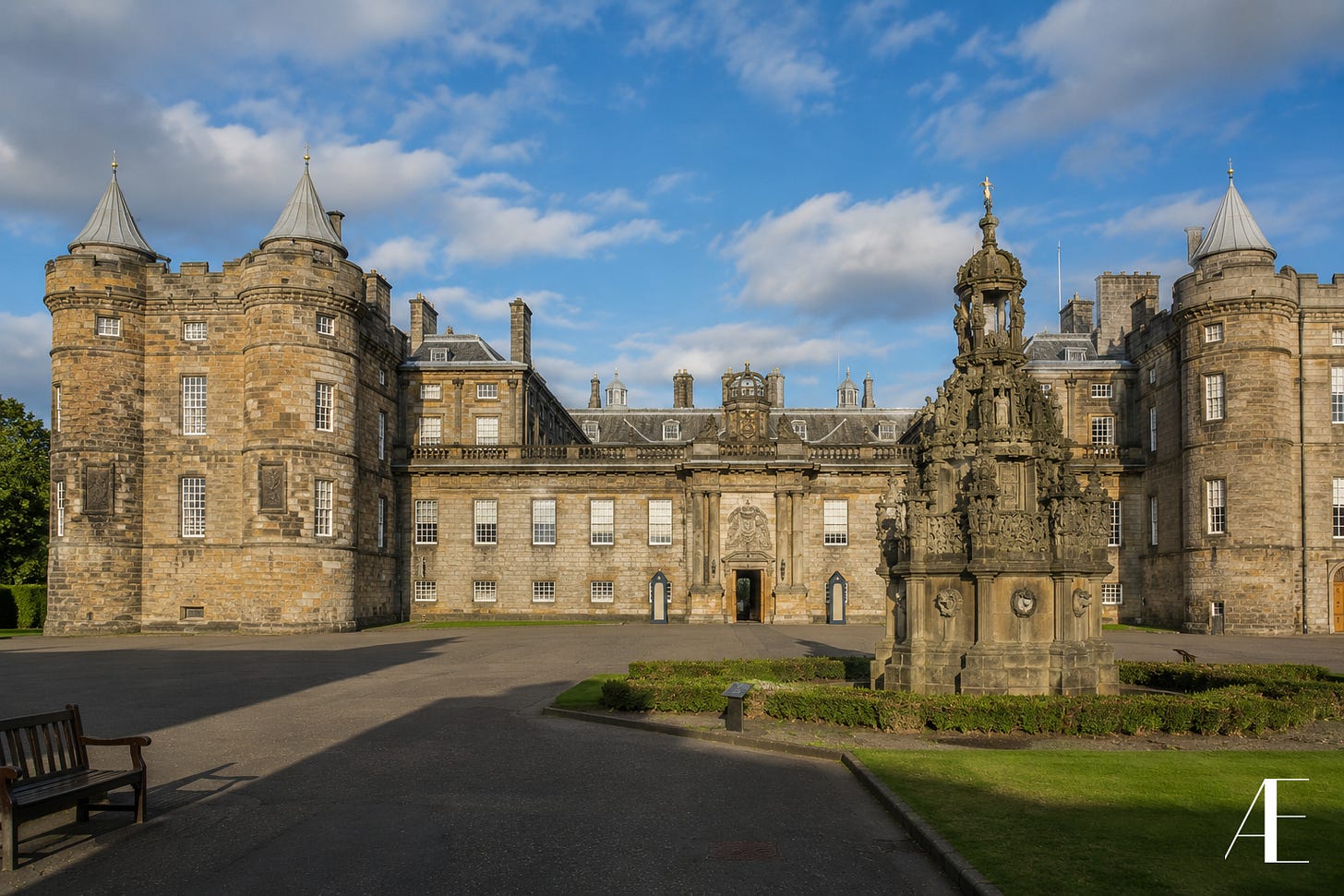
What it is and why it matters
The official Scottish residence of the reigning British monarch, at the foot of the Royal Mile beneath the volcanic heights of Arthur’s Seat. The palace began as a guest house for Holyrood Abbey, founded by David I in 1128; the ruined nave of the abbey church is still visible in the grounds, open to visitors. The existing palace dates primarily from the 17th century (built for Charles II), though the northwest tower is 16th century and contains the apartments most associated with Mary Queen of Scots.
Mary’s apartments in the northwest tower are among the most historically charged rooms in Scotland. Her outer chamber, bedchamber, and a small supper room (the room where her secretary David Rizzio was murdered) are preserved and interpreted. The bloodstain shown in the floor is not original (it has been replaced many times) but the room itself, and its tiny scale, are unexpectedly affecting.
The Great Gallery contains 89 portraits of Scottish monarchs, from the legendary Fergus I to Charles II, all commissioned in two years from Jacob de Wet the Younger in the 1680s. The portraits of the earlier kings are confected (de Wet had no source material) but the artistic project, asserting the antiquity and legitimacy of the Scottish crown, is historically interesting.
The palace is closed to visitors when the Royal Family is in residence. This is typically for one week in late June/early July (the Royal Week or Holyrood Week). Always check for closures.
Practical details
- Opening hours: 9:30am–4:30pm (winter), 9:30am–6:00pm (summer). Varies: check royalcollection.org.uk.
- Admission: Approximately £18.00–£20.00 for adults (2026).
- Pre-Booking: Recommended in summer. Walk-up usually available outside peak season.
- Time to allow: 1.5–2 hours for the palace; extra time if exploring the abbey ruins and grounds.
What clients often miss
Holyrood Park immediately behind the palace is 260 hectares of genuine wild landscape in the centre of a capital city. Arthur’s Seat, the ruined St Anthony’s Chapel, Dunsapie Loch: all accessible directly from the palace grounds.
Book your client’s tickets through GetYourGuide or Viator to get your commission.
Arthur’s Seat
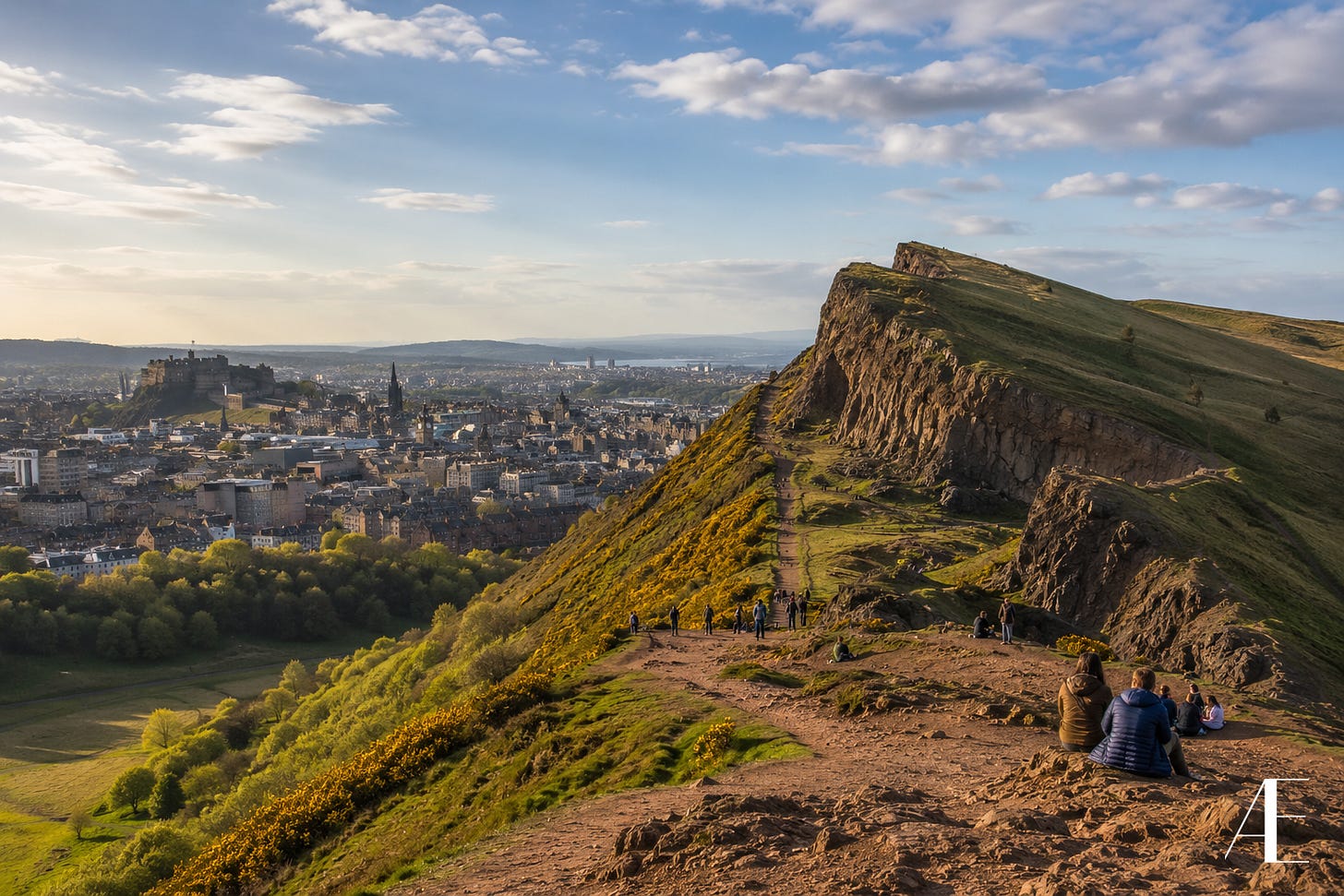
What it is and why it matters
The main peak of a group of ancient volcanic hills rising to 251 metres in the heart of the city, entirely within Holyrood Park. The climb to the summit is the finest urban walk in Europe, with extraordinary views across Edinburgh, the Firth of Forth, Fife, and on clear days to the Highland mountains.
Practical details
- Free to access. No booking required.
- Multiple routes to the summit. The most straightforward begins from the Holyrood Park Road near St Margaret’s Loch, following the Volunteer’s Walk route (approximately 45–60 minutes at a gentle pace).
- Best time to go: Early morning (7–9am) for the light, the relative solitude, and the full drama of the city below. Sunset is spectacular but crowded in summer.
- Difficulty: Moderate. The final section involves a short scramble over volcanic rock. Not suitable for clients with significant mobility limitations. Appropriate for averagely fit clients of most ages.
- Footwear: Proper walking shoes strongly recommended. Trail trainers minimum. Regular city shoes are inadvisable.
What clients often miss
Most visitors climb Arthur’s Seat and return the same way. The full loop around the entire Holyrood Park, past Duddingston Loch, the ruins of St Anthony’s Chapel, Dunsapie Loch, takes 2–3 hours and is extraordinary. Recommend this for the right client.
The detail worth knowing
In 1836, a group of boys hunting rabbits on the north face of Arthur’s Seat discovered a cache of 17 miniature coffins, each containing a tiny carved figure dressed in cotton. The origin and purpose of the Arthur’s Seat coffins has never been satisfactorily explained; the most compelling theory links them to the Burke and Hare body-snatching murders of 1828. Eight of the original coffins are on display at the National Museum of Scotland.
The National Museum of Scotland
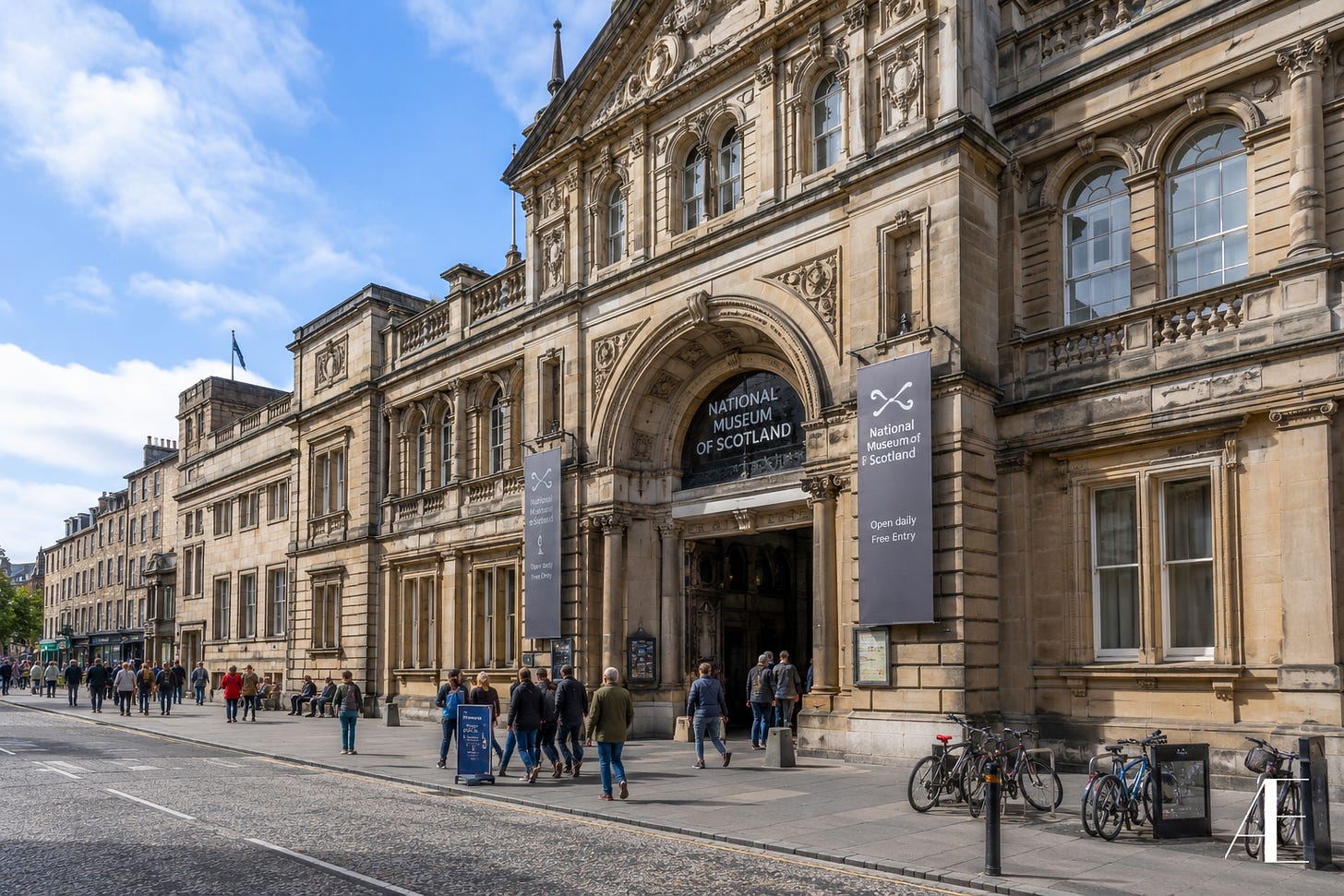
What it is and why it matters
One of the finest free museums in the United Kingdom, covering Scottish history from the earliest prehistoric settlement through to the present day, as well as natural history, science, technology, world cultures and decorative arts. Two buildings: a Victorian edifice (1861) and a spectacular contemporary extension (1998) designed by Benson + Forsyth, combined into a single complex on Chambers Street.
Why it matters
For any client visiting Edinburgh, this museum is the single most comprehensive way to understand Scotland: its people, its history, its contributions to global science and industry, its natural landscape, and its contemporary culture. The interactive quality is high; it works for all ages.
Highlights include
Dolly the sheep (the first cloned mammal, who was born at the Roslin Institute near Edinburgh in 1996 and is preserved here), the Lewis Chessmen (a set of 12th-century chess pieces found on the Isle of Lewis in 1831; most are in the British Museum in London but 11 pieces are here), the Maiden (Edinburgh’s 16th-century beheading machine, used from 1564 to 1710, including on the man who invented it), and an extraordinarily rich collection of Scottish gold, silver and decorative arts.
Practical details
- Opening hours: 10:00am–5:00pm daily.
- Admission: Free for permanent collections. Temporary exhibitions may have charges.
- Booking: Not required for permanent collections.
- Time to allow: Minimum 2.5 hours; a full day is not wasted here.
What clients often miss
The roof terrace, accessible via the Victorian building, offers one of the least-known views in Edinburgh: looking north over the Old Town rooftops to the castle. Free, rarely crowded.
Book a tour with a local guide through GetYourGuide or Viator to get a commission.
The Scottish National Gallery
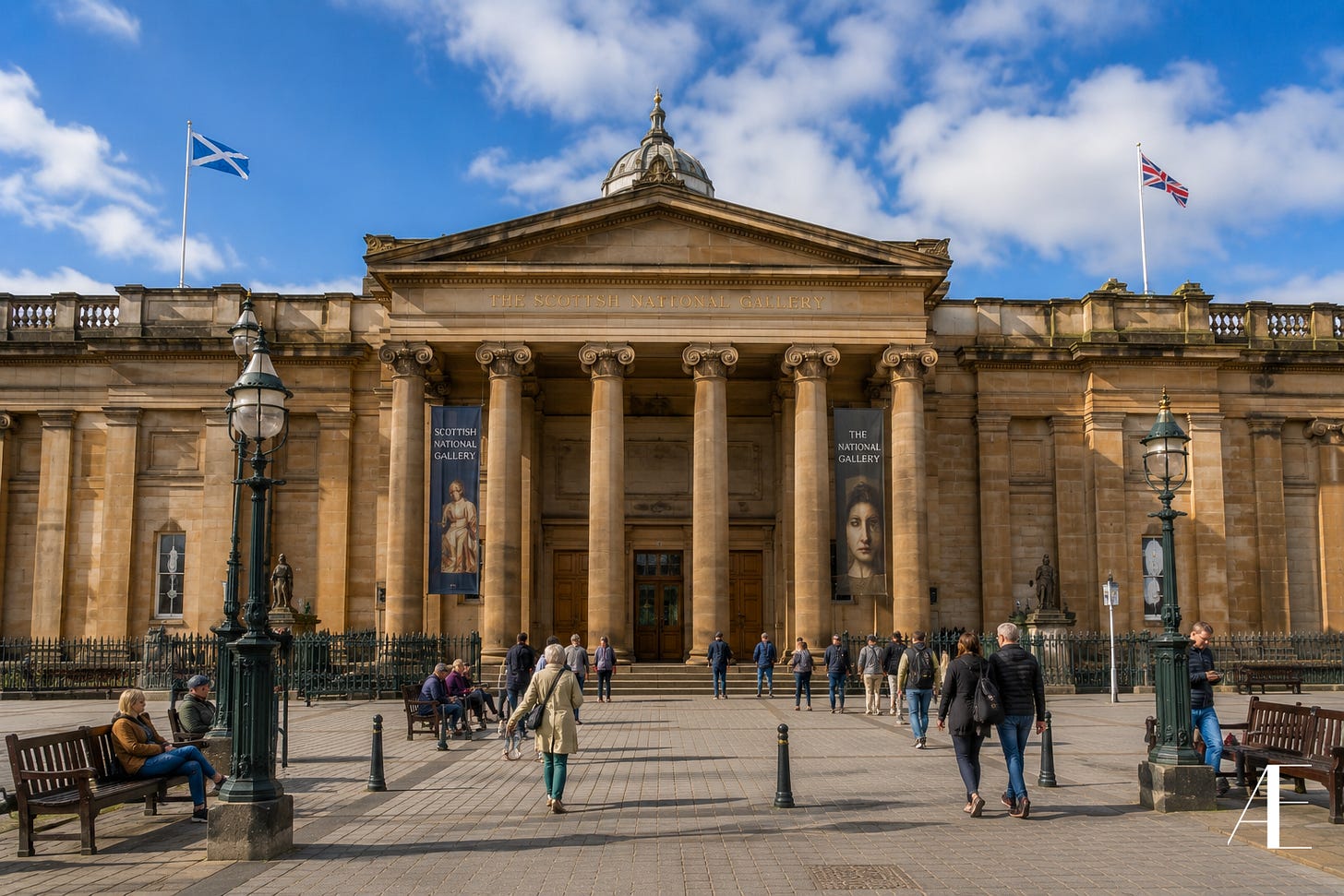
What it is and why it matters
Scotland’s national collection of fine art, housed in a handsome neoclassical building on The Mound between the Old Town and New Town. The collection covers European painting from the early Renaissance to the late 19th century and is of genuinely world-class quality.
Key works include Vermeer’s Christ in the House of Martha and Mary, El Greco’s An Allegory, Botticelli, Raphael, Titian, Velázquez, Rembrandt, Rubens, Constable, Turner, and, particularly strong, the Scottish masters: Allan Ramsay, Henry Raeburn and David Wilkie. The Scottish Impressionists (the Glasgow Boys, the Scottish Colourists) are well represented.
Practical details
- Opening hours: 10:00am–5:00pm daily (Thursdays until 7:00pm).
- Admission: Free for permanent collections.
- Time to allow: 2–3 hours for thorough visit; 1 hour for highlights.
Pair with
The Scottish National Portrait Gallery on Queen Street (New Town), also free, which has an outstanding collection of historical and contemporary Scottish portraiture in one of Edinburgh’s finest Victorian buildings. The Scottish National Gallery of Modern Art (two buildings on Belford Road) is a 20-minute walk from the centre.
Book a tour with a local guide through GetYourGuide or Viator to get a commission.
Greyfriars Kirkyard
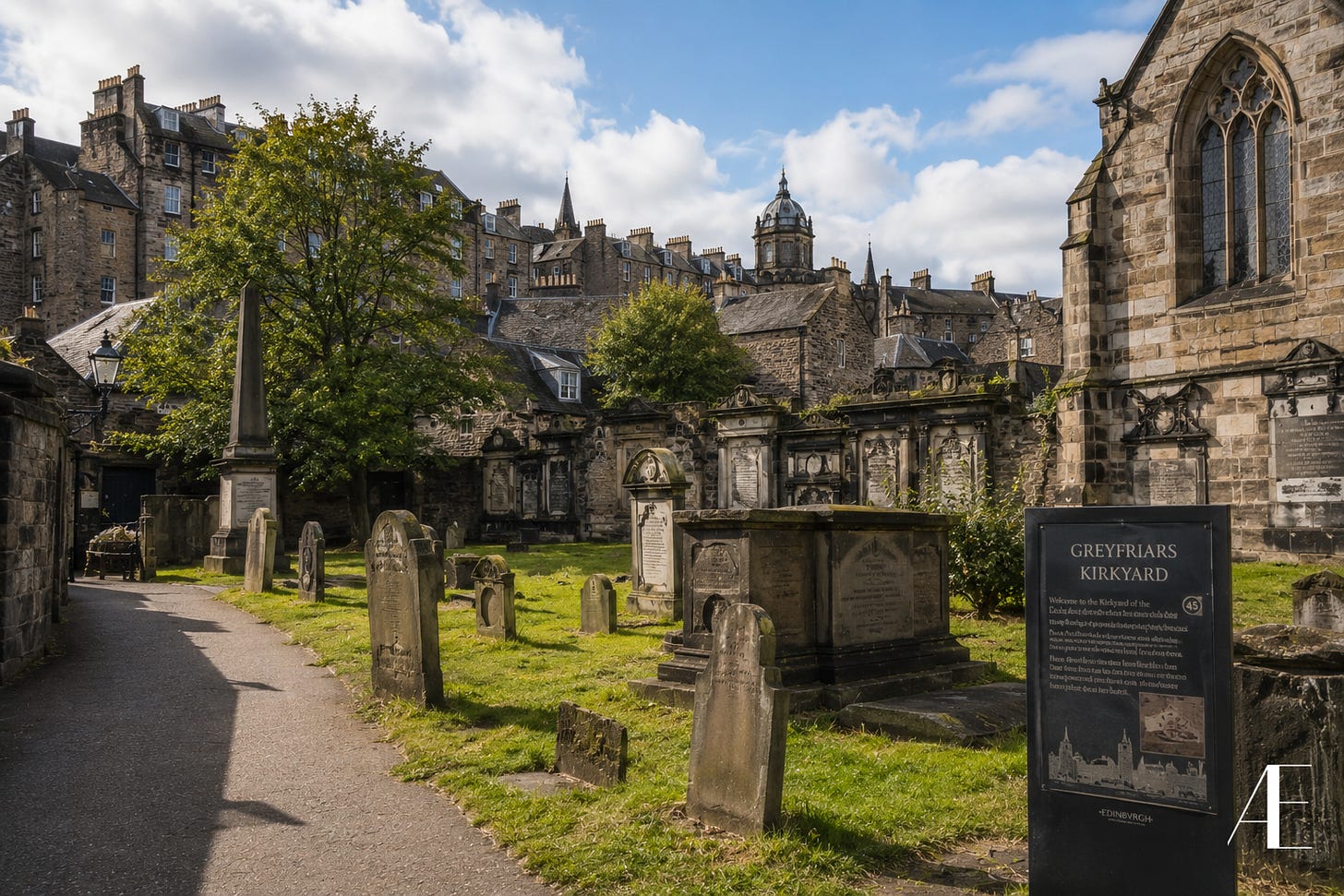
What it is and why it matters
One of Edinburgh’s most visited and most atmospheric spaces: a historic cemetery attached to Greyfriars Kirk, in use since 1562.
Significant for multiple reasons
- The Covenanting Martyrs’ Prison: the Covenanters (Scottish Presbyterians who refused to accept the King’s control over the Church) who were imprisoned here in open air in 1679 following the Battle of Bothwell Brig. Around 400 prisoners were held here in terrible conditions for five months in what is now called the Covenanters’ Prison, a locked section of the graveyard.
- Greyfriars Bobby: the Skye Terrier who, according to the legend (and the well-documented historical record), guarded his owner John Gray’s grave in this kirkyard for 14 years after Gray’s death in 1858. Bobby died in 1872. His small statue on the south side of Greyfriars Kirk is one of the most photographed in Edinburgh. The story has genuine historical support: Bobby’s collar is in the Museum of Edinburgh.
- The Harry Potter connection: the kirkyard contains headstones with names that appear directly in J.K. Rowling’s books: Thomas Riddell (Tom Riddle/Lord Voldemort), McGonagall, Moodie, and others. This is one of the strongest documented links between Edinburgh and the books.
- George Heriot’s School: visible from the kirkyard, the magnificent 17th-century school building that is the strongest visual candidate for Hogwarts.
Practical details
- Open daily. Free admission (except the locked Covenanters’ Prison, which requires a paid tour).
- Time to allow: 30–45 minutes independently. 1 hour with the Covenanters’ Prison tour.
- Go at dawn or dusk for the atmosphere. It is one of the more atmospheric spaces in Scotland at any hour.
Book a tour with a local guide through GetYourGuide or Viator to get a commission.
The Royal Yacht Britannia
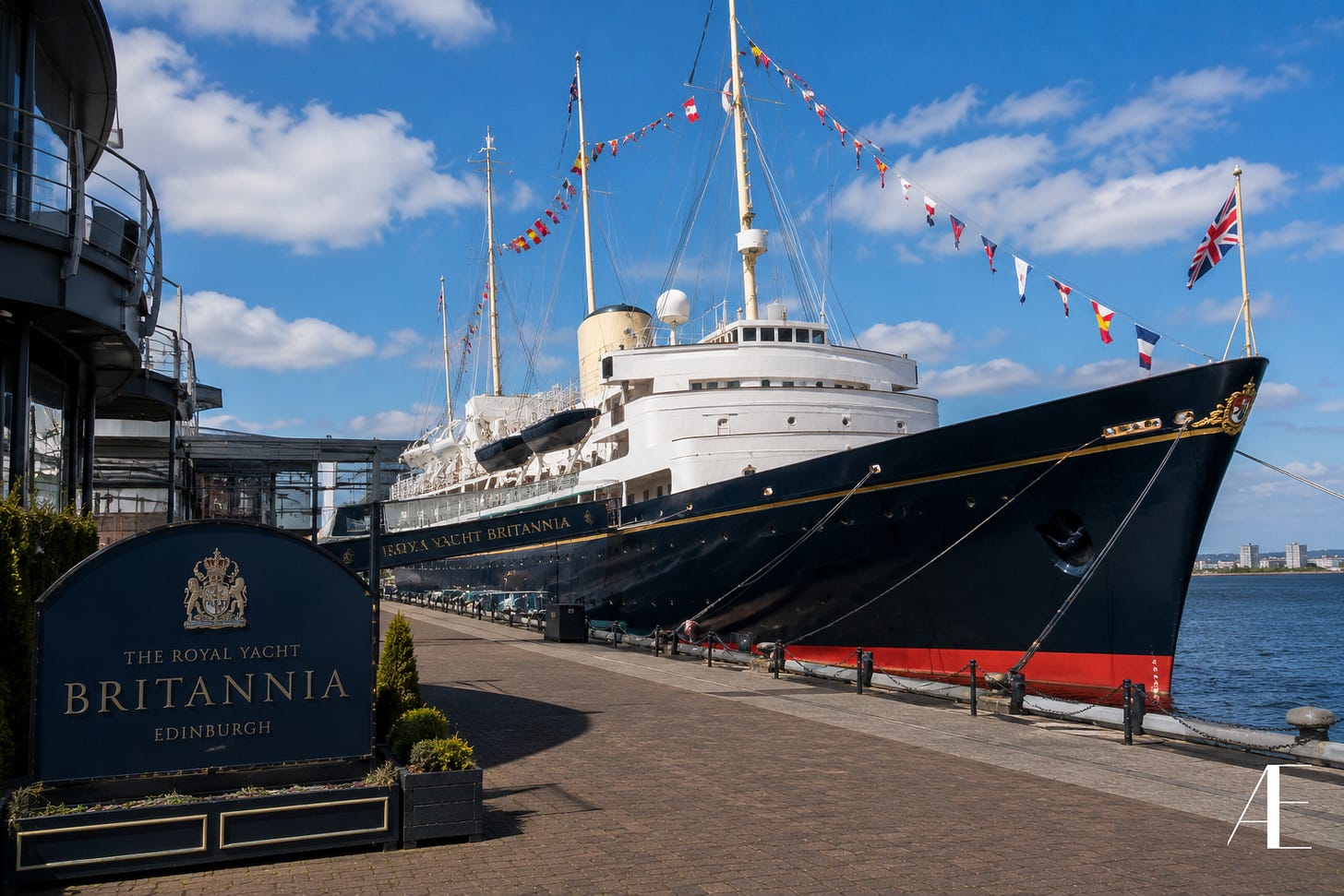
What it is and why it matters
The former Royal Yacht, used by the British Royal Family from 1954 to 1997, moored permanently at Ocean Terminal in Leith since decommissioning. Open to the public as a guided audio tour covering the entire vessel: royal apartments, state dining room, officers’ quarters, engine room, the Yacht’s bridge.
Why it is worth visiting
The Britannia is a time capsule of a particular kind of British life: the furnishings, fittings, and domestic arrangements are preserved exactly as they were in 1997. The royal quarters are not what most visitors expect: modest in scale, domestically comfortable rather than palatially grand, with family photographs, the Queen’s record collection, and the Duke of Edinburgh’s study exactly as he left them. It is unexpectedly moving.
The yacht hosted Royal honeymoons (Charles and Diana, Anne and Mark Phillips, Andrew and Sarah Ferguson), state banquets for heads of government, and was used in support of British commercial interests worldwide. The story of its decommissioning and the reported tears of Queen Elizabeth II at the farewell ceremony is part of the visit.
Practical details
- Location: Ocean Terminal, Leith. 15 min by tram from Princes Street.
- Opening hours: 9:30am–5:30pm (summer), 10:00am–5:00pm (winter). Varies: check royalyachtbritannia.co.uk.
- Admission: Approximately £21.00 for adults (2026). Book online in advance.
- Time to allow: 2–2.5 hours.
Pair with
Lunch at one of the Leith Shore restaurants (the Kitchin, the Scran & Scallie, or the Shore Bar & Restaurant) after the visit. This is the ideal Leith half-day: Britannia in the morning, lunch at The Shore.
Book your client’s tickets through GetYourGuide or Viator to get your commission.
The Scotch Whisky Experience
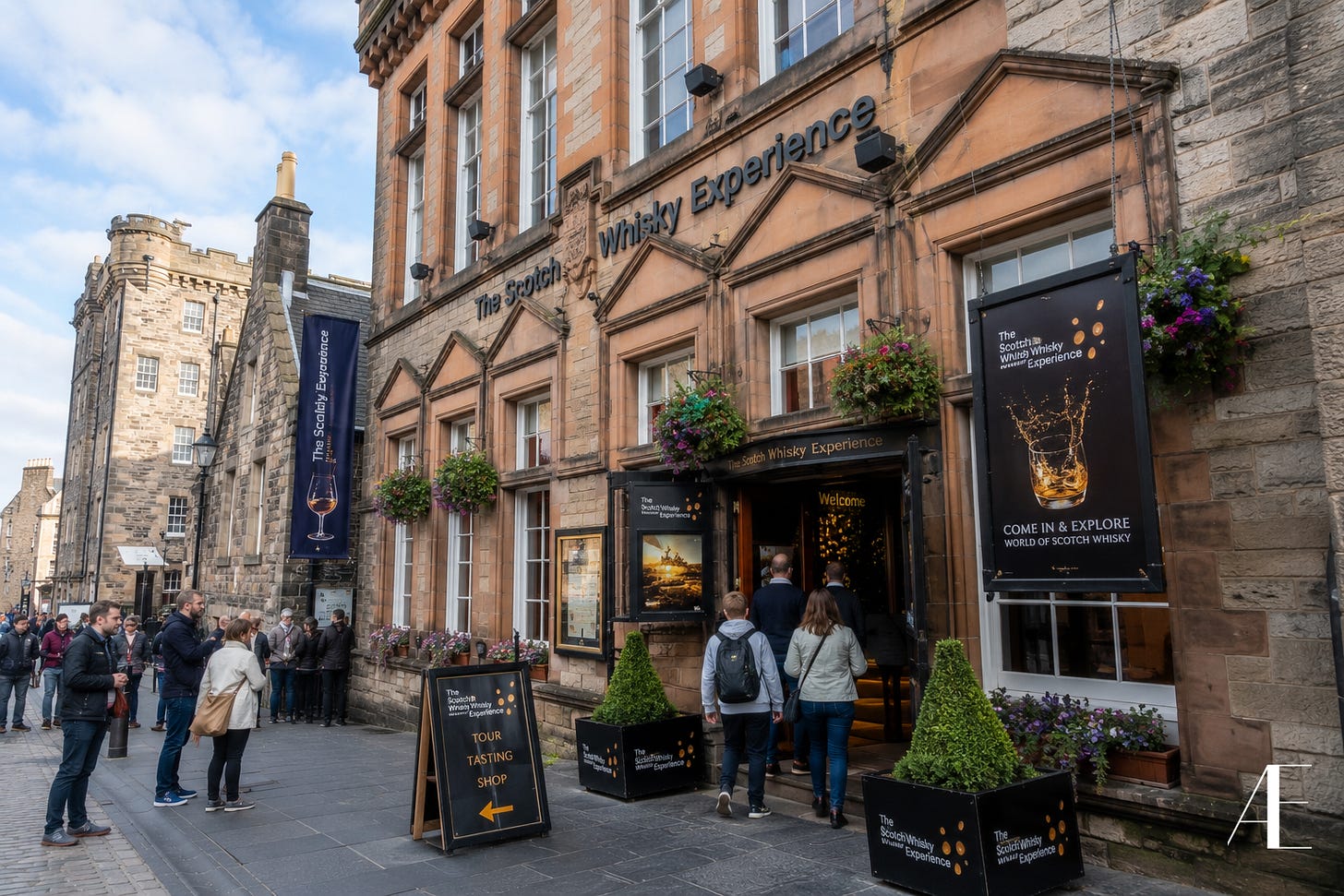
What it is and why it matters
The most comprehensive whisky education experience available without leaving Edinburgh, located at the top of the Royal Mile just below the castle. The guided tour covers the five Scotch whisky production regions (Highlands, Lowlands, Speyside, Islay, Campbeltown), the production process, and the regional flavour profiles, culminating in a guided tasting of representative whiskies. The vault holds one of the world’s largest private whisky collections (over 3,500 bottles).
Why it matters for agents
Many clients are interested in whisky but do not know how to navigate it. The Scotch Whisky Experience gives them a framework for understanding what they are tasting on the rest of their Scottish trip. It makes every subsequent whisky experience more meaningful, whether at a distillery, in a Highland pub, or at a Leith bar.
Practical details
- Opening hours: 10:00am–6:30pm (last tour 5:00pm). Times vary: check scotchwhiskyexperience.co.uk.
- Admission: The basic Silver Tour (the standard guided experience with one tasting) is approximately £19.00. Premium tours with more extensive tastings are available.
- Booking: Strongly recommended, especially in summer.
- Time to allow: 1 hour for the basic tour. Longer for premium options or time in the bar.
Book your client’s tickets through GetYourGuide or Viator to get your commission.
The Bow Bar and the Edinburgh Pub Experience
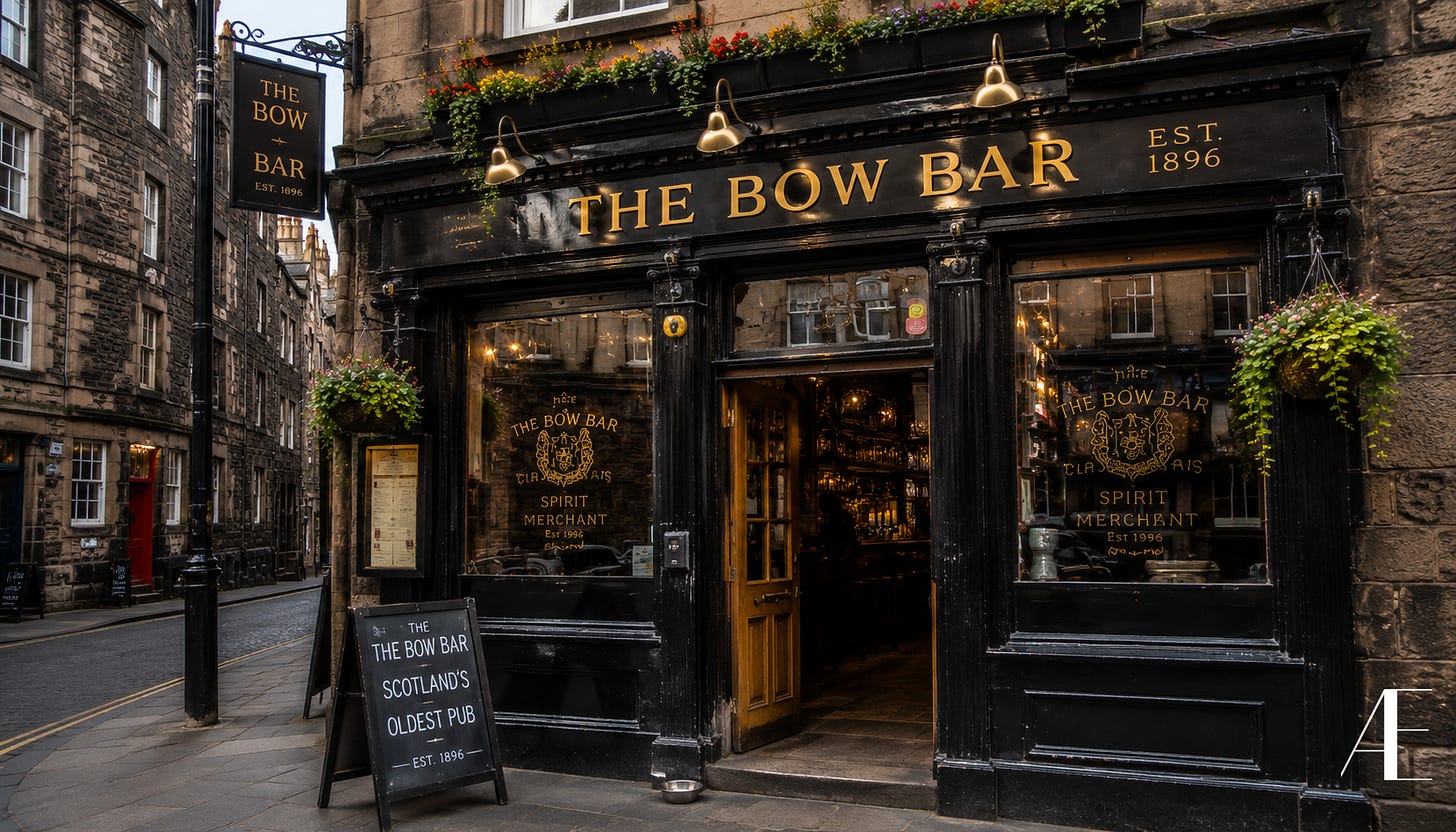
What it is and why it matters
An evening in an Edinburgh pub is not an optional extra. It is a defining experience of the city. The pub tradition in Edinburgh is distinct from England: noisier, less formal, with a strong tradition of folk music (trad sessions) on weekends. Single malt Scotch whisky is the drink of the city, and the better pubs carry selections that rival specialist whisky bars.
Key pubs
- The Bow Bar (West Bow, Old Town): One of the finest selections of single malt Scotch whisky in the city, in a traditional Victorian pub without music or food. The benchmark.
- Café Royal (West Register Street, New Town): The finest-preserved Victorian pub interior in Edinburgh, with oval portrait tiles, stained glass, and ornate plasterwork. The circular bar is one of the most beautiful pub interiors in the UK.
- The Oxford Bar (Young Street, New Town): Inspector Rebus’s local, made famous by Ian Rankin’s novels. A small, unassuming, absolutely authentic Edinburgh pub. No food, minimal décor, strong regulars. The anti-tourist tourist pub.
- Sandy Bell’s (Forrest Road, Southside): Traditional folk music almost every evening. One of the great trad music pubs of Scotland.
- The Last Drop (Grassmarket): Name refers to the executions that took place in the Grassmarket. Atmospheric location, castle views, good whisky selection.
Book a tour with a local guide through GetYourGuide or Viator to get a commission.
Mary King’s Close
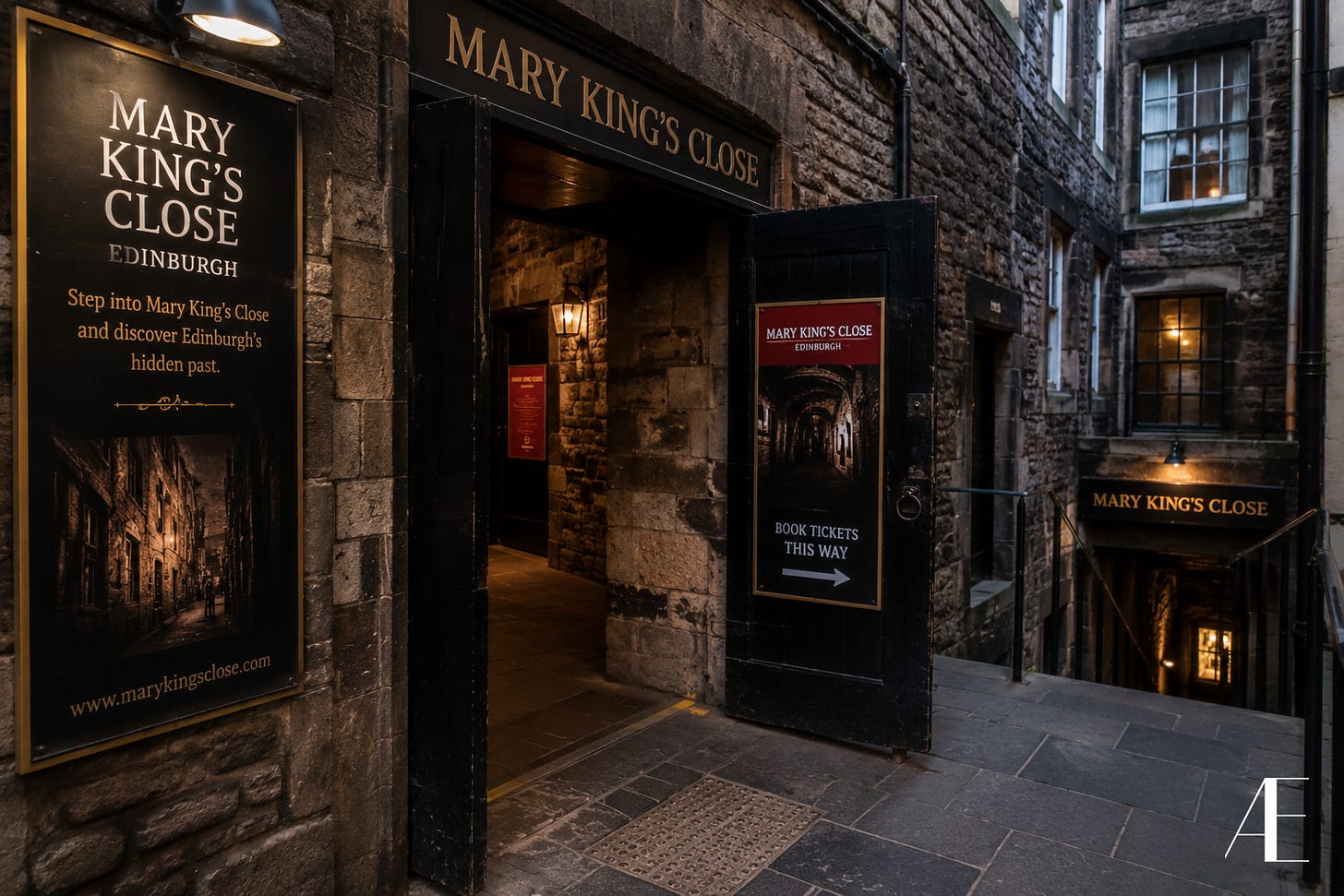
What it is and why it matters
A preserved network of underground closes (alleyways) beneath the Royal Mile, sealed off in the 17th century when the Royal Exchange (now the City Chambers) was built over them. The existing lower floors of the old buildings, including parts of residential rooms, a merchant’s house, and a narrow medieval alleyway, are preserved beneath the current street level and accessible by guided tour.
Why clients respond to it
The experience of walking through an actual 17th-century Edinburgh street, below the current city, is unlike anything available in comparable British cities. The guides are storytelling-focused and the atmosphere is genuinely remarkable.
What clients often misunderstand
Mary King’s Close is not a horror attraction, though it is marketed with some ghost-tour elements. It is a serious historical site with good interpretation. Worth distinguishing for clients who might otherwise dismiss it.
Practical details
- Location: Royal Mile (Warriston’s Close, off the Royal Mile)
- Opening hours: Vary seasonally. Generally 10:00am–5:00pm (winter), later in summer.
- Admission: Approximately £18.00 for adults (2026). Book in advance: this sells out on busy days.
- Time to allow: 75 minutes (the tour is fixed-length).
Book a tour with a local guide through GetYourGuide or Viator to get a commission.
Calton Hill
What it is and why it matters
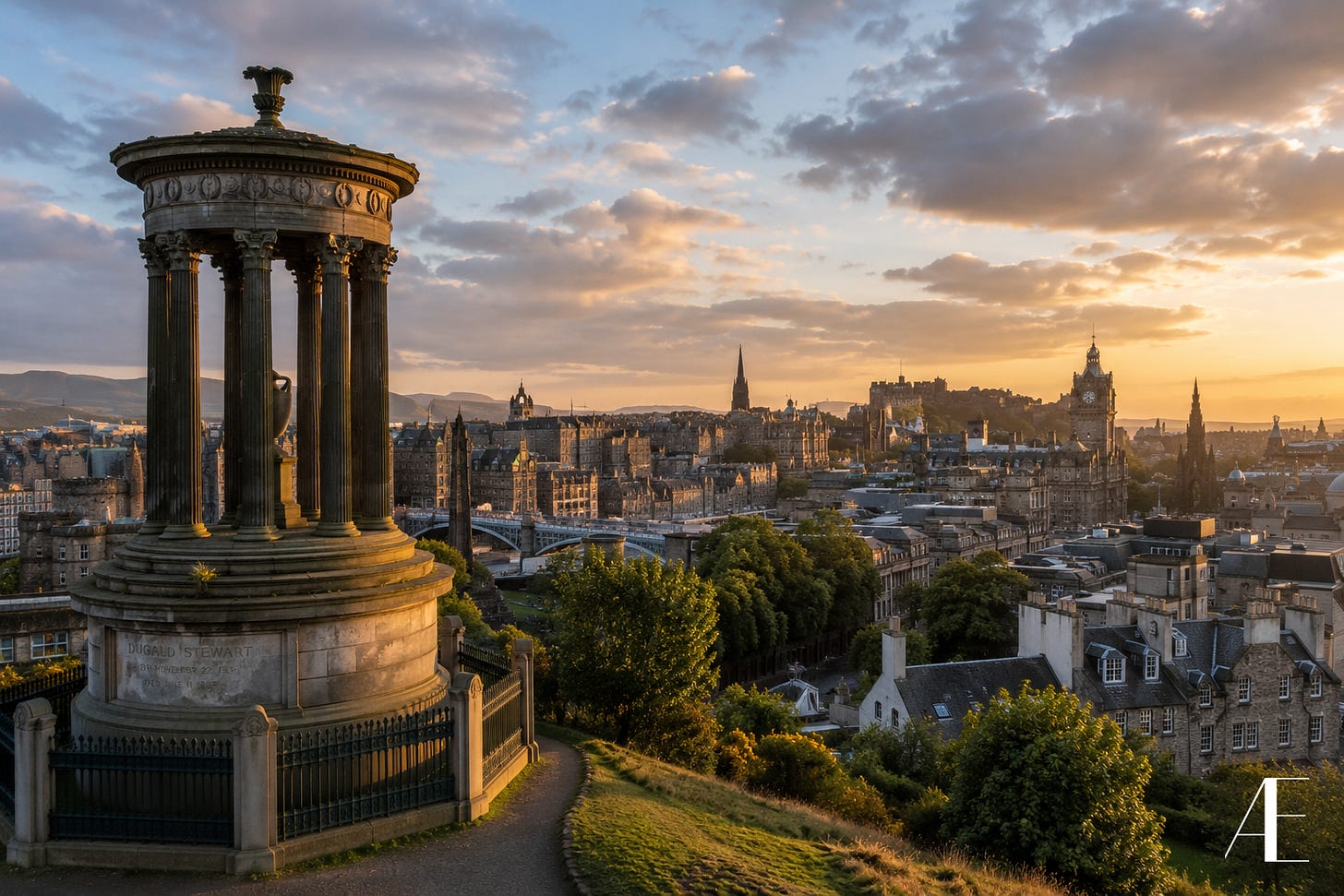
A volcanic hill at the east end of Princes Street, dotted with neoclassical monuments and offering one of the finest panoramic views over Edinburgh: the castle, Arthur’s Seat, the Forth, the New Town, and the sea. The unfinished National Monument (modelled on the Parthenon, begun in 1826 and abandoned when funds ran out) gives the hill its nickname: “Edinburgh’s Disgrace” or, alternatively, “Edinburgh’s Parthenon.”
Free, open at all hours, 10-minute walk from Princes Street. The finest view in central Edinburgh, in the author’s view, particularly at dawn or dusk. Not overhyped. Often undervisited relative to Arthur’s Seat.
Book a tour with a local guide through GetYourGuide or Viator to get a commission.
Victoria Street and the Grassmarket
What it is and why it matters
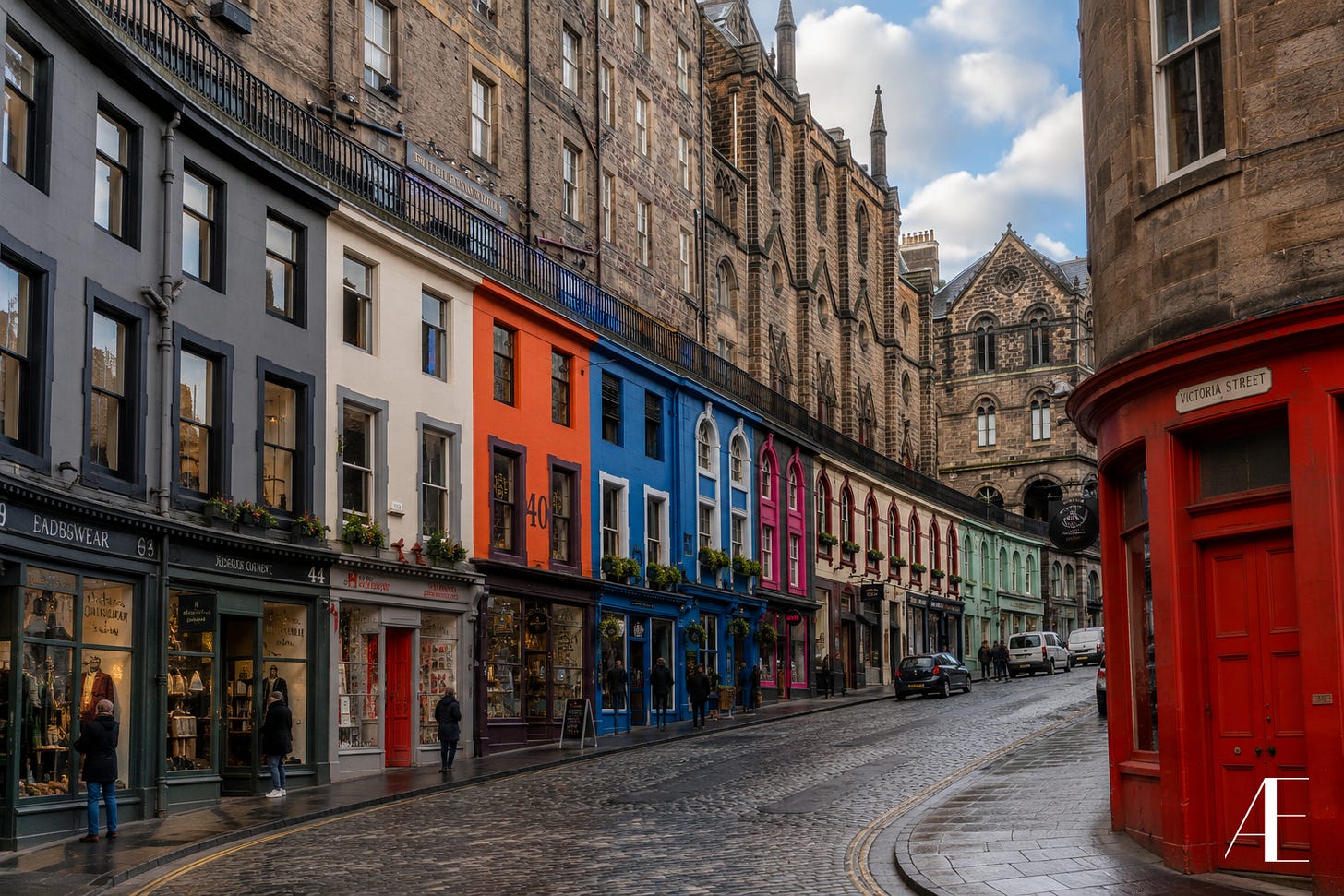
Victoria Street is a curved, cobbled, two-tier street running from George IV Bridge down to the Grassmarket, lined with colourful shopfronts and independent businesses. It is widely considered the visual inspiration for Diagon Alley in the Harry Potter books, though Rowling has never officially confirmed this. The curving, layered quality of the street, with shops at both levels and the bridge above, is visually unlike anywhere else in Edinburgh.
The Grassmarket at its foot is the former market square and place of public execution, now lined with pubs and restaurants. The view of the castle from the Grassmarket, rising on its rock directly overhead, is one of the dramatic viewpoints in the city.
Best for
All clients, especially Harry Potter-interested visitors. Victoria Street is most enjoyable in the morning before the tourist rush.
Book a tour with a local guide through GetYourGuide or Viator to get a commission.
The Day Trips & Regions to Visit
Stirling and Bannockburn
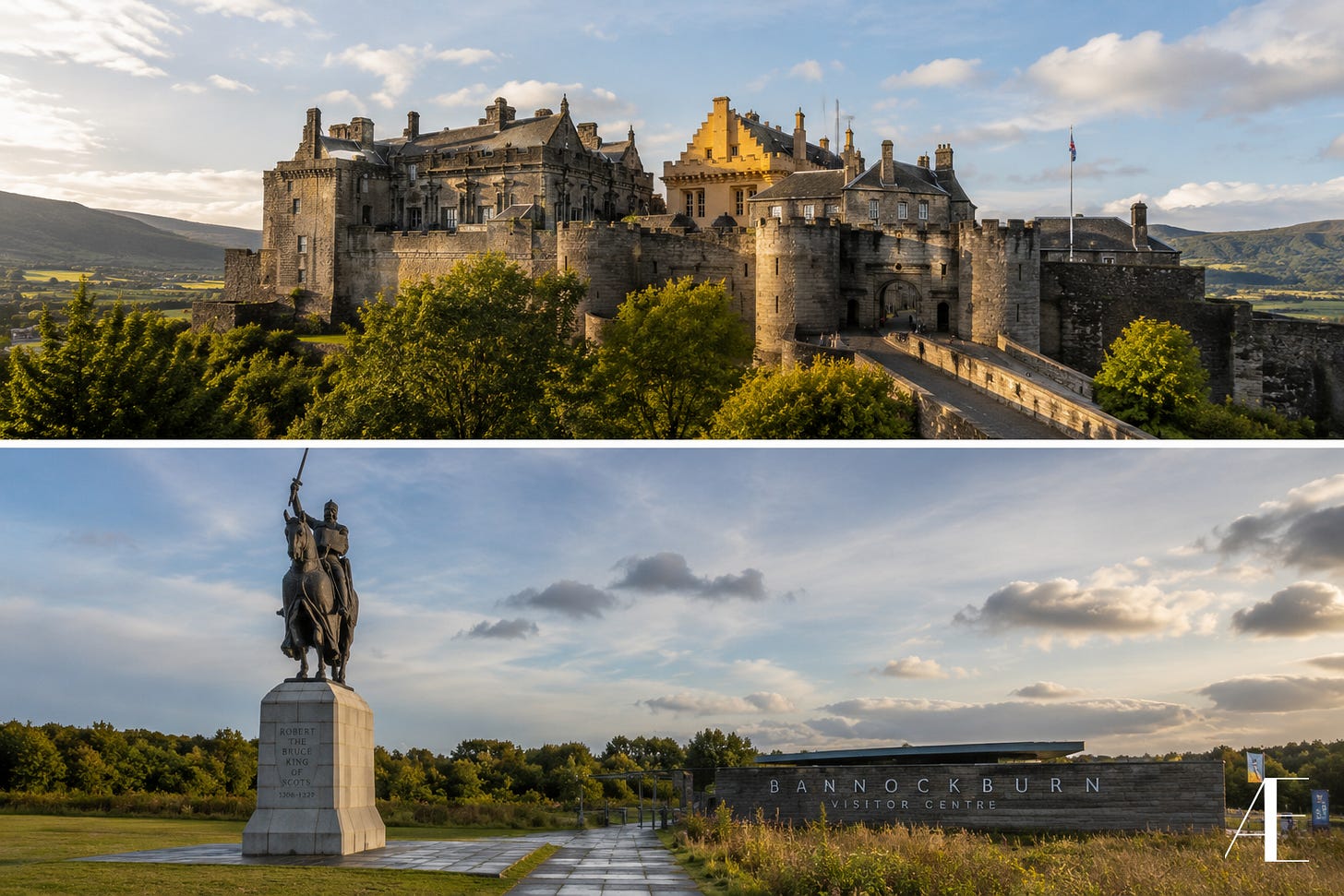
Distance / time : 45 minutes by train from Edinburgh Waverley, or 1 hour by car.
What’s there: Stirling Castle (arguably equal to Edinburgh Castle in historical importance: this is where Mary Queen of Scots was crowned at nine months old, and where James VI was baptised), the William Wallace Monument, and the Bannockburn Heritage Centre at the site of the 1314 battle that defined Scottish independence.
Best for: History-focused clients. The combination of Stirling Castle and Bannockburn in a single day is the most historically concentrated day trip available from Edinburgh.
By transport: Train to Stirling; taxi or bus to the monuments (the castle is walkable from the station; Bannockburn requires a bus or taxi). Tours available from Edinburgh for those who prefer a structured day.
Worth it: Absolutely, for the right client. Prioritise Stirling Castle above all else.
St Andrews and the East Neuk of Fife
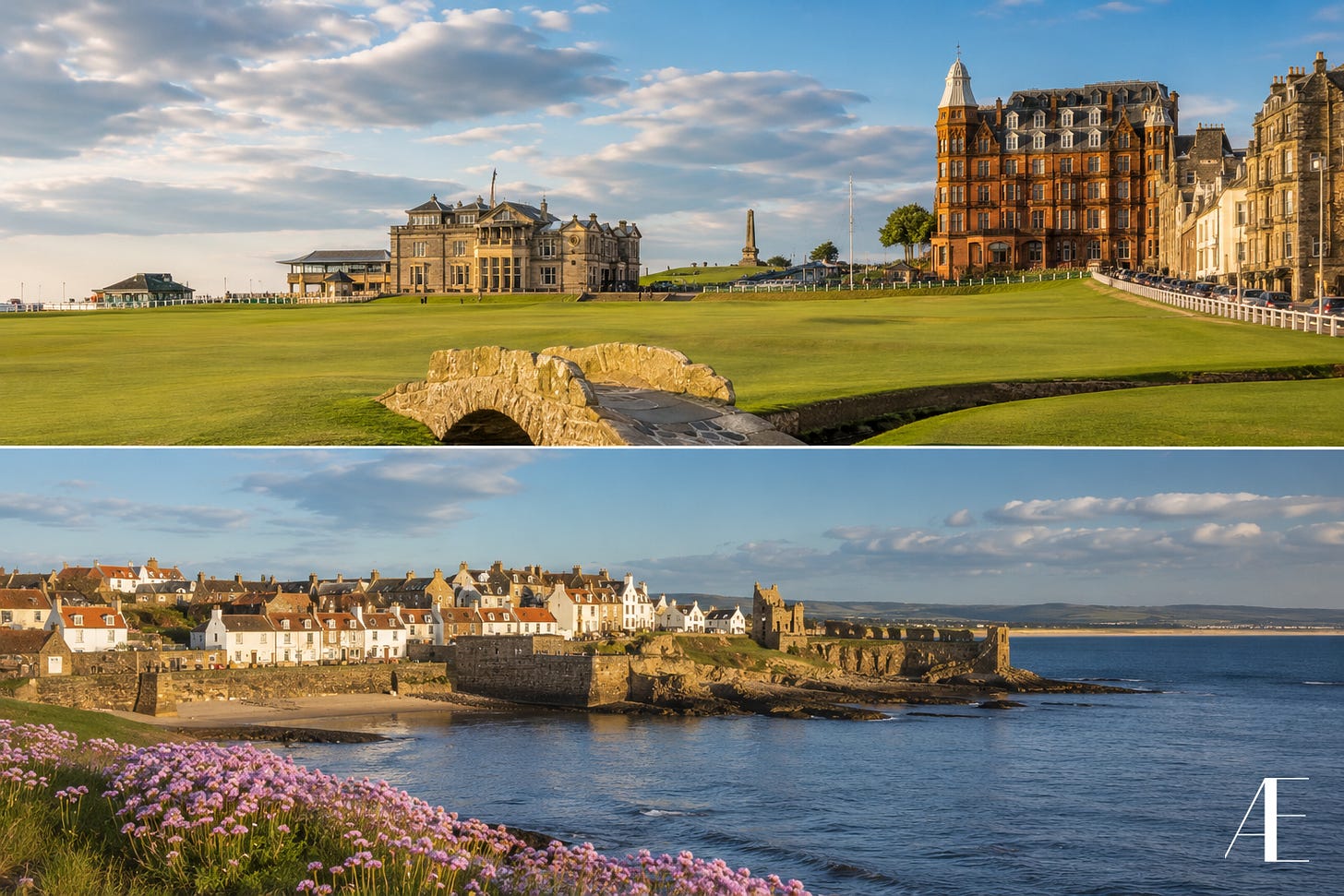
Distance / time: 1 hour by car; approximately 1.5 hours by public transport (train to Leuchars or Kirkcaldy, then bus).
What’s there: St Andrews is Scotland’s oldest university town (founded 1413), with the ruined cathedral (once the largest in Scotland), the medieval castle, and the Old Course, the most famous golf course in the world and playable by ballot.
The East Neuk fishing villages (Anstruther, Crail, Pittenweem, St Monans) are among the most beautiful in Scotland: stone harbours, painted houses, fishing boats, and the fish and chips at the Anstruther Fish Bar (widely regarded as the best in Scotland).
Best for: Culture clients, golf clients, food-focused clients. The East Neuk is the secret component of this day trip: visually extraordinary and almost unknown outside Scotland.
Worth it: Yes. One of the genuinely underrated day trips in the British Isles.
The Highlands and Loch Ness
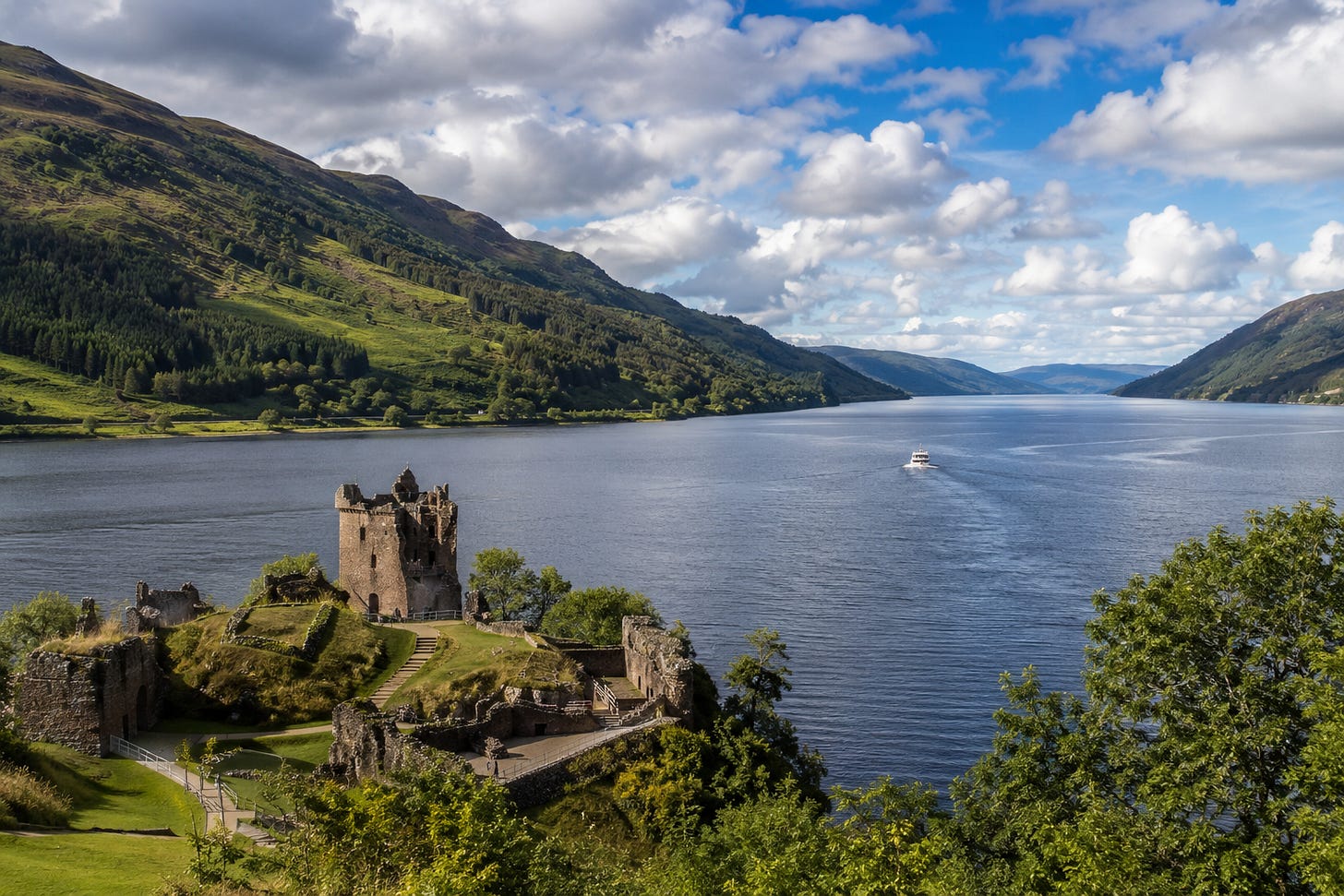
Distance / time: Loch Ness is approximately 3 hours from Edinburgh by car. Inverness (the Highland capital) is 3 hours by car or 3 hours by train.
What’s there: The Highland landscape, moorland, mountains, lochs, deer forests, has no visual equivalent in Western Europe. Loch Ness itself is 37 km long, up to 230 metres deep, and more water than all the lakes in England and Wales combined. The monster is (probably) fictional.
Glencoe, the great glacial valley on the A82 road north, is worth a stop in its own right: one of the most dramatic landscapes in Scotland, and the site of the Glencoe Massacre of 1692.
Best for: First-timers who want a taste of the Highlands without a multi-day trip. Outdoor and nature clients.
Worth it: As a day trip from Edinburgh, the drive time is significant. Better as an overnight at minimum. Recommend Inverness-based options or a dedicated Highlands itinerary for clients who are genuinely Highland-focused.
By tour: Multiple operators offer day trip coaches to Loch Ness from Edinburgh. Practical for clients without a car; the day is long.
Book a tour with a local guide through GetYourGuide or Viator to get a commission.
The Scottish Borders
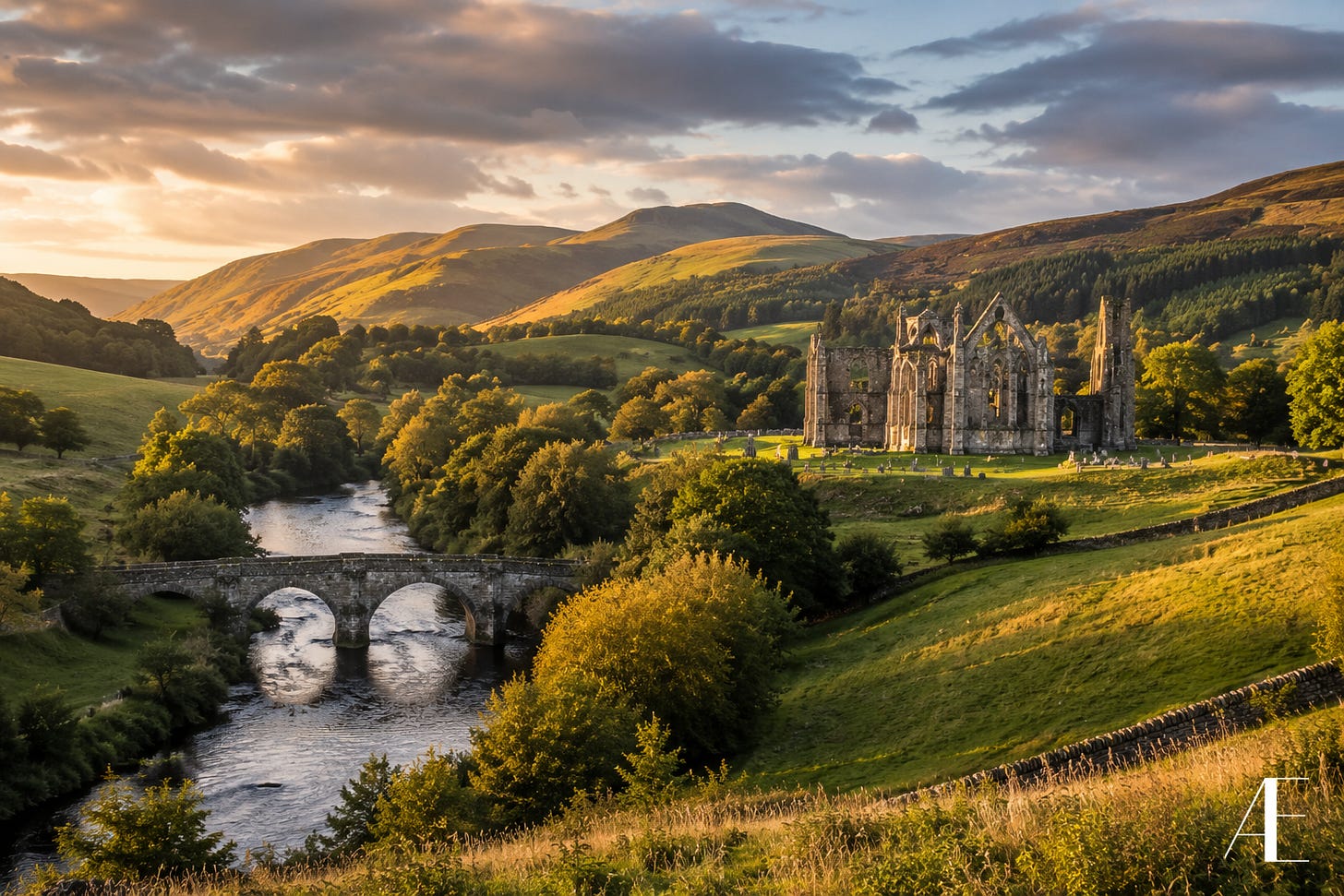
Distance / time: 30–60 minutes south of Edinburgh by car (depending on destination).
What’s there: A gentle, beautiful landscape of rolling hills, ruined abbeys and literary history. Melrose Abbey (the most beautiful ruined abbey in Scotland), Dryburgh Abbey (where Walter Scott is buried), Abbotsford (Scott’s Gothic house on the Tweed, one of the great literary houses in Britain), Traquair House (the oldest continuously inhabited house in Scotland).
Best for: Clients interested in landscape and literary history. Less dramatic than the Highlands but more accessible and less crowded.
Worth it: Yes, particularly for the right client (Walter Scott fans, garden lovers, those who want a calm day outside the city).
Note for agents: The Borders are frequently overlooked in Edinburgh itineraries. They are particularly beautiful in autumn (September–October). Recommend strongly for extended stays.
Loch Lomond and the Trossachs
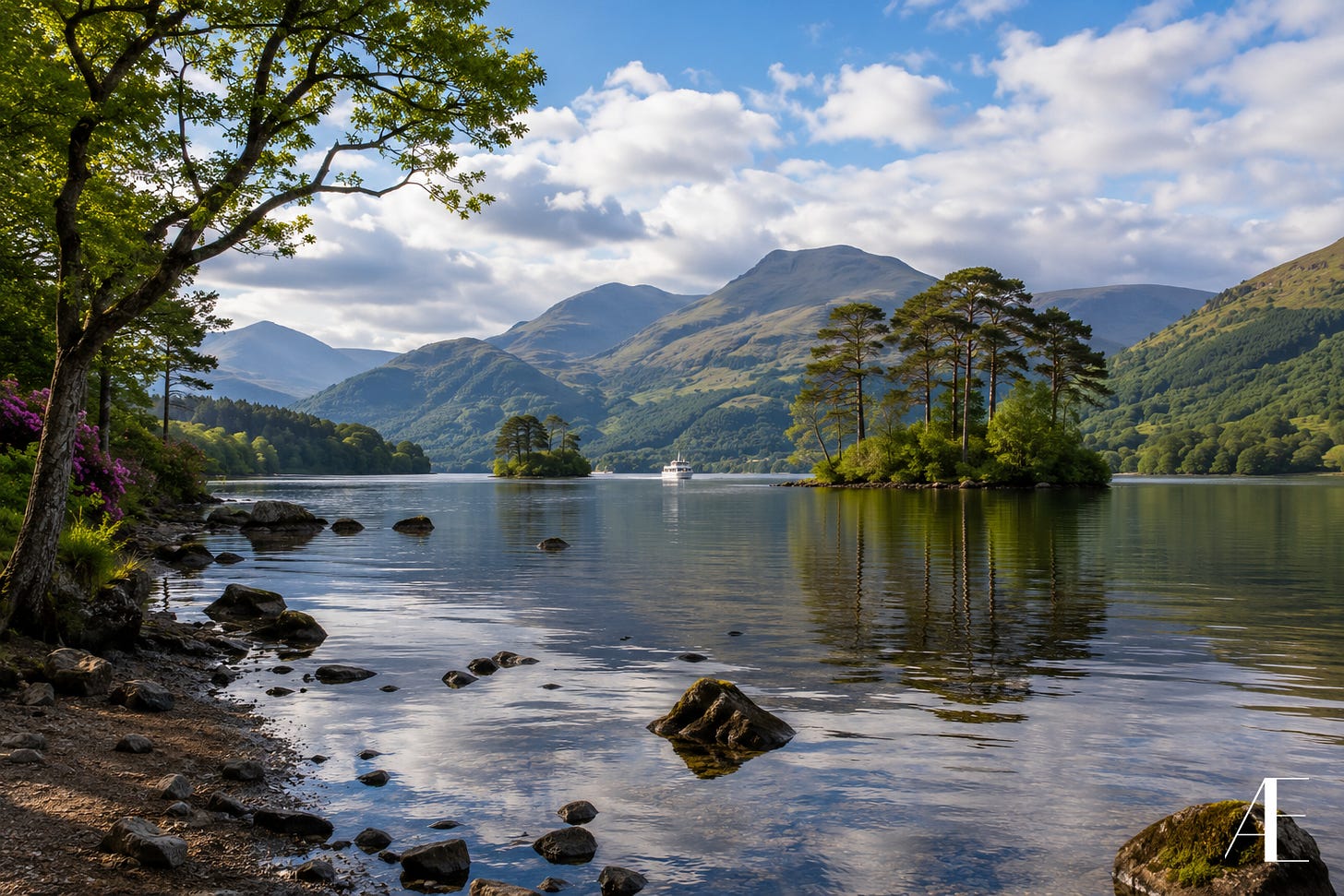
Distance / time: 1 hour by car to Loch Lomond’s southern shore.
What’s there: The largest freshwater lake in the British Isles (71 km² surface area) and the first landscape to be designated a National Park in Scotland (2002). The Trossachs hills to the north and east complete a landscape that inspired much of the Romantic poetry about Scotland.
Best for: Nature clients, day-trippers who want dramatic landscape without the Highlands drive.
Pair with: Stirling (45 min to the east) for a full day combining Scottish history and landscape.
The Edinburgh Broader Itineraries
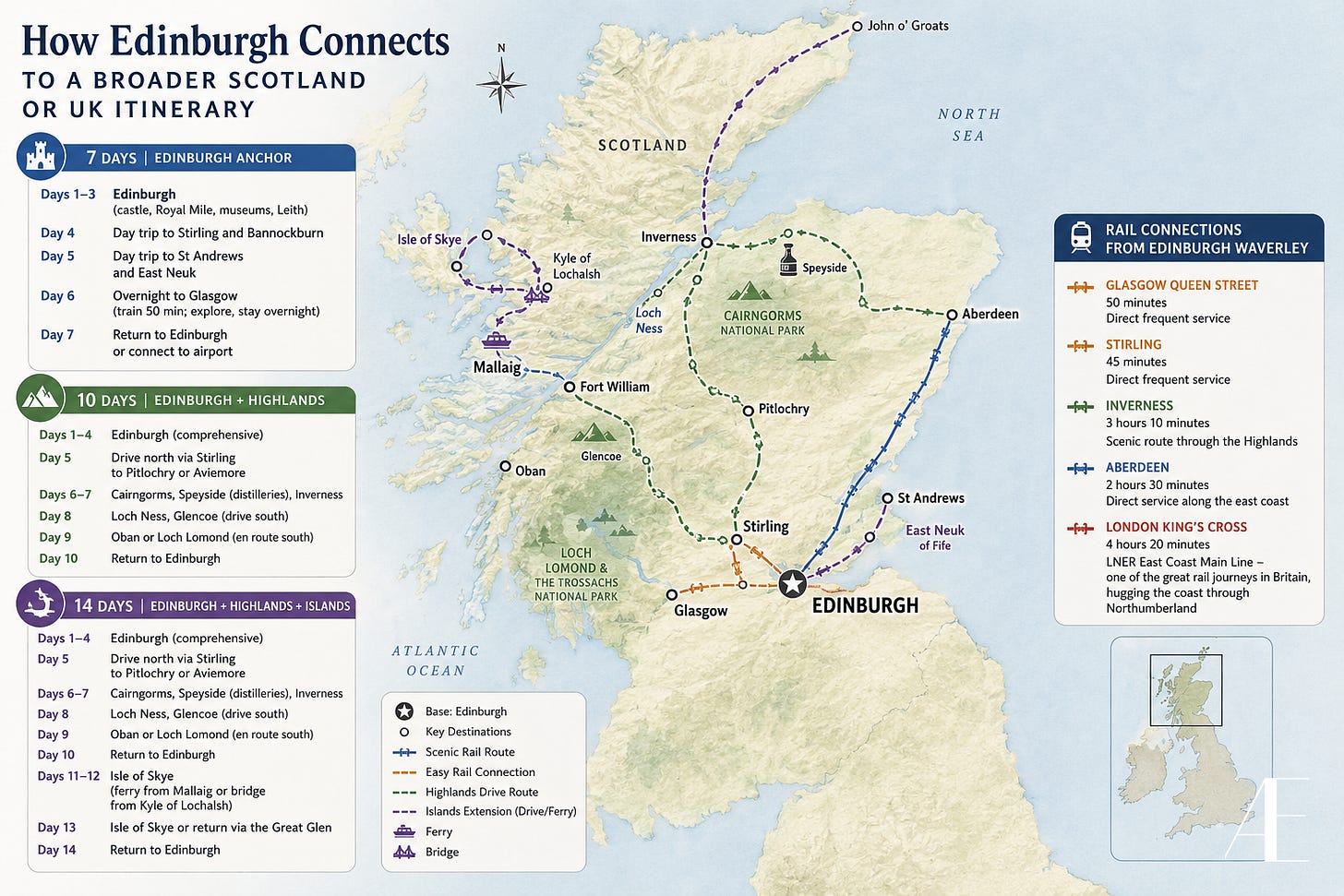
7-Day Itinerary: Edinburgh Anchor with Easy Day Trips
- Days 1–3: Edinburgh
Begin with three days in Edinburgh, allowing clients to explore the Old Town, Royal Mile, Edinburgh Castle, St Giles’ Cathedral, Holyrood Palace, Arthur’s Seat, the New Town, Dean Village, Stockbridge, Leith and the Royal Yacht Britannia. This gives first-time visitors enough time to experience the city properly without rushing. - Day 4: Stirling and Bannockburn
Take a day trip to Stirling for Stirling Castle, the Wallace Monument and Bannockburn. This is one of the best history-focused excursions from Edinburgh and gives clients a deeper understanding of Scotland’s royal, military and independence history. - Day 5: St Andrews and the East Neuk
Spend the day in St Andrews and the coastal villages of the East Neuk. St Andrews offers medieval ruins, university atmosphere, golf heritage and sea views, while villages such as Anstruther, Crail and Pittenweem add harbour charm, seafood and photography stops. - Day 6: Glasgow Overnight
Travel by train from Edinburgh to Glasgow, usually in under an hour. Spend the day exploring the city centre, Merchant City, Kelvingrove, the West End, Finnieston, music venues, restaurants and Mackintosh architecture. Overnighting is worthwhile because Glasgow’s evening scene is one of its strengths. - Day 7: Return to Edinburgh or Depart
Return to Edinburgh by train or connect onward via Edinburgh or Glasgow Airport. If departure is later in the day, clients can enjoy a relaxed breakfast, last museum visit or short walk before transferring onward.
10-Day Itinerary: Edinburgh and the Highlands
- Days 1–4: Edinburgh
Begin with four nights in Edinburgh, giving clients enough time to experience the city properly before heading into the Highlands. They can explore the Old Town, Royal Mile, Edinburgh Castle, St Giles’ Cathedral, Holyrood Palace, Arthur’s Seat, the New Town, Dean Village, Stockbridge, Leith and the Royal Yacht Britannia. This also leaves room for a whisky experience, a strong restaurant evening, shopping or a short excursion to Rosslyn Chapel or the coast. - Day 5: Edinburgh to Pitlochry or Aviemore via Stirling
Drive north with a stop at Stirling Castle or the Wallace Monument. Continue into Highland Perthshire, overnighting in Pitlochry for charm, scenery and a gentler pace, or Aviemore for easier access to the Cairngorms and more outdoors-oriented clients. - Days 6–7: Cairngorms, Speyside and Inverness
Use these two days for Highland landscapes, whisky country and northern history. Clients can explore the Cairngorms National Park, visit Speyside distilleries, continue to Inverness, and include Culloden Battlefield, Clava Cairns or Loch Ness depending on their interests. This section works especially well for clients who want scenery, whisky, clan history and ancient sites in one compact route. - Day 8: Inverness to Glencoe via Loch Ness and the Great Glen
Travel south along Loch Ness and the Great Glen, with possible stops at Urquhart Castle, Fort Augustus and scenic viewpoints. Continue toward Fort William and Glencoe, one of Scotland’s most dramatic landscapes. This is a longer driving day, but it delivers the classic Highland progression: lochs, mountains, valleys and big cinematic scenery. - Day 9: Glencoe to Oban or Loch Lomond
Spend the morning in Glencoe, then continue either west to Oban or south toward Loch Lomond. Oban is best for clients who want seafood, harbour atmosphere and a west-coast feel. Loch Lomond is better for a softer final Highland night with easier access back toward Edinburgh or Glasgow. Keep this day scenic and relaxed rather than overloaded. - Day 10: Return to Edinburgh
Return to Edinburgh for departure or a final overnight, depending on flight timing. From Oban, clients can route via Inveraray, Loch Lomond and the Trossachs. From Loch Lomond, they can return via Stirling or the Trossachs. This final day should feel like a graceful return to the capital, not a luggage-and-motorway endurance test.
14-Day Itinerary: Edinburgh, Highlands and Isle of Skye
- Days 1–4: Edinburgh
Begin with a comprehensive Edinburgh stay. This gives clients enough time for the Old Town, Royal Mile, Edinburgh Castle, Holyrood Palace, Arthur’s Seat, New Town, Dean Village, Leith, the Royal Yacht Britannia, excellent restaurants, whisky experiences and possible day trips to St Andrews or the Borders. - Day 5: Edinburgh to Pitlochry or Aviemore via Stirling
Drive north from Edinburgh with a stop at Stirling Castle or the Wallace Monument. Continue into Highland Perthshire, with an overnight in Pitlochry for a softer scenic route, or Aviemore for clients who want to be closer to the Cairngorms. - Days 6–7: Cairngorms, Speyside and Inverness
Explore the Cairngorms National Park, then continue toward Speyside for distillery visits. Overnight in or near Inverness. Clients interested in history can include Culloden Battlefield and Clava Cairns, while whisky-focused clients can prioritize Speyside distilleries. - Day 8: Loch Ness and the Great Glen to Isle of Skye
Travel from Inverness along Loch Ness and the Great Glen, with stops at Urquhart Castle and Fort Augustus if time allows. Continue west toward Kyle of Lochalsh and cross to the Isle of Skye via the Skye Bridge. Overnight on Skye, ideally in Portree or another well-located base. - Days 9–10: Isle of Skye
Spend two full days exploring Skye. Highlights may include the Old Man of Storr, the Quiraing, Kilt Rock, Portree, Dunvegan Castle, Neist Point and the island’s dramatic coastal scenery. This is where the itinerary should slow down. Skye is not a place to rush; the roads are narrow, the weather changes quickly and photo stops multiply like rabbits in a whisky warehouse. - Day 11: Isle of Skye to Fort William via Mallaig or Kyle of Lochalsh
Leave Skye either by ferry from Armadale to Mallaig or by driving back across the Skye Bridge via Kyle of Lochalsh. The Mallaig ferry route is especially scenic, but clients must check schedules and book ahead where possible. CalMac confirms that travellers can either take the ferry from Mallaig to Armadale, which takes about 45 minutes, or drive farther north and cross via the bridge at Kyle of Lochalsh. Overnight in Fort William or nearby. - Day 12: Glencoe and Oban or Loch Lomond
Drive through Glencoe, one of the most dramatic landscapes in Scotland. Continue either to Oban for a west-coast overnight with seafood, harbour views and possible island connections, or continue toward Loch Lomond for a softer final Highland night closer to Edinburgh or Glasgow. - Day 13: Oban or Loch Lomond to Edinburgh
Return toward Edinburgh, with possible stops depending on the routing: Inveraray Castle, Loch Lomond, the Trossachs, Doune Castle or Stirling. This day works well as a scenic transition back to the capital rather than a rushed dash across the country. - Day 14: Edinburgh departure
Final morning in Edinburgh for shopping, a relaxed breakfast, museum time or a last walk through the New Town before departure.
Rail connections from Edinburgh Waverley
- Glasgow Queen Street: approximately 45–65 minutes
- Stirling: approximately 40–50 minutes
- Inverness: approximately 3 hours 30 minutes to 4 hours 30 minutes
- Aberdeen: approximately 2 hours 20 minutes to 3 hours
- London King’s Cross: approximately 4 hours 10 minutes to 4 hours 50 minutes. The East Coast Main Line is one of Britain’s classic rail journeys, with memorable coastal sections through Northumberland.
When to Visit Edinburgh
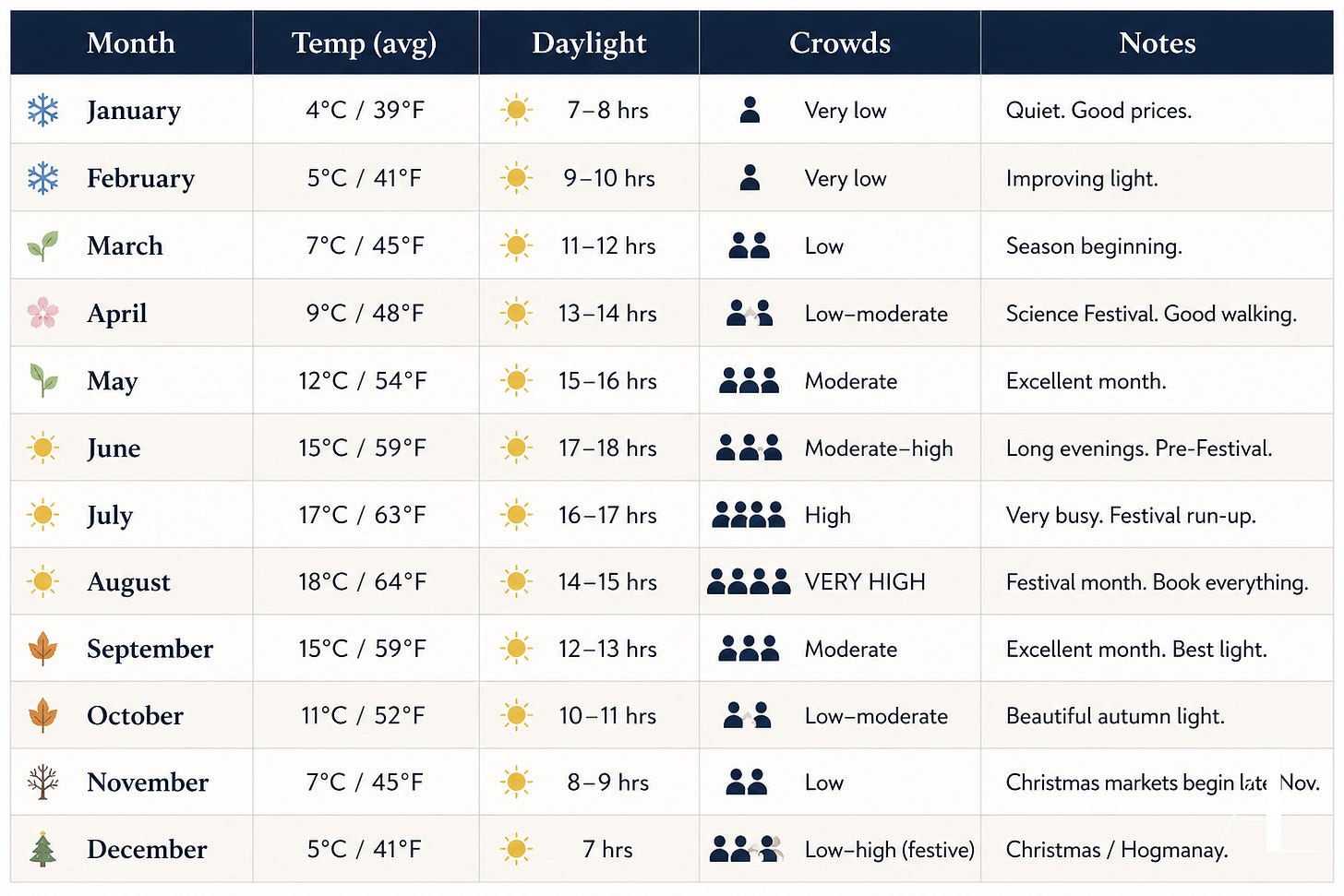
Spring (March–May)
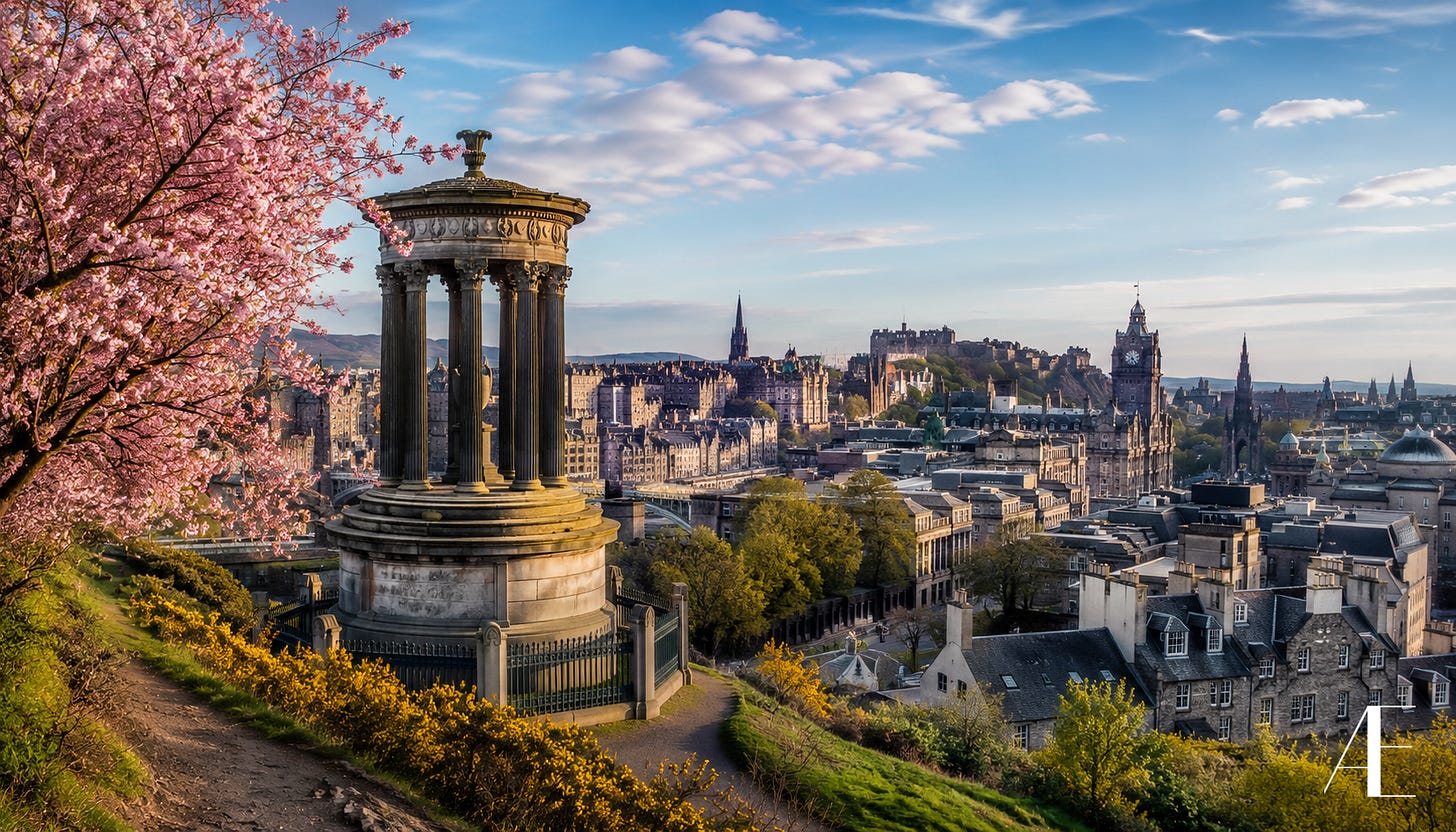
- Average temperatures: 7–14°C (45–57°F)
- Daylight hours: Rising from 11 to 16+ hours through the season
- Rainfall: Moderate. April is frequently the wettest spring month.
- Crowd levels: Low to moderate. The most manageable time for popular attractions.
- Key events: Edinburgh Science Festival (April), Scottish Grand National (Ayr, April), early season for events and outdoor experiences.
- What is open/limited: Almost everything is open. Gardens (Royal Botanic Garden) are at their best from April onwards.
- Who this season is right for: First-timers who want a good experience without summer crowds. Active clients. Anyone who wants to walk Arthur’s Seat comfortably. Couples.
- Booking lead time: 4–8 weeks for most accommodation; castle and major attractions should be pre-booked 2–4 weeks ahead.
Summer (June–August)
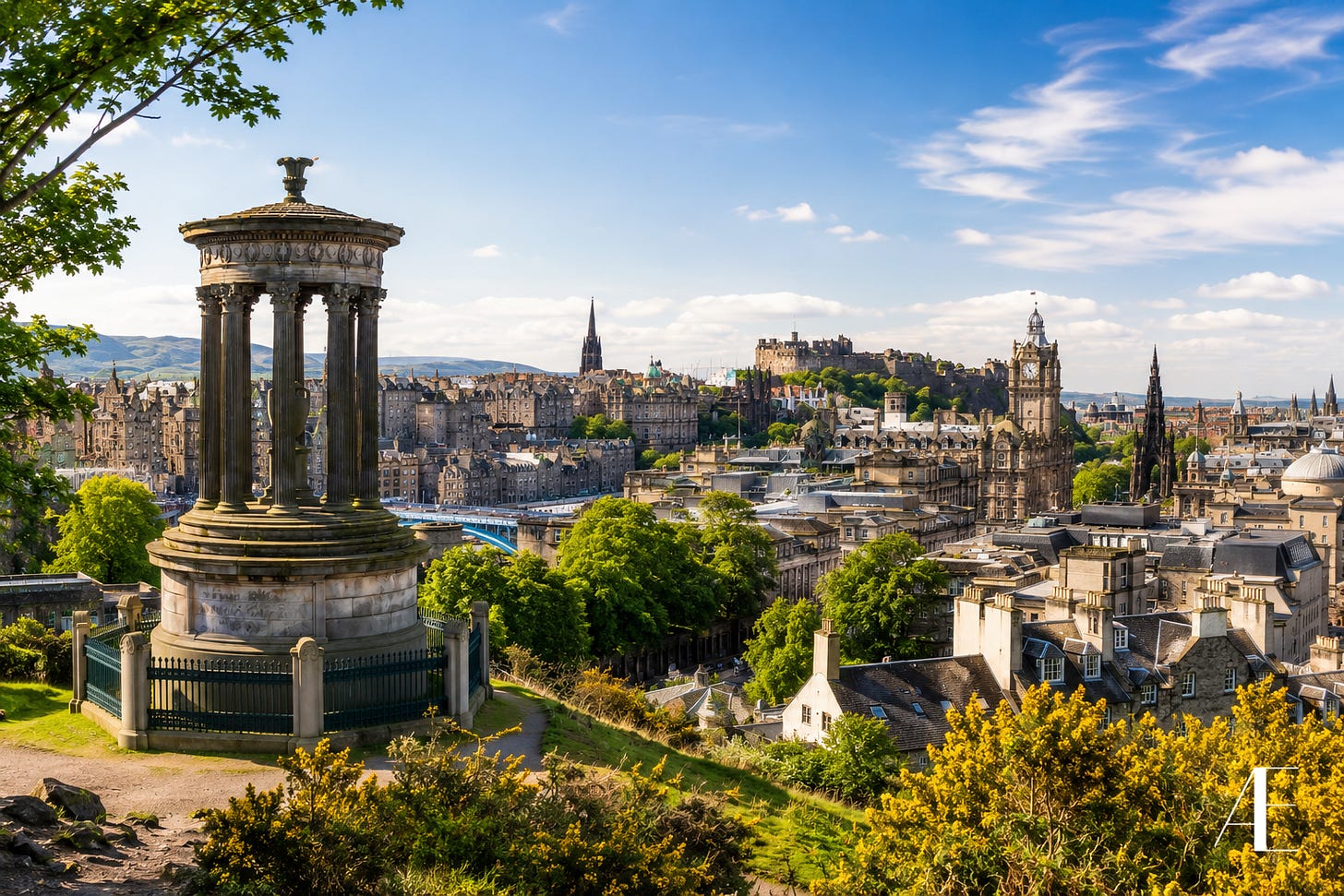
- Average temperatures: 14–20°C (57–68°F), occasionally higher
- Daylight hours: Extraordinary. Sunset at 10:15pm at summer solstice. Essentially never fully dark in June.
- Rainfall: Moderate. Rain possible at any time; generally the driest season.
- Crowd levels: VERY HIGH, especially August. The Festival Fringe alone brings over 3 million ticket sales and approximately 250,000 visiting performers and crew.
- Key events: Royal Highland Show (June), Edinburgh International Film Festival (June), Edinburgh International Festival (August), Edinburgh Festival Fringe (August, the world’s largest arts festival), Military Tattoo (August, at the castle).
- What is open/limited: Everything. Summer is full operation. Accommodation is at maximum occupancy and prices during August Festival are 2–3x standard rates.
- Who this season is right for: Festival-goers, clients who want the maximum Edinburgh experience, those who can manage crowds. Not right for clients seeking calm.
- Booking lead time: August Festival: 6–12 months for accommodation and Tattoo tickets. June–July: 3–6 months for preferred hotels. Castle tickets: 4–6 weeks minimum.
Autumn (September–October)
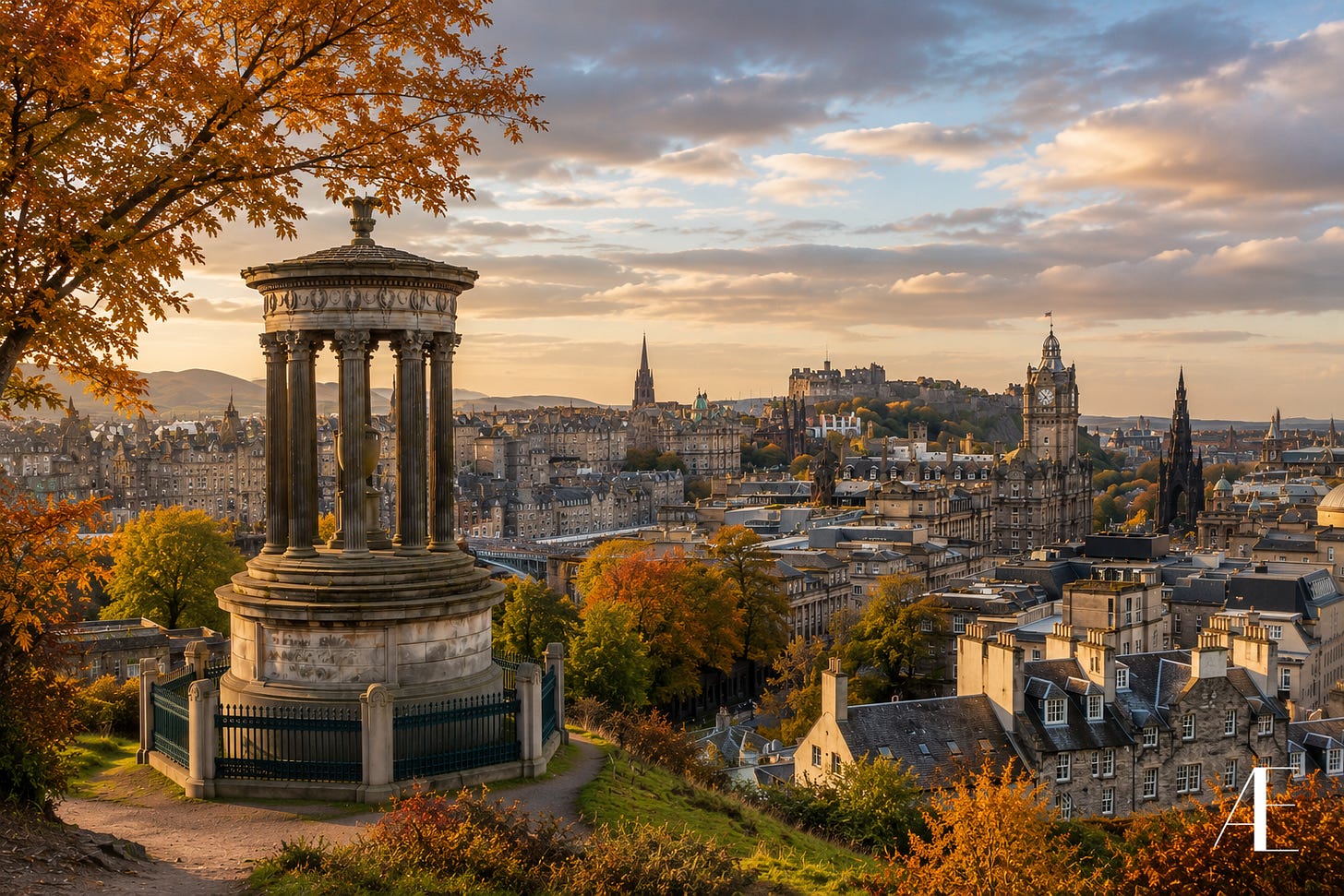
- Average temperatures: 10–15°C (50–59°F)
- Daylight hours: Declining from 13 hours in September to 10 hours in late October.
- Rainfall: Increasing through October. September is often one of the finest months weatherwise.
- Crowd levels: Low to moderate. A significant drop from summer.
- Key events: Autumn is the peak cultural season for galleries, theatre and concerts. The Edinburgh International Book Festival (formerly August, sometimes autumn). Heritage Open Days.
- Who this season is right for: One of the two best times to visit Edinburgh (along with spring). The light in October is extraordinary: low-angled, golden, dramatic. Recommended to virtually all client types. The best balance of good weather (relative), long enough days, manageable crowds, and the full cultural season.
- Booking lead time: 4–8 weeks usually sufficient. Always book the castle in advance.
Winter (November–February)
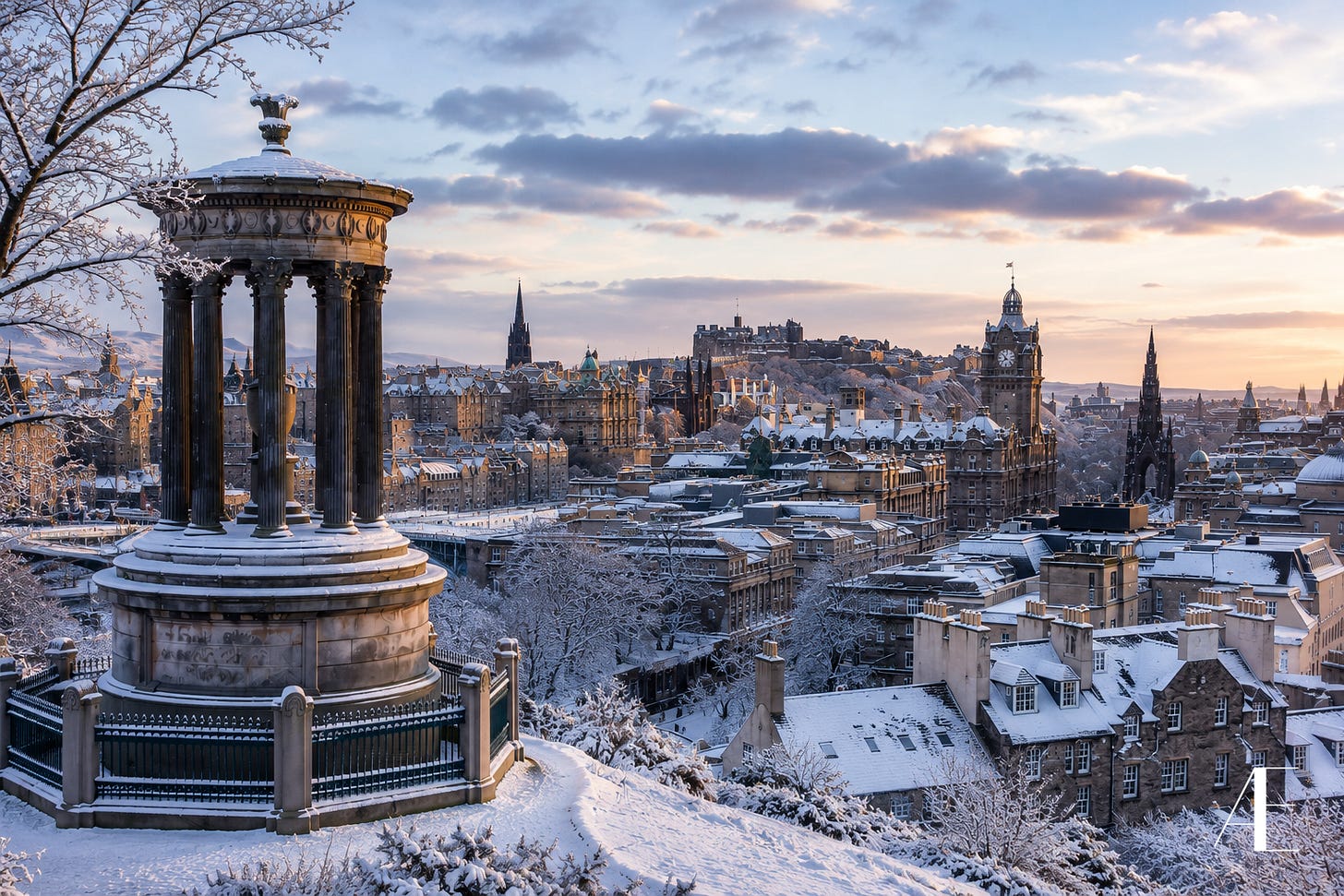
- Average temperatures: 3–8°C (37–46°F)
- Daylight hours: Minimum: approximately 7 hours in December
- Rainfall: Regular. Snow in the city is uncommon but possible.
- Crowd levels: LOW outside the Christmas-Hogmanay period.
- Key events: Edinburgh’s Christmas (late November through early January, with markets, an ice rink on Princes Street, and a fairground on the Royal Mile), Hogmanay (31 December, the world’s most famous New Year celebration, with fireworks over the castle and a ticketed torchlight procession).
- What is closed/limited: Some seasonal attractions have reduced hours. Outdoor experiences like Arthur’s Seat are fully accessible but require appropriate clothing.
- Who this season is right for: Budget-conscious clients (lowest prices of the year outside the festive period). Clients drawn by Hogmanay (which requires booking 6+ months ahead for good accommodation). Romantic short-break clients.
- Booking lead time: Christmas–Hogmanay period: 4–6 months. Standard winter: 2–4 weeks usually sufficient.
How Many Days to Stay
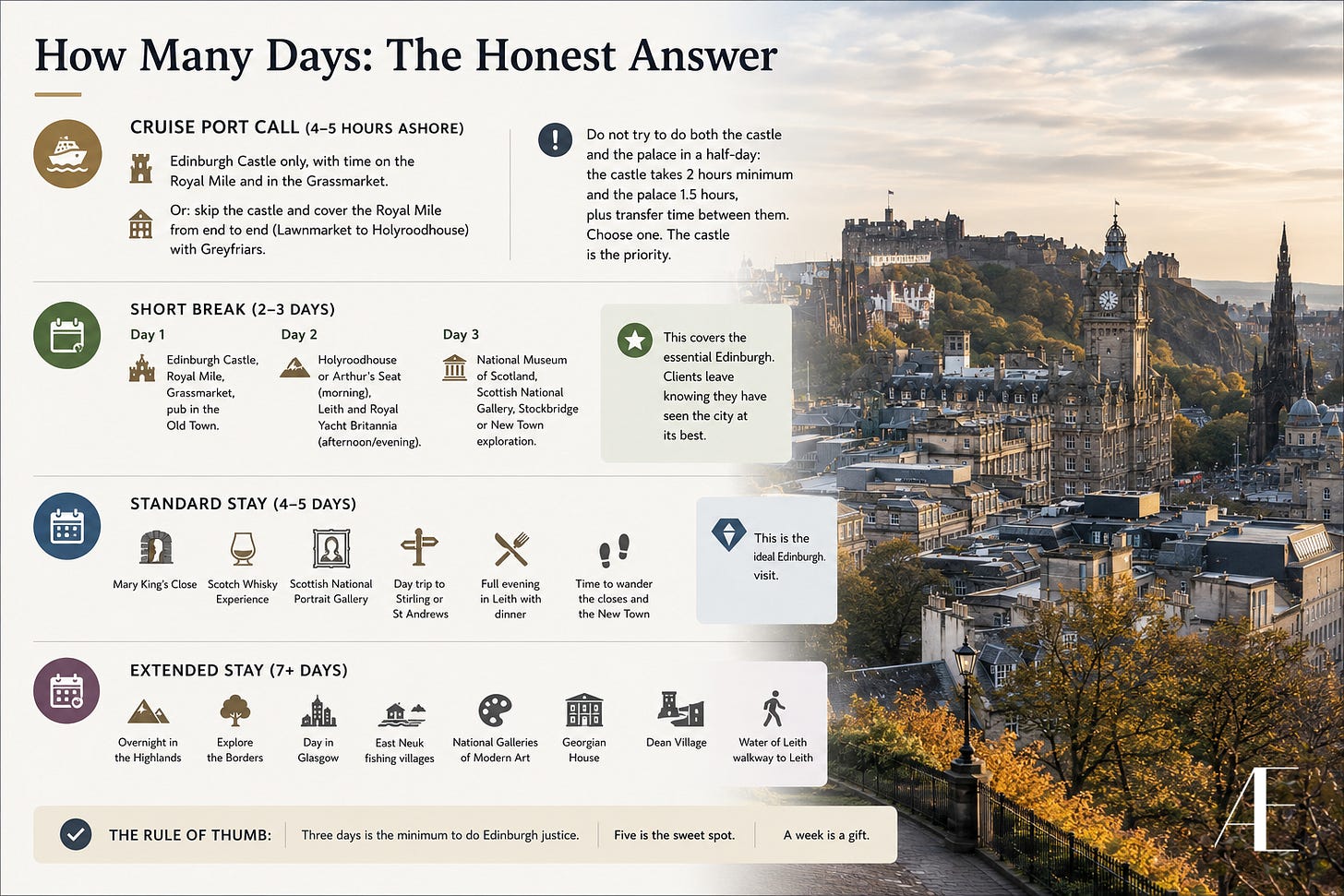
Cruise port call (4–5 hours ashore)
Edinburgh Castle only, with time on the Royal Mile and in the Grassmarket. Or skip the castle and cover the Royal Mile from end to end (Lawnmarket to Holyroodhouse) with Greyfriars.
Do not try to do both the castle and the palace in a half-day: the castle takes 2 hours minimum and the palace 1.5 hours, plus transfer time between them. Choose one. The castle is the priority.
Short break (2–3 days)
Day 1: Edinburgh Castle, Royal Mile, Grassmarket, pub in the Old Town.
Day 2: Holyroodhouse or Arthur’s Seat (morning), Leith and Royal Yacht Britannia (afternoon/evening).
Day 3: National Museum of Scotland, Scottish National Gallery, Stockbridge or New Town exploration. This covers the essential Edinburgh. Clients leave knowing they have seen the city at its best.
Standard stay (4–5 days)
Adds: Mary King’s Close, Scotch Whisky Experience, the Scottish National Portrait Gallery, a day trip to Stirling or St Andrews, a full evening in Leith with dinner at a serious restaurant, and time to simply wander the closes and the New Town without an agenda. This is the ideal Edinburgh visit.
Extended stay (7+ days)
The extra days reveal the neighbourhoods, the locals, and the surrounding country. Add a overnight in the Highlands, a full Borders exploration, a day in Glasgow, or the East Neuk fishing villages.
The city itself gives more: the National Galleries of Modern Art, the Georgian House, Dean Village, the Water of Leith walkway from the city to the sea at Leith.
The rule of thumb: Three days is the minimum to do Edinburgh justice. Five is the sweet spot. A week is a gift.
Where to Eat: The Curated List
Scottish cuisine has undergone a transformation since the 1990s. The produce is exceptional: Loch Fyne oysters, Atlantic salmon, Borders lamb, Highland venison, langoustines from the cold Northern waters, hand-dived scallops. The current generation of Edinburgh chefs is doing extraordinary things with it.
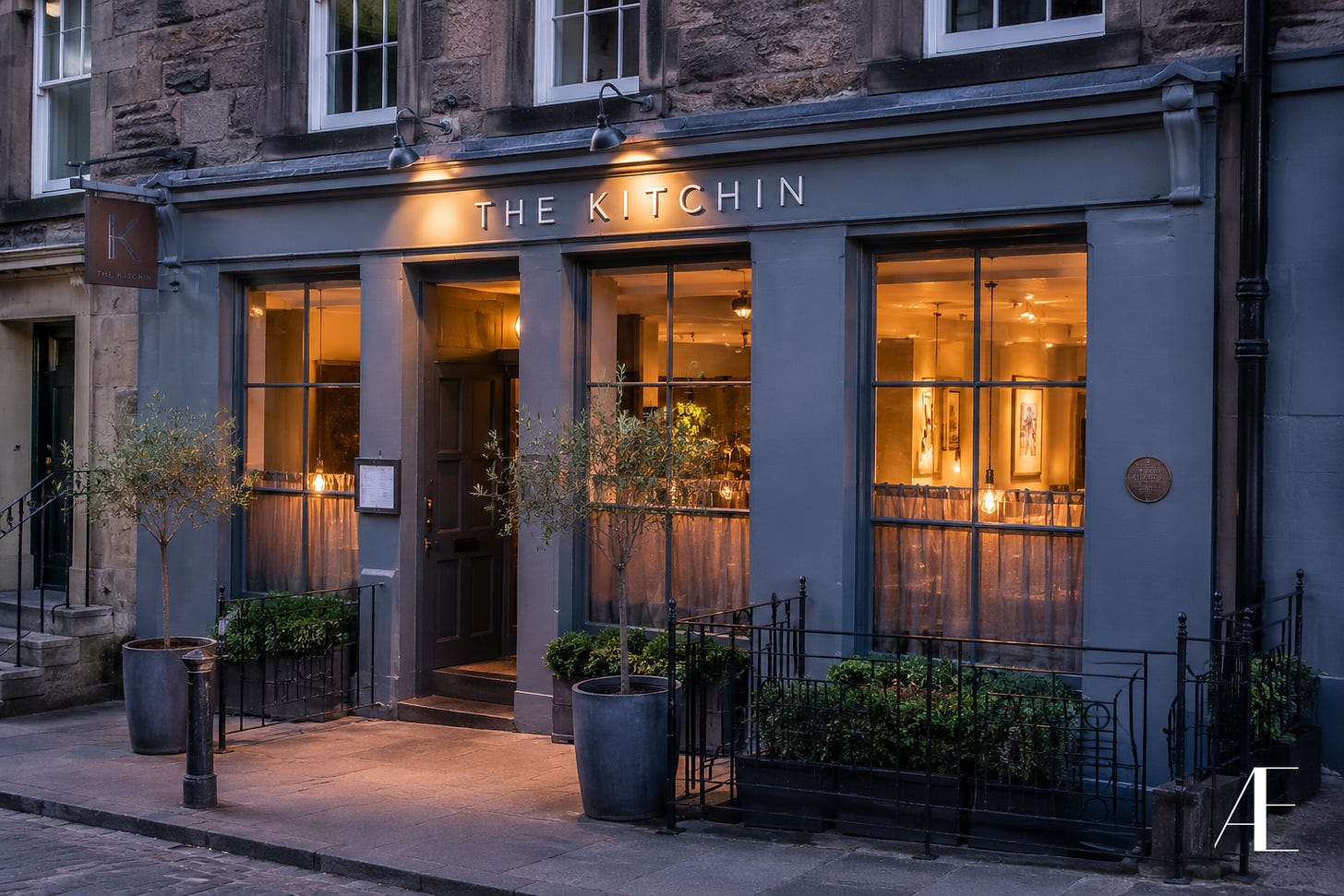
The Kitchin
Leith | Contemporary Scottish | ££££
The Kitchin is Tom Kitchin’s flagship restaurant in Leith and one of Edinburgh’s most important fine-dining addresses. Opened in 2006, it earned a Michelin star within its first year and remains Michelin-starred today. The cooking follows Kitchin’s “From Nature to Plate” philosophy: seasonal, provenance-driven, rooted in Scottish produce and shaped by classical French technique. Menus change with availability, with tasting-menu and à la carte options showcasing Scotland’s larder.
Right for: Luxury clients, food-focused clients and serious occasion dining.
Booking: Essential. Recommend several weeks ahead, especially in summer and during festival periods.
Insider detail: Private dining is available, and the restaurant can also be hired exclusively for larger events. The bar menu is a useful option for clients who want a shorter, more flexible Kitchin experience.
Condita
Marchmont/Southside | Tasting menu | ££££
Condita is one of Edinburgh’s most intimate Michelin-starred restaurants, with just a handful of tables and a surprise tasting menu built around seasonal Scottish produce. The menu changes with what the kitchen can source, including ingredients from small producers and the restaurant’s own garden. Dinner is highly personal, quiet and immersive rather than showy, with the only preview often coming through a hand-drawn ingredient card or bookmark. Michelin describes Condita as a one-star restaurant in the 2026 guide.
Right for: Serious food clients who value originality, intimacy and provenance over familiar luxury.
Booking: Essential. Book several weeks in advance, and earlier for peak summer or festival dates.
Agent note: Excellent for clients who want one of Edinburgh’s most distinctive fine-dining experiences, but not for guests who need lots of menu choice or a lively dining room.
The Scran & Scallie
Stockbridge | Gastropub | £££
The Scran & Scallie is Tom Kitchin and Dominic Jack’s Stockbridge gastropub, offering generous Scottish cooking in a warm, relaxed setting. The food is seasonal, hearty and produce-led, with polished versions of classic pub dishes, Scottish seafood, haggis, pies and comforting desserts often appearing on the menu.
It is one of Edinburgh’s most useful restaurant recommendations because it works for a wide range of clients: couples, families, groups, food-focused travellers and guests who want quality without formality. The restaurant has also held Michelin Bib Gourmand recognition, reinforcing its reputation for strong value at this level.
Right for: Almost all client types, especially families, groups and clients who want serious food in an unpretentious setting.
Booking: Recommended, especially for dinner and weekends, but usually easier than The Kitchin. Request a window table if clients want the best street-facing atmosphere.
Café St Honoré
New Town | French-Scottish brasserie | £££
Café St Honoré is a charming French-Scottish bistro tucked down a pedestrian lane just off Thistle Street, close to Frederick Street. It has one of Edinburgh’s most atmospheric dining rooms: warm, intimate, convivial and quietly elegant without feeling formal.
The cooking is seasonal and produce-led, with menus that change regularly and a strong emphasis on Scottish sourcing. The wine list is thoughtful and often leans toward independent, organic and low-intervention producers, making it a strong choice for clients who care about both food and wine.
Right for: Couples, food-focused clients and travellers who want a proper restaurant experience without stiffness.
Booking: Recommended, especially for dinner. Request a table in the main dining room for the best atmosphere.
Hendersons
Hendersons is the modern continuation of one of Scotland’s most important vegetarian restaurant names, originally founded by Janet Henderson in 1962. Today, the restaurant carries that legacy forward with unfussy, produce-led vegetarian cooking in a relaxed neighbourhood setting near Bruntsfield Links.
The food is simple, generous and good value, with a style that makes vegetarian dining feel natural rather than like a compromise. It works especially well for casual lunches, relaxed dinners and clients who want something lighter between heavier Scottish meals.
Right for: Vegetarian clients, budget-conscious clients, families and travellers looking for a casual, wholesome meal.
Booking: Recommended for dinner; lunch is usually more flexible.
Timberyard
Old Town | Contemporary Scottish | ££££
Timberyard is a family-run, Michelin-starred restaurant set in a former timber warehouse in the western Old Town. The room is distinctive — open kitchen, reclaimed materials, high ceilings and a quietly rustic feel — but the cooking is refined, ingredient-led and highly seasonal. The restaurant works closely with Scottish growers, foragers and artisan producers, with menus shaped by what is available rather than by fixed signature dishes. Timberyard received its Michelin star in 2023 and a Michelin Green Star in 2026 for its sustainability work.
Right for: Design-oriented clients, food-focused clients and travellers interested in modern Scottish cooking with a strong sense of place.
Booking: Essential. Book well ahead, especially for weekends, summer and festival periods.
The Dome
New Town | Grand brasserie | £££
The Dome is one of Edinburgh’s most visually dramatic dining rooms, set inside a grand former banking hall on George Street. Soaring columns, ornate detailing, a painted ceiling and a central chandelier make the room the main event. The food is solid and crowd-pleasing rather than cutting-edge, but the setting delivers exactly the kind of occasion many clients want.
The bar is also one of the city’s most impressive, making The Dome useful for cocktails, celebratory dinners or clients who want a memorable New Town evening without needing a fine-dining tasting menu.
Right for: Clients who want atmosphere, grandeur and visual drama. Good for groups, celebrations and first-time visitors.
Booking: Recommended for dinner, weekends and festive-season visits.
Anstruther Fish Bar
East Neuk of Fife (day trip) | Fish and chips | £
Anstruther Fish Bar is one of Scotland’s best-known fish and chip shops, set on the harbourfront in the East Neuk of Fife. It is a natural stop on a St Andrews and East Neuk day trip, especially for clients who want a casual, local food experience rather than a formal lunch. Expect fresh Scottish seafood, haddock and chips, queues at busy times and a classic seaside setting.
Anstruther is approximatly 1 hour 30 minutes by car from Edinburgh. The fish bar itself highlights its award-winning status and use of fresh local ingredients, while recent Fry Awards coverage still places it among notable UK fish and chip restaurants.
Right for: Clients doing St Andrews and the East Neuk, families, casual food lovers and anyone who wants a proper Scottish seaside fish supper.
Agent note: Best treated as part of a full East Neuk day rather than a quick detour from Edinburgh. For clients who do not want to travel that far, Edinburgh’s Newhaven waterfront also has strong fish-and-chip options.
Where to Stay: The Breakdown
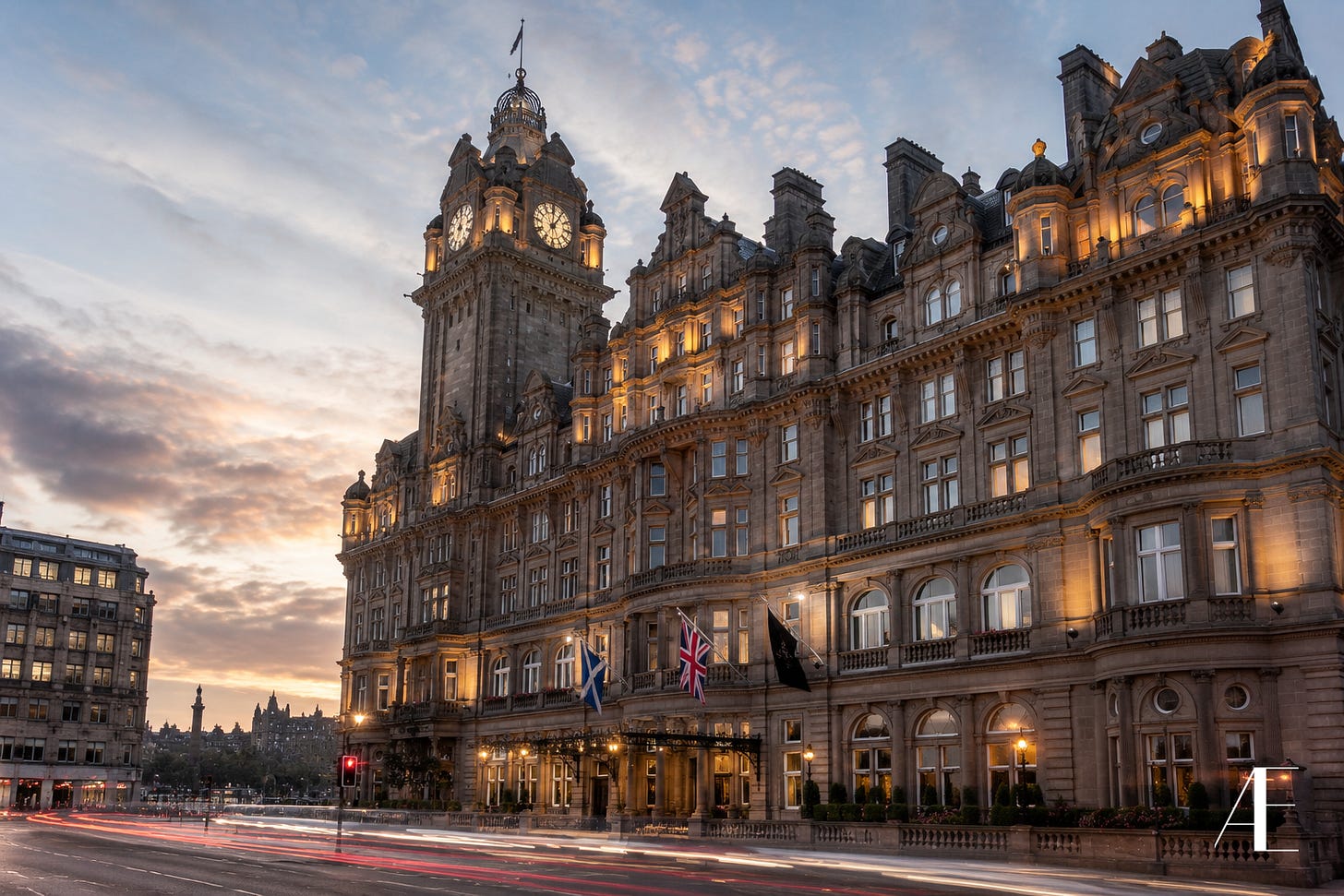
For the Luxury Client
The Balmoral
Princes Street, New Town | ££££
The Balmoral is Edinburgh’s grand railway hotel and one of the city’s great landmarks. Opened in 1902 as the North British Station Hotel, it stands above Waverley Station at the east end of Princes Street. Its famous clock tower is set three minutes fast, a tradition meant to help travellers catch their trains.
The hotel has 167 rooms and suites, with a prime location between the Old Town and New Town. Depending on room category, views may include Edinburgh Castle, Princes Street Gardens, Calton Hill or the Firth of Forth. Number One, the signature restaurant, is Michelin Guide recommended and holds four AA Rosettes, while Palm Court is one of Scotland’s most elegant afternoon tea settings.
Suite 552 is where J.K. Rowling finished Harry Potter and the Deathly Hallows in January 2007. Now known as the J.K. Rowling Suite, it remains one of the hotel’s most distinctive specialty suites.
Agent note: Best for luxury clients who want landmark status, rail convenience, classic grandeur and a stay that feels unmistakably Edinburgh.
The Witchery by the Castle
Royal Mile, Old Town | ££££
Seven suites only, each individually designed in an extravagant Scottish Gothic style with red velvet, dark wood panelling, candlelight, stone walls, four-poster beds and roll-top baths. The hotel occupies a 16th-century building at the foot of the Castle Esplanade, making the location one of the most atmospheric in Edinburgh.
The restaurant, open to non-residents, is considered one of the finest dining rooms in the Old Town.
Rooms to request: All seven suites are distinctive, though The Inner Sanctum is the most dramatic and theatrical.
Agent note: Ideal for clients who want romance, atmosphere and a stay that feels deeply tied to Edinburgh’s medieval character. Commissionable independent boutique property; contact directly for agent rates.
The Gleneagles Townhouse
St Andrew Square, New Town | ££££
Gleneagles Townhouse is the Edinburgh outpost of the famous Gleneagles Hotel in Perthshire, bringing the brand’s polished country-house style into a New Town setting. Set in a handsome historic townhouse on St Andrew Square, it offers 33 rooms and suites with the same sense of refined Scottish luxury, but in a more urban, intimate form.
The property includes a restaurant, bar and wellness space, making it a strong choice for clients who want boutique scale without losing the confidence of a major luxury name.
Agent note: Best for clients who already know and love Gleneagles, or for luxury travellers who want New Town elegance, strong dining and a more discreet alternative to Edinburgh’s grand railway hotels.
For the Boutique Client
The Scotsman
North Bridge | £££–££££
The Scotsman Hotel occupies the former headquarters of The Scotsman newspaper, built in 1905, and still carries much of the building’s original character. Marble staircases, high ceilings and preserved printing-press details are worked into the design, giving the property a strong sense of history without feeling like a museum.
Its North Bridge location is one of its biggest strengths, placing guests directly between the Old Town and New Town, close to the Royal Mile, Waverley Station and Princes Street. The hotel’s basement Art Deco swimming pool is also a rare feature in central Edinburgh.
Rooms to request: Upper-floor rooms facing North Bridge for the best views.
Agent note: A strong choice for clients who want heritage, atmosphere and central convenience, but prefer something slightly less formal than the city’s grand luxury hotels.
Hotel du Vin Edinburgh
Old Town | £££
Hotel du Vin Edinburgh occupies one of the Old Town’s more unusual historic buildings, a former city poorhouse and asylum dating back to the 18th century, later used for scientific and medical purposes. The hotel handles that layered past with the brand’s familiar wine-focused style: atmospheric interiors, comfortable rooms, a strong bistro and a relaxed, characterful feel.
It is more distinctive than the standard Hotel du Vin formula, largely because the building itself gives the property so much personality.
Agent note: Best for clients who want Old Town character, a good brasserie, wine-bar atmosphere and a boutique stay with history, without paying top-tier luxury rates.
For the Budget Client
The Bonham
West End | £££
The Bonham is a stylish boutique hotel set in a Victorian townhouse in Edinburgh’s West End, on a quiet residential street within easy reach of the New Town. It offers spacious, well-furnished rooms, warm personal service and a genuinely good restaurant, making it one of the stronger price-to-quality options in the city’s boutique category.
The location works well for clients who want a calmer base than the Royal Mile while still being close to Princes Street, Dean Village, Stockbridge and the main New Town shopping and dining areas.
Agent note: Best for clients who want boutique comfort, good value, a quieter neighbourhood feel and easy access to central Edinburgh without staying in the busiest tourist zone.
Grassmarket Hotel
Grassmarket, Old Town | ££
Grassmarket Hotel is a simple, well-located option in the heart of the Old Town, set directly in the Grassmarket below Edinburgh Castle. Rooms are compact and contemporary rather than luxurious, but the location is excellent for clients who want to be close to the Royal Mile, Victoria Street, Edinburgh Castle, pubs, restaurants and nightlife.
Some rooms may offer castle or Old Town views, though this should be requested rather than assumed.
Agent note: Best for budget-conscious clients who prioritize location, atmosphere and walkability over space, quiet and upscale amenities. A practical choice for younger travellers, short stays or clients who want to be in the middle of the action.
For Families
Radisson Collection Hotel (Royal Mile)
Royal Mile, Old Town | £££
A contemporary five-star hotel in the heart of the Old Town, close to the Royal Mile, Edinburgh Castle, the National Museum of Scotland and Waverley Station. Rooms are generally larger than many historic Old Town properties, with modern design, good facilities and practical layouts for couples or families.
The location is the main selling point: clients are right in the centre of Edinburgh’s visitor core, with easy walking access to both the Old Town and New Town.
Agent note: Best for clients who want a central Royal Mile location, contemporary comfort and a more practical room configuration than many boutique or heritage hotels. Verify current operating status and availability before recommending.
InterContinental Edinburgh The George
New Town | £££
InterContinental Edinburgh The George is a beautifully restored historic hotel on George Street, set within a series of elegant New Town townhouses. It offers a strong central location, polished public spaces and generally spacious rooms for Edinburgh, making it one of the city’s most practical higher-end options.
Its location is especially useful for families and first-time visitors: close to Princes Street, St Andrew Square, George Street shopping, restaurants, Waverley Station and the Old Town. The hotel has enough scale and facilities to feel reliable, but still keeps a sense of Edinburgh character.
Agent note: Best for clients who want New Town convenience, dependable upscale comfort and practical room options, especially families who want a central hotel without the intensity of the Royal Mile.
For Solo Travellers
Code Hostel / Code The Loft
Rose Street, New Town | £
Code The Loft is one of Edinburgh’s strongest budget options, set on Rose Street in the heart of the New Town. It offers private rooms, quality dorms and capsule-style accommodation with a noticeably higher design standard than most hostels.
The location is excellent for clients who want nightlife, restaurants, shopping and easy access to both Princes Street and the Old Town. It is still budget accommodation, so clients should expect compact rooms and a social atmosphere rather than hotel-style privacy.
Agent note: Best for solo travellers, younger clients and budget-conscious guests who want a central location, good design and hostel sociability without the usual hostel chaos.
The Inn on the Mile
Royal Mile, Old Town | ££
The Inn on the Mile is a small boutique hotel set above a lively pub on the Royal Mile, placing guests directly in the heart of the Old Town. Rooms are stylish and well designed, with more personality than many standard mid-range hotels, and the service tends to feel friendly and personal.
The location is excellent for clients who want to walk everywhere: Edinburgh Castle, St Giles’ Cathedral, Victoria Street, Waverley Station and the New Town are all within easy reach. Because it sits above a pub and on one of Edinburgh’s busiest streets, it is better suited to clients who enjoy atmosphere than those seeking total quiet.
Agent note: Best for solo travellers, couples and short-stay clients who want boutique character, central location and good value directly on the Royal Mile.
The Practical Information
Currency and payment
Scotland uses the British Pound Sterling (GBP / £). Scottish banknotes (issued by Royal Bank of Scotland, Bank of Scotland, and Clydesdale Bank) are legal tender throughout Scotland but may occasionally be refused in England: worth flagging to clients. Contactless payment is universal: buses, taxis, markets, pubs, and virtually all restaurants accept contactless.
ATMs (cash machines) are widely available; Travelex and similar operators charge fees; advise clients to use bank ATMs at the Waverley station or major bank branches. Currency exchange: advise clients to exchange at home bank before travel or use local bank ATMs on arrival; airport exchange rates are poor.
Language
English throughout. The Edinburgh accent is among the more accessible Scottish accents; working-class Edinburgh speech (Scots dialect, sometimes called “Scots” or “Lallans”) can require an ear for adjustment. Gaelic appears on some public signage. Basic useful Scots: “dreich” (grey and miserable weather), “wee” (small), “braw” (excellent), “aye” (yes), “nae bother” (no problem).
Getting around
Airport transfers:
- Tram: Edinburgh Trams operate between Edinburgh Airport and Newhaven (via Princes Street). Journey time Edinburgh Airport → St Andrew Square: approximately 30–35 minutes. Fare: approximately £8.50 single (2026). Runs every 8–10 minutes during peak hours. The most practical option for most clients.
- Taxi: Approximately £20–£30 from the airport to the city centre. Journey time 25–40 minutes depending on traffic. Metered taxis are reliable; the rank is outside the arrivals hall.
- Private transfer: Available from various operators. Advisable for luxury clients or groups.
Within the city:
- Walking: The essential mode. The Old Town, New Town, Grassmarket, and the lower slopes of Arthur’s Seat are all walkable from each other.
- Lothian Buses: Excellent coverage of the entire city. Contactless payment accepted. The app (Lothian Buses or MyCityWay) shows real-time arrivals. The number 35, 36, and 6 routes are particularly useful.
- Edinburgh Trams: Runs from Newhaven through Leith Walk to Princes Street and west to the airport. Practical for the airport and for Leith.
- Taxis: Licensed black cabs (metered, reliable, bookable by phone or app) and licensed private hire. City Cabs and Central Taxis are the main operators. Uber operates in Edinburgh.
- Car rental: Unnecessary for the city. Strongly recommended for day trips to the Borders, Highlands, or East Neuk. Most major rental companies at Edinburgh Airport. Note: UK drives on the left; manual transmission is standard.
Tipping Standards
- Restaurants: 10–15% for good service. Many restaurants include a service charge: check the bill. Not obligatory to tip if service charge is included, but customary to add cash if you feel the service warrant it.
- Pubs: No tip expected for drinks ordered at the bar. If staff bring food to the table, 10% is appreciated.
- Taxis: Round up or add 10%.
- Hotel staff: £1–£2 per bag for porterage; £2–£5 per night for housekeeping at luxury properties.
- Tour guides: £5–£15 per person depending on tour length and quality.
Accessibility
Edinburgh’s historic core is challenging for mobility-limited clients. The Royal Mile is heavily cobbled; Edinburgh Castle involves an uphill approach. However: Edinburgh Castle has a shuttle within the castle grounds for those who cannot walk; Holyroodhouse is largely level; the National Museum has full accessibility; most major museums and galleries have lifts.
For clients using wheelchairs, recommend focusing on the New Town (flat, good pavement), the National Museum, and the National Galleries, plus a taxi-accessible visit to the Royal Yacht Britannia. The cobblestones of the Old Town are a significant limitation.
Health and safety
- Edinburgh is a very safe city. Standard urban vigilance is sufficient.
- NHS services are available to visitors; EU Global Health Insurance Card (GHIC) is not applicable for Canadians and Americans. Standard travel insurance with medical coverage is essential.
- Pharmacies (called “chemists” in the UK) are widespread; Boots on Princes Street and on North Bridge are convenient.
- The water is excellent and safe to drink everywhere.
- Emergency number: 999 (police, fire, ambulance)
- Non-emergency police: 101
- NHS 24 (non-emergency medical advice): 111
Power
UK three-pin plug (Type G), 230V / 50Hz. Adapters are essential for North American plugs and devices. Most modern electronics (laptops, phone chargers, cameras) are dual-voltage and require only an adapter, not a converter. Hair dryers brought from North America may require a converter.
Internet and connectivity
- A UK eSIM is the most practical solution for Canadian and American clients. Companies including Airalo, Holafly, and local operators offer competitive UK eSIM options. Advise clients to set this up before departure.
- Alternatively: many North American carriers offer international day passes. Check roaming charges.
- Wi-Fi: Available in virtually all Edinburgh cafes, restaurants, hotels and public spaces (including some areas of Princes Street). The quality is generally good.
Open an affilate account with Breeze eSim, GigSky or Holafly and receive commissions on the sales of eSims.
Useful apps
- Lothian Buses / Edinburgh Trams: Real-time transport information
- VisitScotland: Official tourism app with maps and guides
- Historic Scotland: For castle and monument booking
- OpenTable / Resy: Restaurant reservations
- Deliveroo / Uber Eats: Delivery (useful for self-catering clients)
- Trainline: Train booking across Scotland and the UK
- Google Maps: Reliable for Edinburgh navigation; download offline maps before arrival
What to pack that most visitors forget
- A quality packable waterproof jacket (not just a light raincoat. Edinburgh wind and rain demand a real waterproof)
- Comfortable, non-slip walking shoes (cobblestones are genuinely treacherous in smooth-soled shoes)
- Layers (Edinburgh can go from 10°C to 18°C in a single day in spring or autumn)
- A universal plug adapter
- A small umbrella (wind frequently defeats standard umbrellas; the flat folding type works better)
Who Is This Destination For?
The first-time European traveller
Edinburgh is an excellent first European destination for a North American client: English-speaking, safe, compact, dramatically beautiful. Lead with: “You get everything you love about European history and architecture without the language barrier, and it’s nothing like London: this feels like a different world.” This is genuinely true.
The history and culture enthusiast
This is Edinburgh’s core market. The city delivers centuries of Scottish, British and European history within walking distance, in remarkably preserved physical settings. Lead with the Mary Queen of Scots narrative, the castle’s role in Scottish independence, the Edinburgh Enlightenment. They will not run out of things to explore in a week.
The foodie / culinary traveller
Stronger than clients expect. Lead with: “Scotland has some of the finest raw ingredients in the world: the langoustines, the salmon, the Highland game, the oysters. And Edinburgh has a generation of chefs doing extraordinary things with them. Leith has become one of the most interesting food districts in the UK.” Book the Kitchin; visit the Cheese Lady in Stockbridge; do the Saturday Stockbridge market.
The whisky / brewery / distillery client
Edinburgh is the gateway: the Scotch Whisky Experience provides the framework; the Bow Bar has the selection; and the Highlands and Speyside distilleries are within a day’s drive. Lead with: “You’ll learn more about whisky in two days in Edinburgh than you would anywhere else... then we can add a distillery tour in Speyside.” Scotch Whisky Experience is the essential booking.
The outdoor / active client
Stronger than expected for a capital city. Arthur’s Seat, the Water of Leith walkway, the Pentland Hills (30 min south), the Fife Coastal Path (accessible from St Andrews day trip). Lead with: “You can climb an extinct volcano in the middle of the capital city.” Then layer in day trips to the Highlands for those who want more.
The luxury client
Very well served. The Balmoral, the Witchery, Condita, the Kitchin, private castle access, private guiding. Lead with: “The level of quality here, the hotels, the restaurants, the whisky, the experiences, is outstanding and the pound is still reasonably favourable for North American clients.” Edinburgh is underrated at the luxury level relative to, say, Paris or Rome.
The budget-conscious traveller
Extremely well suited. Free museums (National Museum, Scottish National Gallery, Portrait Gallery), walkable city, good hostel options, excellent pub food, accessible public transport. Lead with: “The castle is the main paid admission; everything else of cultural significance is free. This is one of the most rewarding cities in Europe to visit on a budget.”
The festival or event traveller
The August Festival is one of the world’s great cultural experiences: 4,500+ shows across the city in three weeks. Lead with: “Nothing in North America comes close to the scale and energy of the Edinburgh Fringe in August.” But warn them: book everything (accommodation, shows) 6+ months ahead, and prices are 2–3x normal.
The multigenerational family
Very well suited for the right combination of ages. Kids love the castle (the One O’Clock Gun, the crown jewels, the views), Arthur’s Seat (with appropriate ages), the National Museum (interactive, engaging, free). Teenagers respond to the Harry Potter trail and the underground city of Mary King’s Close. Lead with: “There’s enough here for every age group and a lot of it is free.”
The solo traveller
Edinburgh is one of the best solo travel destinations in the UK. The pub culture is genuinely welcoming to solo visitors. The city is compact and safe. The hostel scene (particularly Code Hostel) is excellent. The August Festival is extraordinary solo. Lead with safety, walkability, and the social character of the pub scene.
The romantic / honeymoon client
The Witchery is made for this: Gothic, theatrical, entirely private. Arthur’s Seat at sunrise. Leith by night. The Scotch Whisky Experience followed by dinner at Condita. Lead with atmosphere and intimacy rather than monuments. Edinburgh in autumn (September–October) has a light and quiet that is particularly romantic.
The cruise client (with 4 hours in port)
Edinburgh Castle is the priority. Pre-book before embarkation. Walk the upper Royal Mile. A drink in the Grassmarket under the castle. That is enough for a genuinely memorable half-day. Tell them what they will see clearly: “You’ll spend two hours in the castle, it’s extraordinary, and then walk down the Royal Mile. You won’t see everything but you’ll see the best of it.”
The cruise client (with a full day)
Castle in the morning, Royal Mile through lunchtime (lunch in the Grassmarket), Holyroodhouse or the Royal Yacht Britannia in the afternoon, Calton Hill for the evening view before returning. This is a full, satisfying Edinburgh day. The Britannia is a particularly natural pairing for cruise clients: they arrive by ship and visit the most famous ship in Britain.
The client who “has already been to London”
Your strongest selling point: this is not London. Lead hard on the difference: “Edinburgh is completely separate: different history, different culture, different food, different character. You’ll feel like you’ve gone to a foreign country without leaving the British Isles.” This client often becomes Edinburgh’s biggest advocate after the trip.
The client who says “Scotland? Is there much to do there?”
This objection comes from lack of information, not genuine resistance. Lead with: “Two UNESCO World Heritage Sites in the same city. A castle on a volcano. The world’s biggest arts festival. Some of the finest whisky and seafood on earth. And yes, it can be rainy... but so is Paris.” Then show them the itinerary.
The Common Client Objections

Client says: “Scotland in October? Won’t it be cold and rainy?”
Agent answers: “October in Edinburgh averages 11°C: cool, but not cold. The light is extraordinary in autumn: low-angled, golden, and dramatic against the castle. Crowds are manageable. The cultural season is in full swing. Pack a waterproof and layers and you’ll have one of the finest experiences the city offers. Many people who visit Edinburgh in October say they preferred it to summer.”
Client says: “I’ve already been to London. Why would I go to Scotland?”
Agent answers: “Edinburgh is nothing like London: different history, different culture, different language, different food and drink scene. It’s Scotland’s capital, and Scotland is a genuinely distinct country. You won’t feel like you’re repeating yourself. Many clients who visit Edinburgh after London tell us it was the more surprising and memorable of the two.”
Client says: “We’re only stopping there for one day on a cruise. Is it worth getting off the ship?”
Agent answers: “Absolutely, and for Edinburgh specifically, I’d say it’s one of the three or four most important port calls you can make in the British Isles. Pre-book Edinburgh Castle before you embark; that alone is worth the day. Walk the Royal Mile. If you have a full day, add Holyroodhouse or the Royal Yacht Britannia in Leith. One day is genuinely enough to have an experience you’ll be talking about for years.”
Client says: “I’ve heard the weather is terrible. We’d rather go somewhere sunny.”
Agent answers: “The weather is changeable, I won’t pretend otherwise... but terrible is an exaggeration. Edinburgh gets a similar amount of rainfall to London over the year. In summer, you can easily have a full week of mild, sunny weather. In spring and autumn, you get beautiful clear days alongside some rain. Pack a waterproof, wear comfortable shoes, and the weather becomes part of the adventure rather than a problem. The dramatic sky is one of the reasons the city is so extraordinarily photogenic.”
Client says: “We’re worried about the cobblestones and the hills. My partner has difficulty walking.”
Agent answers: “This is worth planning for, and there are real solutions. The New Town is almost completely flat. The National Museum, the National Galleries, and the Palace of Holyroodhouse are all level and fully accessible. At Edinburgh Castle, there’s an accessible shuttle within the castle complex; the main entry is the challenging part. I’d structure the itinerary around those accessible experiences first and flag the one or two places that require more care.”
Client says: “There’s not much to do beyond the castle and a few museums, is there?”
Agent answers: “Edinburgh is one of the most activity-dense cities in Europe for its size. Two UNESCO World Heritage Sites. Free world-class museums and galleries. An extraordinary food scene in Leith. The world’s largest arts festival in August. The Royal Yacht Britannia. Arthur’s Seat, a volcanic mountain climb in the middle of a capital. Whisky experiences. Walking tours that go underground. Day trips to the Highlands, Stirling and St Andrews. My clients consistently tell me they ran out of time before they ran out of things to do.”
Client says: “Is it safe? We’ve heard about pickpockets in European cities.”
Agent answers: “Edinburgh is one of the safest capital cities in Europe, genuinely. It regularly features in the top tier of European cities for personal safety. Standard urban common sense, like watching your bags in crowded festival areas in August, is more than sufficient. My clients have never had safety issues there.”
Client says: “We’re not whisky drinkers. Would Edinburgh still be interesting?”
Agent answers: “Completely. Edinburgh has an exceptional dining scene, world-class free museums, extraordinary architecture, one of the most dramatic settings of any European city, and the world’s greatest arts festival in August. Whisky is part of the Scottish culture and worth at least a casual introduction; many clients who ‘don’t drink whisky’ find a single malt they love at the Scotch Whisky Experience, but it is absolutely not the price of admission.”
Client says: “It’s too expensive in August for what it is.”
Agent answers: “In August during the Festival, yes: prices are 2–3x standard rates. That’s the price of the most extraordinary cultural experience in the English-speaking world: 4,500 shows, world-class comedy, theatre, opera, dance, and street performance for three weeks. If the Festival is the draw, budget accordingly and book 6 months ahead. If it isn’t, go in May, September or October: better prices, manageable crowds, and a city that’s arguably at its most beautiful.”
Client says: “We want history, but we’re not sure Scotland is as interesting as Rome or Paris.”
Agent answers: “Rome and Paris have centuries of history on display. So does Edinburgh, and it’s history that connects directly to a story that many North Americans, particularly those of Scottish or British descent, feel personally. The Wars of Scottish Independence, Mary Queen of Scots, the Jacobites, the Edinburgh Enlightenment: all live, physical, and walkable in Edinburgh. And it’s considerably smaller and more manageable than Rome or Paris. If history is what they want, Edinburgh will not disappoint.”
The Conversation Starters
These are the details your clients will repeat to their friends. Minimum one per dinner.
The Balmoral clock has been wrong for over a century... on purpose.
The famous clock tower of the Balmoral Hotel on Princes Street has been set three minutes fast since the hotel opened, to help travellers catch their trains at Waverley Station below. The hotel corrects it to the exact time precisely once a year: at the stroke of midnight on December 31st, Hogmanay. For 364 days, 23 hours, and 59 minutes, it lies.
The Royal Mile is not a mile.
It runs exactly one Scots Mile, the old Scottish unit of measurement, which works out to 1.81 kilometres, nearly 200 metres longer than an English mile. And it isn’t a single street: it’s five streets that change name as you descend (Castlehill, Lawnmarket, High Street, Canongate, Abbey Strand). Edinburgh has been misrepresenting its own main street for centuries.
Charles Dickens invented Scrooge in Edinburgh, by accident.
Visiting the city in the 1840s and strolling through Canongate Kirkyard, Dickens came across the headstone of one Ebenezer Lennox Scroggie, described as a “mealman” (grain merchant). Dickens misread the inscription as “meanman,” was struck by the idea of a man so terrible his meanness was carved in stone, and the seed of Ebenezer Scrooge was planted. The most miserly character in the English language was inspired by a misreading.
John Knox is buried under a car park.
The great Protestant reformer who shaped the character of Scottish Christianity for five centuries died in 1572 and was buried in the graveyard of St Giles’ Cathedral on the Royal Mile. That churchyard was tarmacked over to create a car park. Knox’s grave now lies under parking space number 23, marked by a small plaque in the asphalt.
Edinburgh has a brigadier penguin, and he has been formally inspected by the Norwegian Royal Guard.
Sir Nils Olav III, a king penguin at Edinburgh Zoo, holds the rank of Brigadier in the Norwegian Royal Guard. The tradition began in 1972 when a Norwegian Guard mascot was adopted at the zoo. Sir Nils III received his knighthood in 2008 and his promotion to Brigadier in 2016. During each visit of the Norwegian Guard to Edinburgh, he formally inspects the troops. This is not a joke.
The city literally ate itself to survive.
During the medieval period and through to the 18th century, Edinburgh’s population density in the Old Town was among the highest in Europe: 50,000 people crammed onto a ridge designed for far fewer. Waste disposal was solved simply: at 10pm, residents would throw all waste (all of it) out of their windows onto the street below, with the cry “Gardyloo!” (a corruption of the French “Garde l’eau,” meaning watch the water). The nickname “Auld Reekie” (Old Smoky) refers not to industrial smoke but to the perpetual miasma that hung over the city from this practice.
A surgeon invented modern antiseptic surgery in Edinburgh by accident.
Joseph Lister, working at the Edinburgh Royal Infirmary in the 1860s, pioneered antiseptic surgical technique by applying carbolic acid to wounds, inspired by its use in treating sewage. Before Lister, surgeons did not wash their hands between operations (they often wore their bloodied aprons as a badge of professional pride). His discovery reduced surgical mortality rates from roughly 50% to under 10%. He is one of the most important medical figures in history, and he developed his breakthrough in Edinburgh.
The castle once had an alcoholic elephant.
In 1838, the 78th Highlanders regiment returned from colonial service in Sri Lanka and brought back a live elephant as their regimental mascot. The elephant quickly developed an enthusiasm for beer, which the soldiers happily supplied. For a period, Edinburgh Castle contained both the Crown Jewels of Scotland and a drunk elephant.
Burke and Hare solved Edinburgh’s corpse shortage.
In the early 19th century, Edinburgh’s medical school was the finest in the world, training surgeons for the British Empire. The school required a constant supply of cadavers for dissection, which the law could not legally provide in sufficient numbers. A thriving black market in exhumed corpses developed; the graveyards of Edinburgh became nocturnal workplaces. Burke and Hare’s particular innovation (1827–1828) was to skip the digging and simply murder their victims, 16 of them in ten months, selling the fresh corpses to Dr Robert Knox’s anatomy school. Hare turned King’s Evidence; Burke was hanged and publicly dissected. Knox was never charged. The case directly led to the Anatomy Act of 1832, which reformed the supply of bodies to medical schools.
The castle has a secret listening window.
In the Great Hall of Edinburgh Castle, a small concealed window is positioned above the fireplace at gallery level, invisible from below. It allowed the monarch or his representatives to listen to conversations taking place among the assembled nobles in the hall below without being seen. In Scots, it was called the “laird’s lug,” meaning the lord’s ear. It is one of several architectural features of Edinburgh’s historic buildings designed for political surveillance.
The underground city beneath the Royal Mile is real, still intact, and people lived there until the 19th century.
When the City Chambers were built over the Royal Mile in the 1750s, they were constructed on top of the existing buildings of Mary King’s Close: not demolished but simply sealed. The lower floors of these 17th-century buildings, including a narrow medieval street, residential rooms, and workshops, survived intact beneath the new construction. They were used intermittently for storage for over a century before being discovered and opened as a heritage site. People lived in what are now underground spaces within living memory of the site’s closure.
The Nor’ Loch, which became Princes Street Gardens, was the city’s open sewer.
The valley between the Old Town ridge and the New Town ridge was occupied by an artificial loch (the Nor’ Loch, created in the 15th century as a defensive feature) that had by the 18th century become the city’s primary waste dump, effectively an open cesspit. It was drained between 1759 and 1820 and replaced, eventually, by Princes Street Gardens, one of the loveliest public parks in Britain. Every visitor who admires the gardens is admiring the spot where Edinburgh deposited several centuries of refuse.
ÆRIA Voyages Academy
Professional resources for travel agents who want to sell with complete confidence.
© 2026 ÆRIA Voyages. All rights reserved.
The content, text, and images contained in this guide are the exclusive property of ÆRIA Voyages and are protected by copyright law.
No part of this material may be reproduced, distributed, transmitted, or republished in any form or by any means without the prior written permission of ÆRIA Voyages.
This guide is intended solely for the professional use of registered ÆRIA Voyages Academy members.


Member discussion